
Useful case study video examples show a buyer how a customer made a decision, what changed in the work, and what evidence supports the result. Look beyond the logo and the praise. A story is easier to use in a sales conversation when the viewer can connect the original problem to a specific change. The three examples below serve different jobs: explaining a buying decision, putting the evidence on screen, and making an operational change concrete. They are examples of customer storytelling, not a ranking of the products featured in them. For each one, we separate what the source says from what your team can adapt. These are historical stories published by a vendor or a production company. Their statements are not independent audits, current product comparisons, or promises that another company will get the same result.
01
Choose case study video examples by the buyer's question
Start with the doubt the video needs to address. A buyer considering a new system might ask whether it fits the team's workflow, how difficult the change will be, or what happened after adoption. Pick an example that answers the same kind of question.
A recognizable customer can attract attention, but name recognition does not replace a relevant story. A small company may learn more from a clear explanation of implementation choices than from a famous brand describing its enthusiasm. Match the operating problem before matching the production style.
Use three checks while reviewing a video. First, can you identify the customer's earlier situation? Second, can you describe the action or process that changed? Third, can you say what supports the outcome? If the story skips one of those links, note what your own case would need to add.
We watched the original uploads linked below and sampled frames from each one on October 4, 2026. For the EZ Texting and Stitch Fix videos we also read YouTube's automatic transcript. YouTube did not serve a transcript for the Fairmont video that day, so for that example we report only what appears on screen. We do not infer camera technique, editing quality, or unseen interface details from a transcript. Automatic captions can mishear names, so titles and on-screen text take precedence for basic case identification.
02
EZ Texting and HubSpot: Make the buying criteria explicit
EZ Texting - HubSpot Customer Success Story, published by HubSpot Marketing in 2019, begins with a sales operations problem: the team needs to prioritize and follow up on a large flow of signups. The speaker connects that problem to criteria for a CRM: easy to scale, a short time to implementation, and fitting the budget.
The useful structure is the connection between a business pressure and a buying decision. A viewer hears why a new system was needed before hearing that HubSpot was chosen. The story then moves into staff experience and specific workflow elements, including rules that round-robin incoming contacts and the sequences feature.
An on-screen title identifies the first speaker as Shawn Lucas, Director of Sales Operations at EZ Texting, at about 0:10. Supporting shots follow: employees at workstations, a laptop showing a chart, a HubSpot sign-in screen at about 0:38, and an employee wearing a headset at about 0:41. That footage gives the spoken sales workflow a concrete setting. It is context for the testimony, not proof of an improvement by itself.
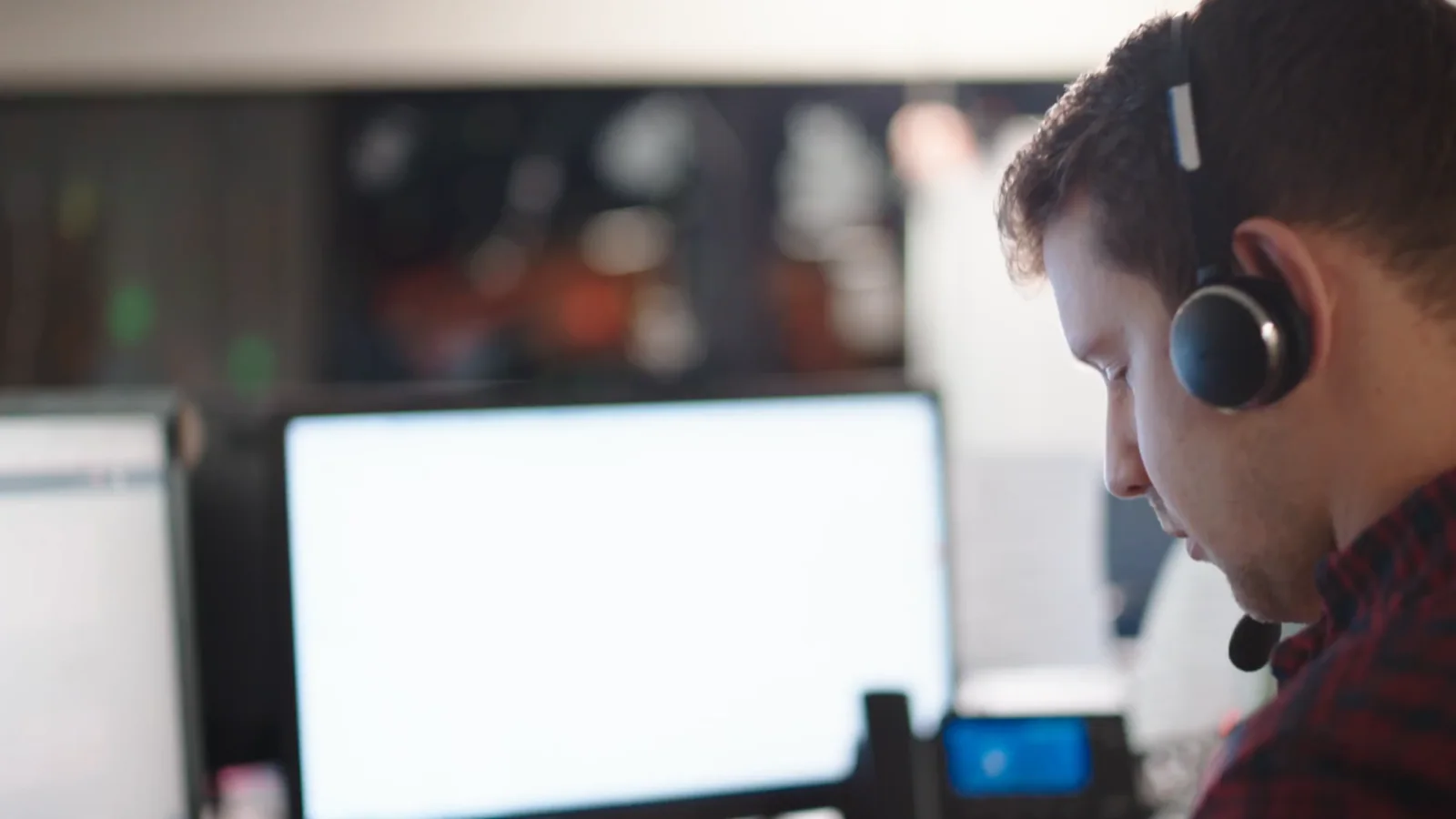
Adapt the sequence by asking a customer what the team needed to change and how it evaluated its options. Keep the answer in the customer's terms. Do not lead with a question that asks them to confirm that your product was fast, easy, or inexpensive.
The boundary is equally useful. The speaker says the team was up and running within a couple of weeks, and later that the company tripled its headcount, with an easy-to-use CRM playing a large part. Those are the customer's statements. The video does not show the project scope, the period behind the headcount figure, or how much of that growth the CRM caused. If your own case uses an implementation claim, support it with the agreed start and end points and explain what work was included.
03
Fairmont and Google Analytics: Check what the screen shows
Google Analytics - Fairmont Hotels Case Study, published by Google Analytics in December 2013, runs about a minute and a half. At about 0:15, an on-screen title identifies the speaker as Barbara Pezzi, Director of Analytics & SEO at Fairmont Raffles Hotels. The film cuts between her interview, hotel properties, staff scenes, and screen recordings of the brand's social channels.
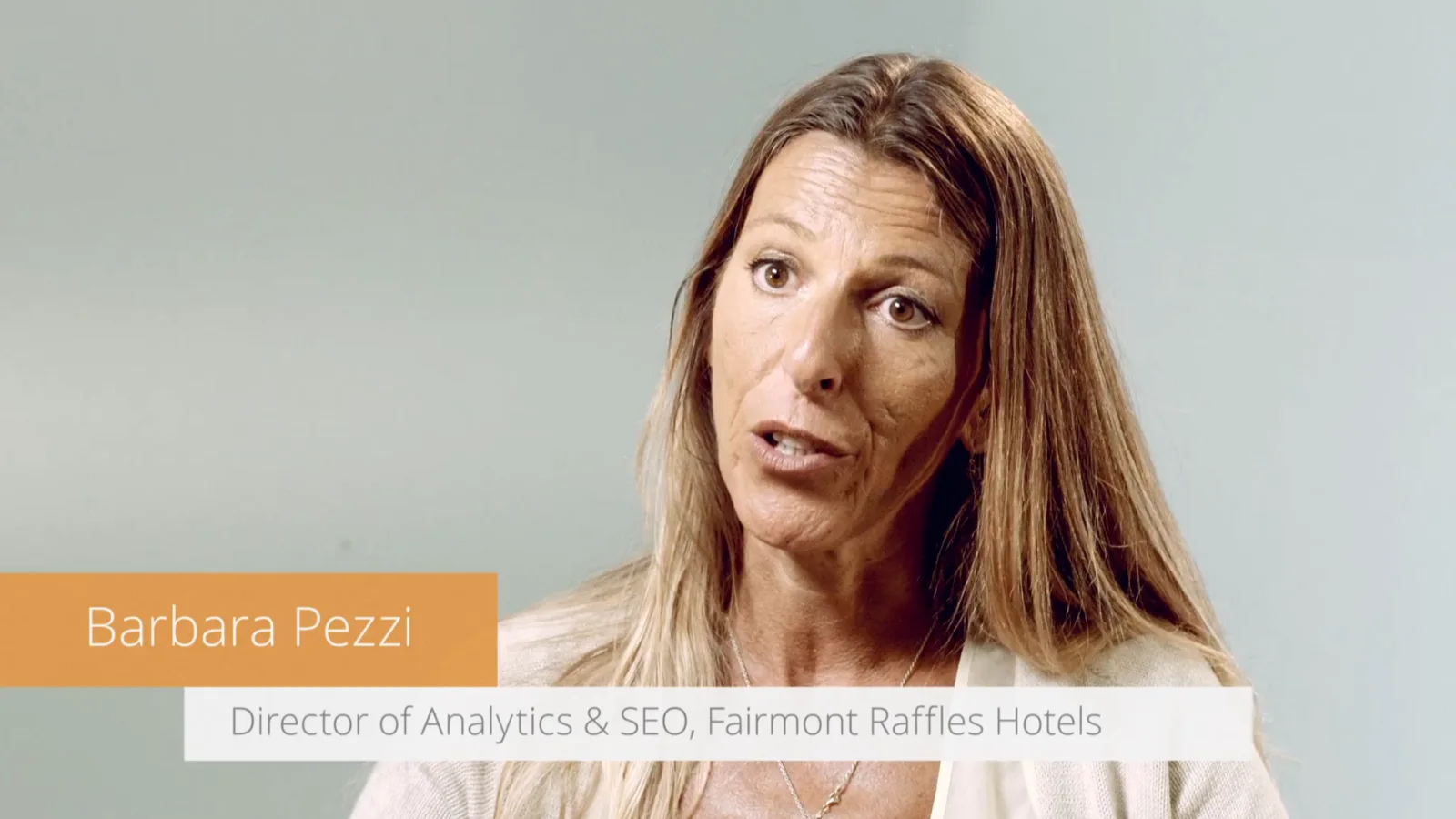
At about 0:54 the film shows a Fairmont Hotels & Resorts Facebook page, and at about 0:58 a Fairmont Twitter feed, both with real posts and public reactions. That is a useful choice. The viewer sees the actual channel the speaker works with instead of a generic social media graphic, so a buyer can confirm which account and what kind of activity the story is about.
What we could not verify is just as instructive. Because no transcript was available, we do not report what the speaker says about measurement, audiences, or results. In the frames we sampled from the first minute, no analytics report, metric, or time period appears on screen. A buyer watching with the sound off would know who is speaking and which channel is involved, but could not check an outcome.
For your own case, put the identifying details and the real working surface on screen: the speaker's name and role, the actual channel or report, and, where the customer approves it, the view that supports the result. If a number is spoken, show its source, period, and definition beside it. A precise caption costs little and lets a buyer check the claim without relying on the voiceover alone.
This is also a historical example. A 2013 story about social channels is not a guide to the current Google Analytics interface or to today's social platforms. Even a fully transcribed version of a short film like this would not supply the measurement period, attribution method, or comparison needed to test causation, so we do not treat it as a performance benchmark.
04
Stitch Fix and OneLogin: Describe the work that changed
OneLogin: Stitch Fix Case Study (NEW), uploaded by CorporateFilming / EventFilming in 2019, discusses application access and provisioning. The speaker contrasts applications that were provisioned manually by different administrators with a centralized process run by IT, and describes the relationship with the vendor.
This is a useful pattern for a product whose benefit is hard to show with a glamorous output. The subject is routine operational work. The story becomes concrete by naming that work and explaining how responsibility changed.
Adapt the approach by asking a customer to walk through a real request before and after the change. Who received it? Which steps did they perform? Where did the request wait? Which part is now different? These questions invite a process account without suggesting the answer.
Do not convert a speaker's broad statement about savings into a numeric savings claim. If your case needs a number, obtain the underlying record and define what was measured. If the evidence is qualitative, describe the changed process in plain terms.
There is also a source-quality lesson here. The automatic transcript mishears the company name more than once, and it records the speaker calling himself head of IT, while the on-screen title reads Ravindra Sunku, Director of IT. The upload title identifies Stitch Fix. Captions should not be copied unchecked into a quote card. For any direct quote in your own story, compare the final wording with the recording and obtain the speaker's approval.
05
Plan customer approval before planning the shoot
A case study needs someone willing and able to approve its use. Confirm the customer contact, who reviews the story, and which materials can appear. A willing interviewee may still need approval for a company name, logo, result, or screen. Our customer testimonial video guide covers the consent and interview workflow in more detail.
In an original Reddit comment about collecting customer stories, one participant writes that sometimes "the person who loves you can't actually say yes without marketing or legal approval." The same commenter questions the effort involved and reports more traction from short testimonials and quotes in their own work. That is one person's experience, not proof that short testimonials always outperform full case studies.
Make the request concrete. Explain the topic, expected customer effort, review stages, and intended channels. Give the customer a clear way to correct a statement or decline a material they cannot share. Do not promise a short call and then introduce an unplanned filming day.
Keep approval attached to the exact version. A later cut can change meaning even when it uses the same words. Review the relationship between a quote and the image beside it, as well as the quote itself. Reconfirm permission when the intended use changes beyond the agreed scope.
06
Build your own case around an evidence plan
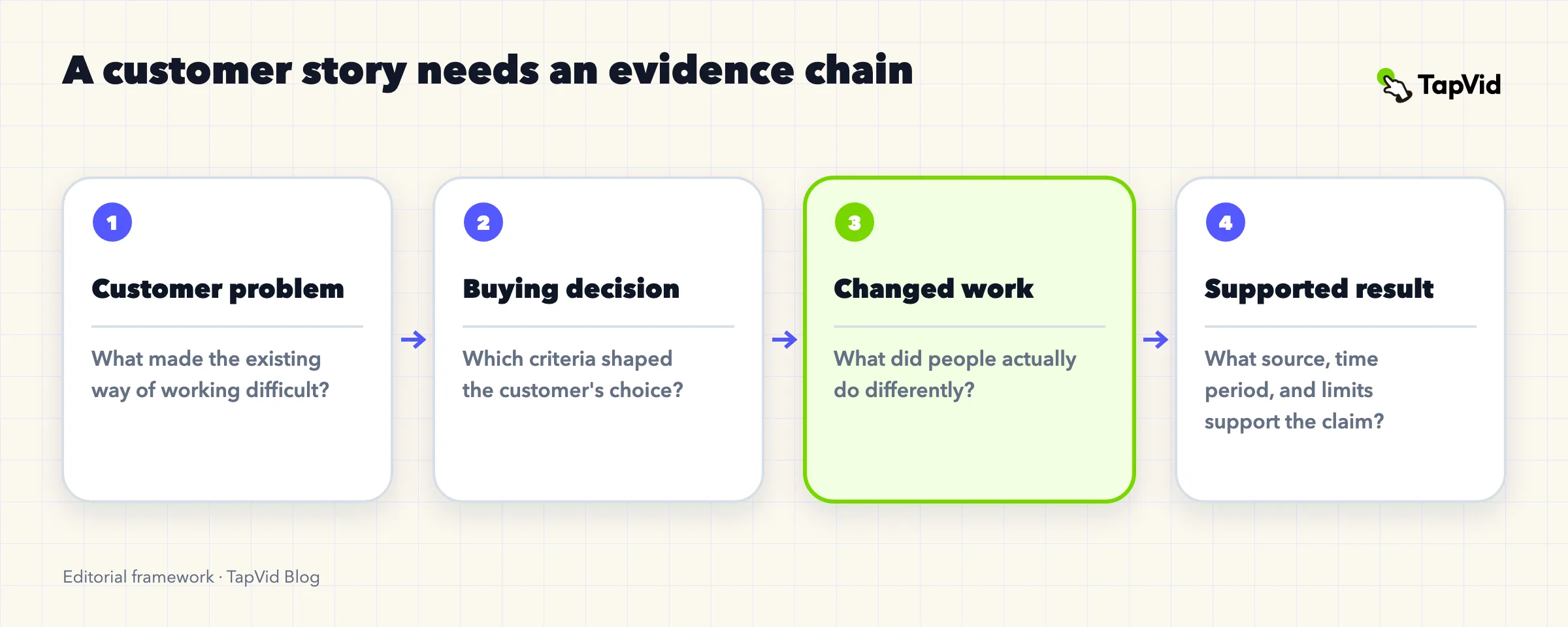
Choose one buyer question and one customer situation. Gather the interview record, approved assets, and any evidence needed for the claims. A simple outline can follow the customer's situation, decision, changed workflow, supported result, and remaining limits.
Before scripting, make a claim table. Put each proposed claim beside its source, scope, and approver. For a number, include the period and definition. For a quote, include the recording location and approved wording. For a screen, include the product state and permission to show it.
Next, decide what the viewer needs to see. An interview can establish the customer's account. A real screen can explain a workflow. A chart can clarify an approved result. Each visual has a different evidence job. Stock footage may establish a setting, but it cannot prove the customer's outcome.
TapVid is an Explainer Video Engine that turns supplied product assets and copy into a video. If you use its case study video workflow to assemble an approved case explanation, keep customer claims and source assets under review. Generating a scene cannot create an authentic interview, permission, or measurement record that you do not already have.
Inspect the final file for the three kinds of accuracy that matter here: the correct asset, the exact approved information, and the match between the statement and the picture. A customer quote about one product should not sit beside a different product's interface. A chart should not drop the period that makes its number meaningful.
For the broader production brief, use the brand video production guide alongside the case-specific evidence checks above.
07
Review the story as a buyer would
Show the cut to someone who did not edit it and ask what problem the customer had, what changed, and what evidence they remember. If they recall only praise, the story may need a more concrete account of the work.
Check the video in the channel where it will appear. A sales follow-up has context that a public landing page may lack. A short excerpt should still identify the customer and preserve the meaning of the claim when it is separated from the full story.
Measure use before declaring business impact. A sales team can record when a relevant case was shared and what question it helped address. That is useful feedback, but it is not by itself proof that the video caused a deal to close. Match any stronger claim to stronger evidence.
08
Case study video questions
What makes a case study different from a testimonial?
A testimonial can be a short statement of experience. A case study usually gives enough context to understand the problem, the change, and the supported result. The label matters less than the evidence the buyer can inspect.
Do I need a famous customer?
No. A relevant situation and a credible account of the work can be more useful than a well-known name with little detail.
Can I make a case study from an existing written story?
Yes, if the source and intended reuse are approved. Keep the original claims, conditions, and attribution intact, and add visuals that explain the story without inventing evidence.