
TL;DR
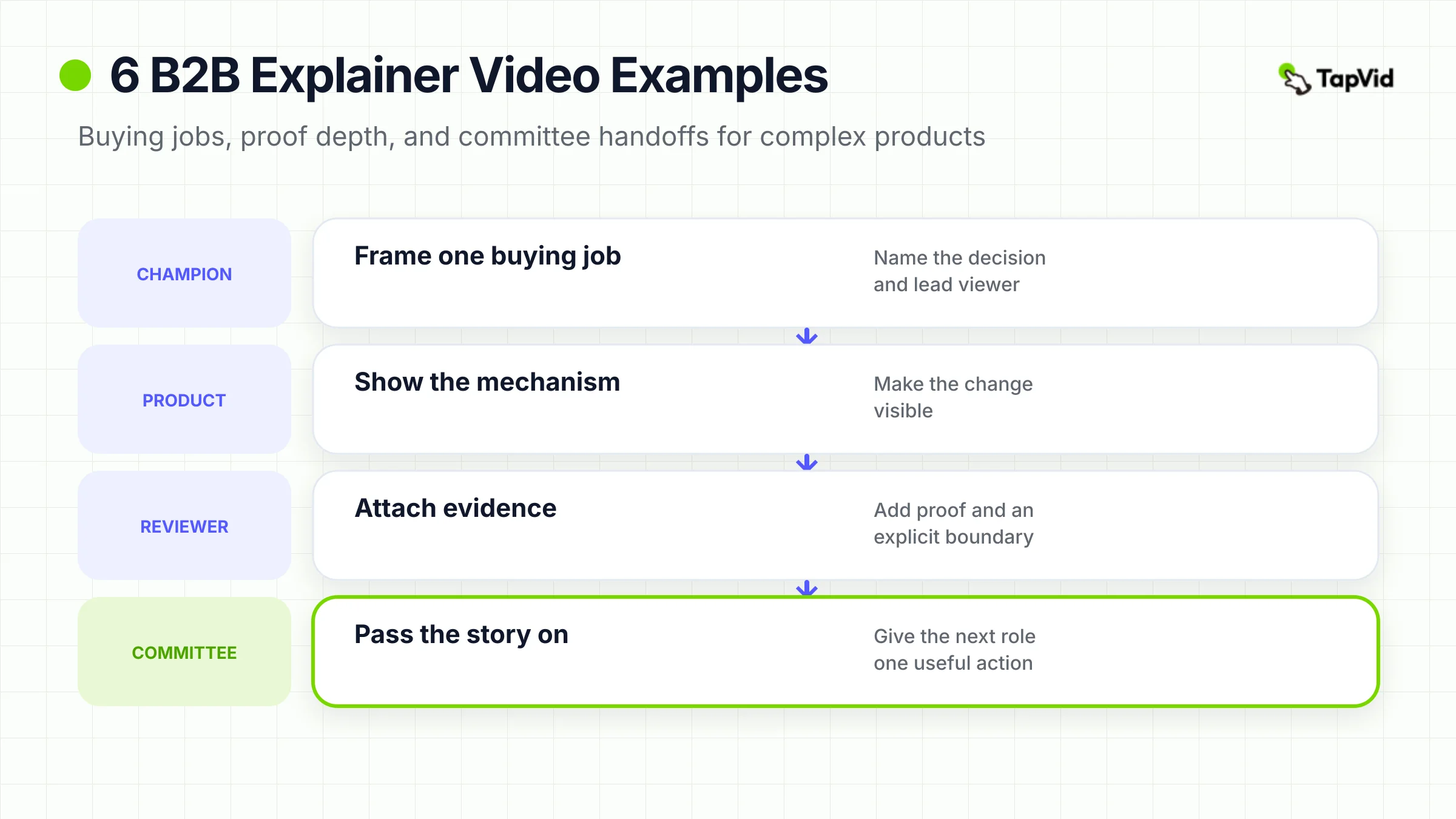
Give a B2B explainer one buying job, one primary committee member, one visible mechanism, and one next step. These six official examples show how proof depth should change from problem identification to consensus creation. Borrow the explanation pattern, not the brand surface, and state what the video does not prove.
The useful lesson is the communication decision, not the animation style. Across these examples, the core mechanisms are a visible problem, a stable analogy, a requirements hierarchy, technical specificity, a traced transaction, and a shared system model.
The stage labels below describe the best-fit buying job for studying each video, not where the publisher necessarily used it. B2B buying is nonlinear, and a committee may reopen earlier questions when a new reviewer joins.
See more explainer video examples
01
6 B2B explainer video examples at a glance
| Example | Best-fit buying job | Primary committee role | Clarity pattern | What it does not prove |
|---|---|---|---|---|
| Salesforce | Problem identification | Executive sponsor or revenue leader | One visual world makes fragmented customer work visible | Implementation or platform fit |
| monday.com | Solution exploration | Team champion or operations lead | One stable analogy teaches an unfamiliar category | Configuration or integration depth |
| ServiceNow | Requirements building | Platform owner or transformation lead | A short hierarchy organizes broad platform needs | That every requirement fits one buyer |
| Cloudflare | Supplier selection | Security lead or IT architect | Three inspectable mechanisms preserve technical meaning | Fit in the buyer's own environment |
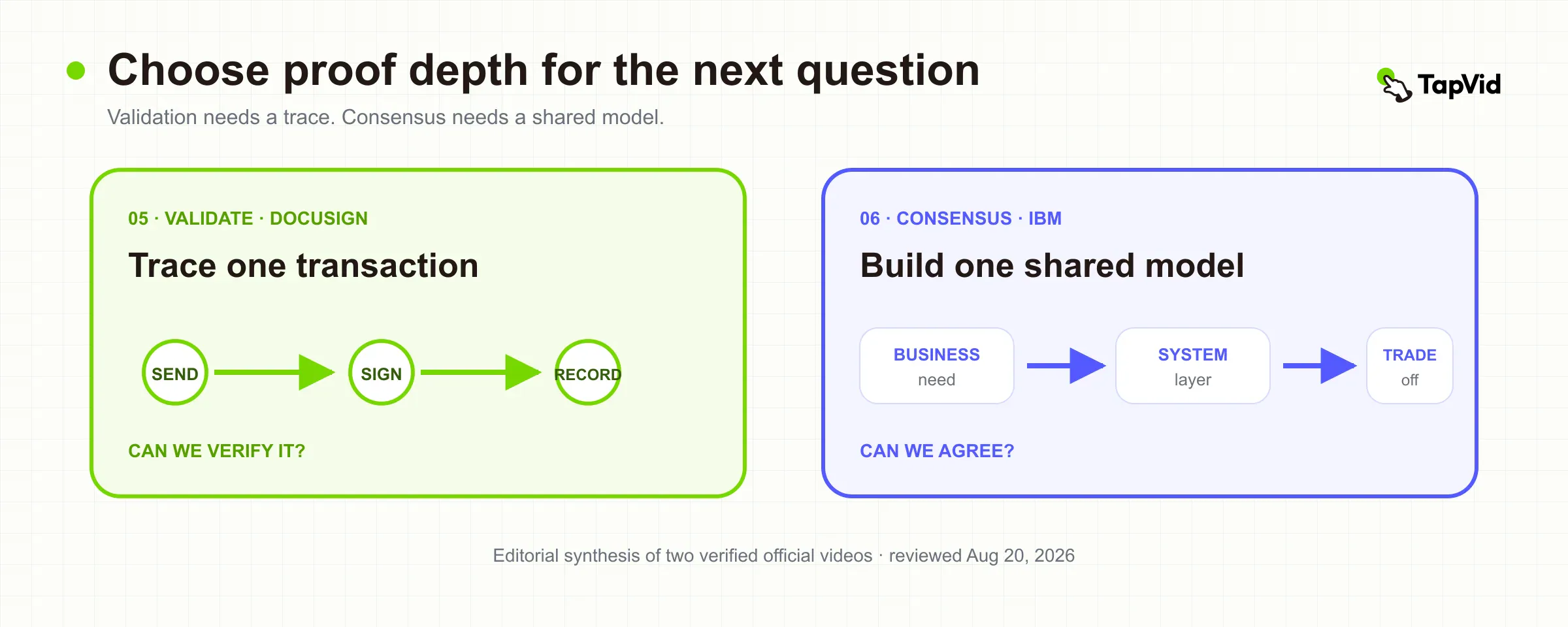
| Docusign | Validation | Process owner or legal reviewer | One object is traced from sender action to stored record | Every policy, exception, or control |
| IBM | Consensus creation | Technical and nontechnical committee members | One worked architecture becomes a shared meeting model | Suitability for cold awareness |
Use the table as a routing guide. If your viewer asks “why act?”, start with a visible problem. If the question is “can we approve this?”, show a process, evidence, and boundary that an evaluator can inspect.
02
A B2B explainer has to travel through a committee
B2B content often imagines one decision-maker. The actual viewing path is a relay. A champion finds the idea, a product expert checks the mechanism, a technical reviewer tests fit, and business or process leaders assess value, risk, and approval.
LinkedIn defines a buying committee as a cross-functional group that can include finance, IT, management, and operations. Its Hidden Buyer Gap research with Bain distinguishes product experts from process experts focused on risk, trust, and approval. Forrester's 2026 buyer research also supports role-specific insight.
The video therefore needs to leave behind an explanation that one member can repeat to another. If someone on the committee is new to the format, share what is an explainer video first.
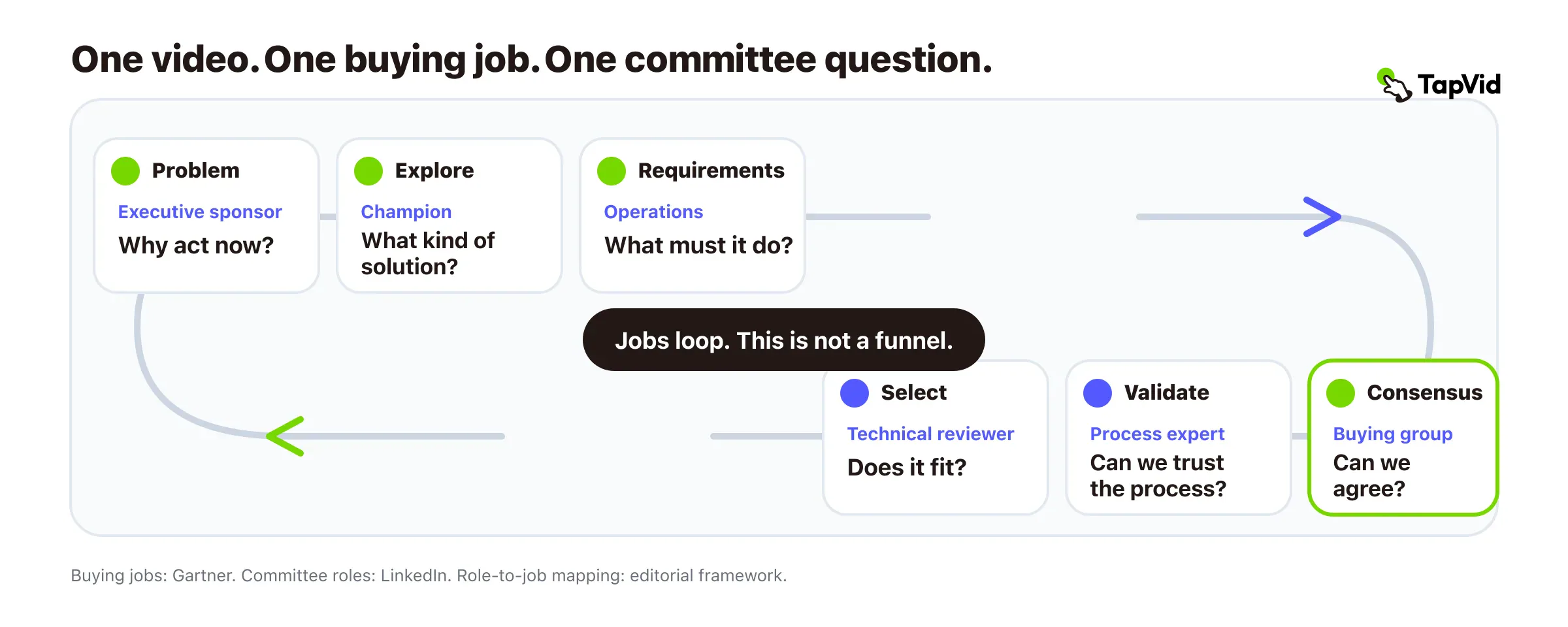
Gartner describes six buying jobs: problem identification, solution exploration, requirements building, supplier selection, validation, and consensus creation. Choose the job the video must advance, then choose the stakeholder question it must answer.
03
How these six examples were reviewed
Every example comes from a brand-owned YouTube channel. On August 20, 2026, each video was public and allowed playback through a working privacy-enhanced embed. Available captions and twelve sampled frames were reviewed together.
Each example was assessed by buying job, viewer, handoff, clarity mechanism, limitation, and reusable pattern. No performance result is inferred from views or polish. Product statements remain the publisher's statements.
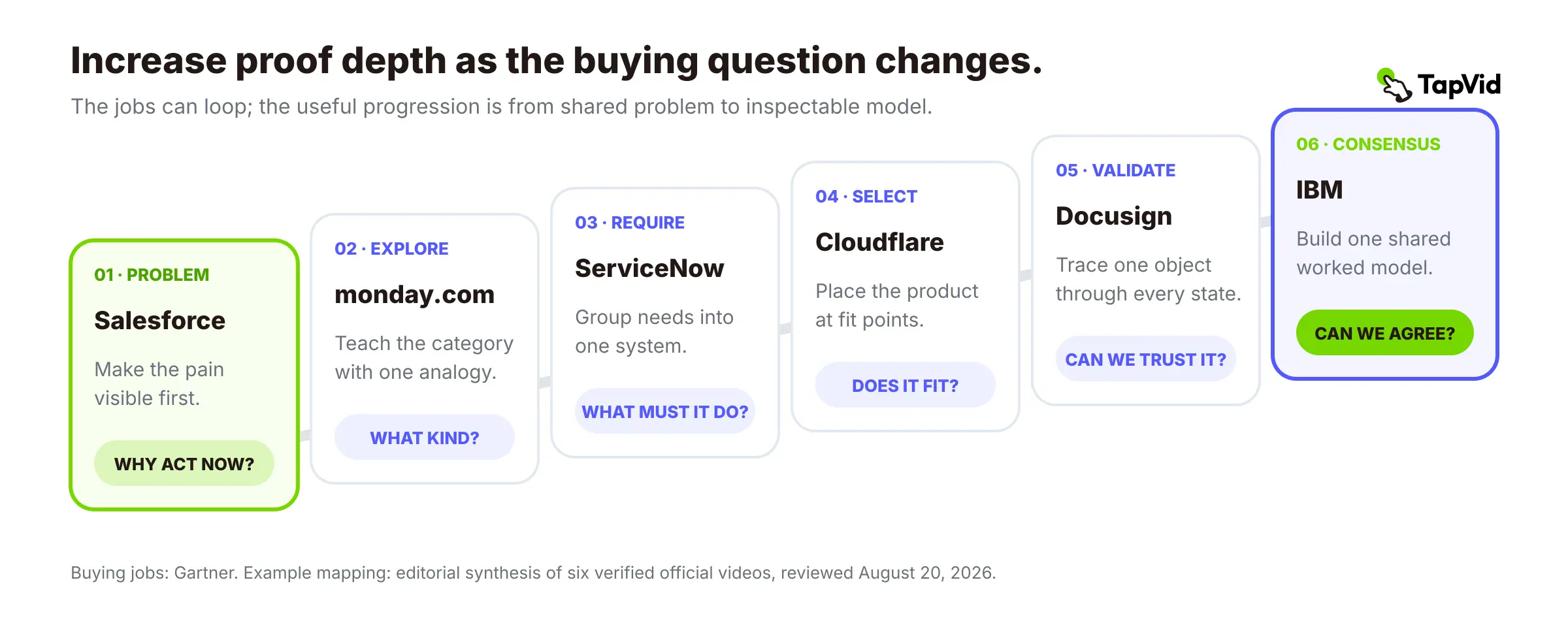
Read the set as a proof-depth ladder, not a fixed funnel. The jobs can loop, but explanations usually become more inspectable as a committee moves from recognizing a problem to validating a process or agreeing on a system model.
04
Salesforce: make the business problem visible
- Best-fit job: Problem identification
- Primary viewers: Executive sponsor, revenue leader, business champion
- Committee question: Why should disconnected customer work become a shared priority?
Salesforce's official one-minute video builds a continuous blue world in which sellers, buyers, service moments, and the Salesforce character share one visual system.
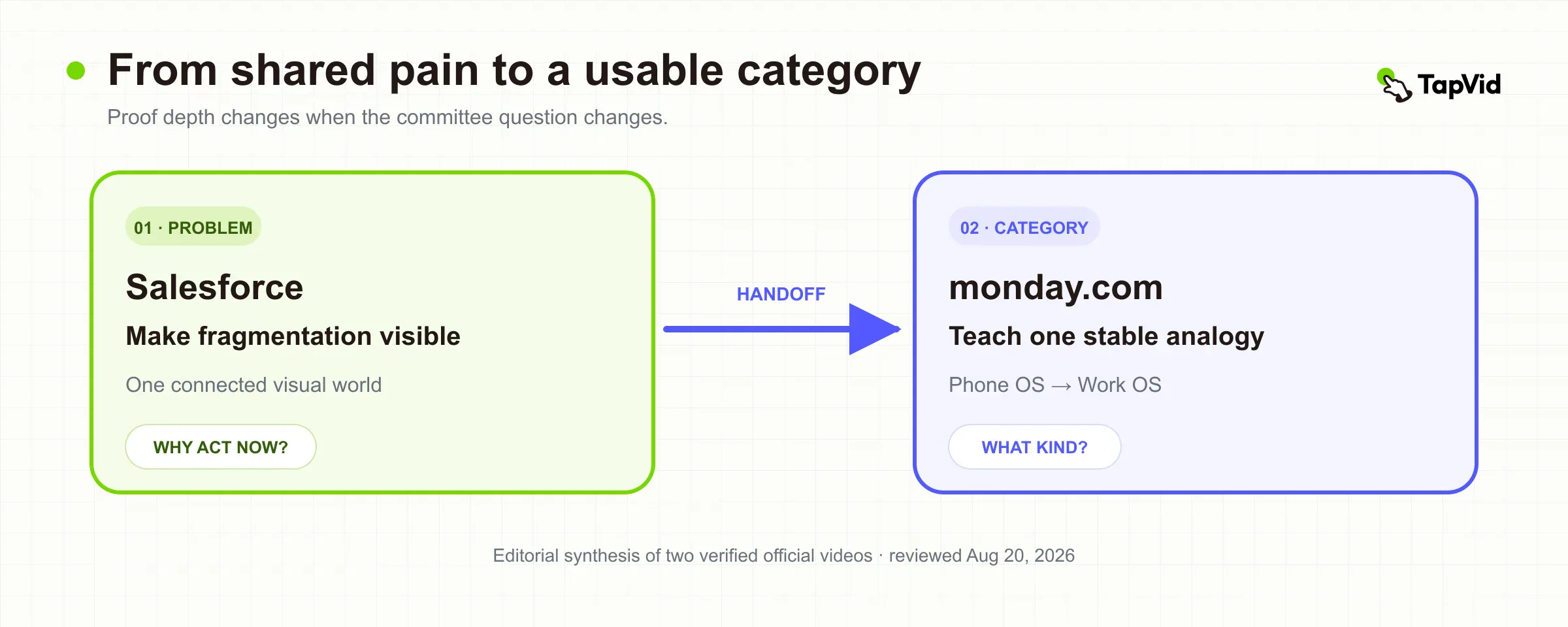
The sequence makes fragmentation visible before asking the viewer to care about software. An executive does not need object-level product detail yet. They need a problem statement that survives a meeting: customer-facing teams operate in separate moments, and the business wants those moments connected.
The limitation is proof depth. The video does not show data models, workflow configuration, or implementation requirements. It can open a problem conversation, but it cannot validate a platform choice.
- Pattern to borrow: Build one visual world in which the fragmented present and connected future can both appear. End with a sentence a sponsor can repeat without product jargon.
05
monday.com: explain a new category with one analogy
- Best-fit job: Solution exploration
- Primary viewers: Team champion, operations lead, prospective user
- Committee question: What kind of solution is this?
monday.com's official Work OS explainer uses a phone operating-system analogy. Different apps and widgets work together through one operating layer, and the video transfers that relationship to work.
The analogy gives a champion a compact category sentence and a consistency test for later capabilities. But analogy can outrun evidence. The viewer still cannot assess workflows, permissions, integrations, or governance.
- Pattern to borrow: Move through three steps: familiar object, mapped mechanism, practical implication. State where the analogy stops, then direct the viewer to requirements-level proof.
06
ServiceNow: compress platform breadth into requirements
- Best-fit job: Requirements building
- Primary viewers: Platform owner, operations leader, transformation team
- Committee question: Which outcomes and system needs belong in our scorecard?
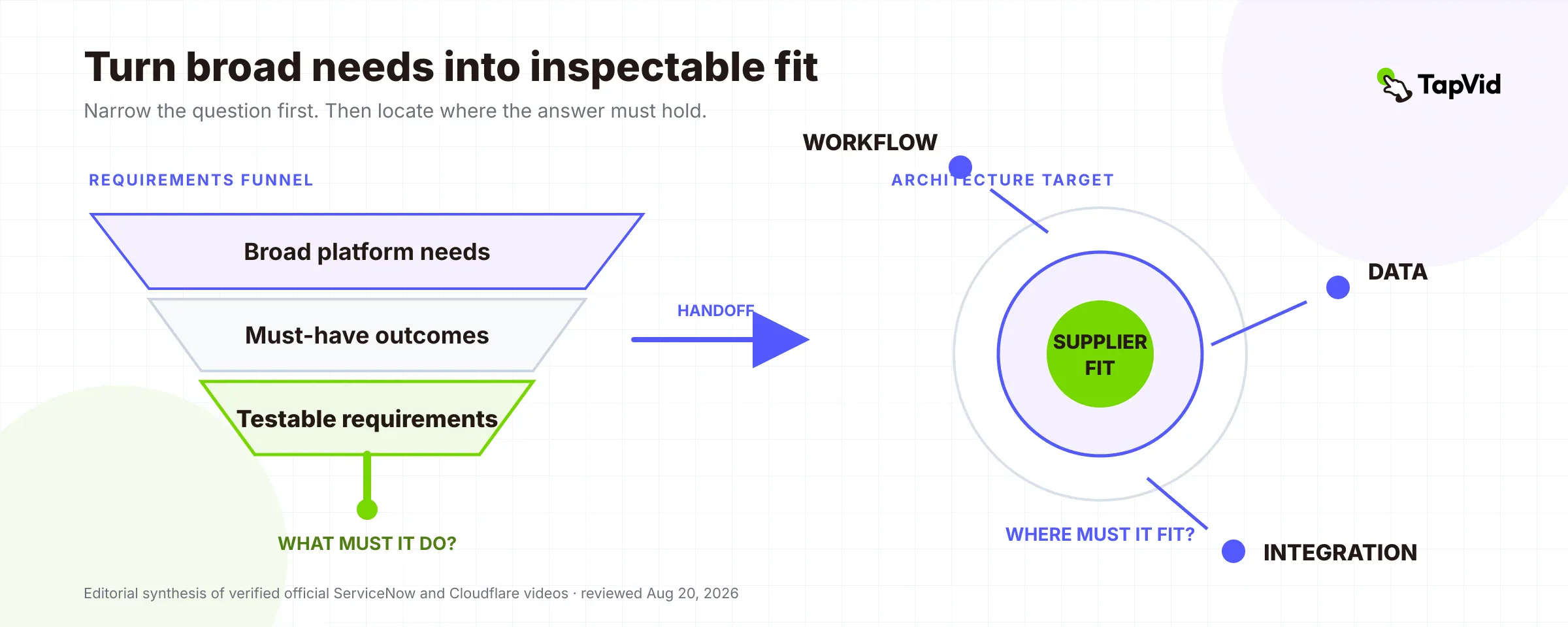
ServiceNow's official platform explainer moves from silos to one extensible platform, then organizes a broad portfolio around productivity, customer growth, operational scale, technology, processes, and speed to value.
Repeated outcome questions turn breadth into a provisional requirements list for different stakeholders. A memorable “yes” still does not show that every outcome fits a particular buyer. The scorecard needs evidence, ownership, constraints, and success criteria.
- Pattern to borrow: Convert platform breadth into five or six buyer requirements, show how one mechanism connects them, and leave each requirement open for later validation.
07
Cloudflare: let technical specificity support selection
- Best-fit job: Supplier selection
- Primary viewers: Security lead, IT architect, technical evaluator
- Committee question: Does this approach fit our network and security model?
Cloudflare's official Zero Trust explainer frames remote-access problems, then explains three mechanisms: connecting users to applications, applying access policies, and filtering or isolating internet requests.
The video keeps terms such as VPN, SaaS applications, request context, access policy, inspection, and attack surface. That specificity helps an expert locate the product inside an existing architecture. Clarity does not require removing the nouns an evaluator needs to test fit.
The animation is still a conceptual model, not an implementation diagram or independent test. Performance and security statements need current primary evidence before another company could make similar claims.
- Pattern to borrow: Place the product at three exact points in the current workflow, connect each point to a selection criterion, and link to architecture, security, and limitation evidence.
08
Docusign: show the transaction from start to record
- Best-fit job: Validation
- Primary viewers: Process owner, legal or procurement reviewer, end user
- Committee question: Can we inspect the complete transaction and its controlled end state?
Docusign's official eSignature explainer starts with a document, adds recipients and signature fields, sends the request, shows recipient action, then returns to status and stored records.
The story continues after the signature because a process is complete only when the record can be found and governed. The interface is dated and is not current product documentation, but the sequence remains useful.
- Pattern to borrow: Follow one representative object across every role and state. Mark each handoff, then place policy or control evidence beside the state it governs.
09
IBM: use one concrete system to create consensus
- Best-fit job: Consensus creation
- Primary viewers: Technical leader, architect, executive sponsor, project team
- Committee question: Can experts and nonexperts discuss the same architecture?
IBM Technology's official hybrid-cloud explainer builds one fictional distribution-company system on a lightboard. The presenter adds on-premises applications, customer data, cloud services, edge environments, integrations, and operating constraints.
The diagram becomes a shared meeting object. Technical reviewers can discuss architecture while executives follow the reason behind each component. The longer runtime fits an interested committee, not a cold homepage visitor.
- Pattern to borrow: Keep one representative system visible, add complexity in causal order, and translate every technical component into the business reason it exists. Label fictional scenarios clearly and never present them as customer evidence.
10
Build one core story, then change proof depth by role
The six formats reduce to one reusable clarity stack.
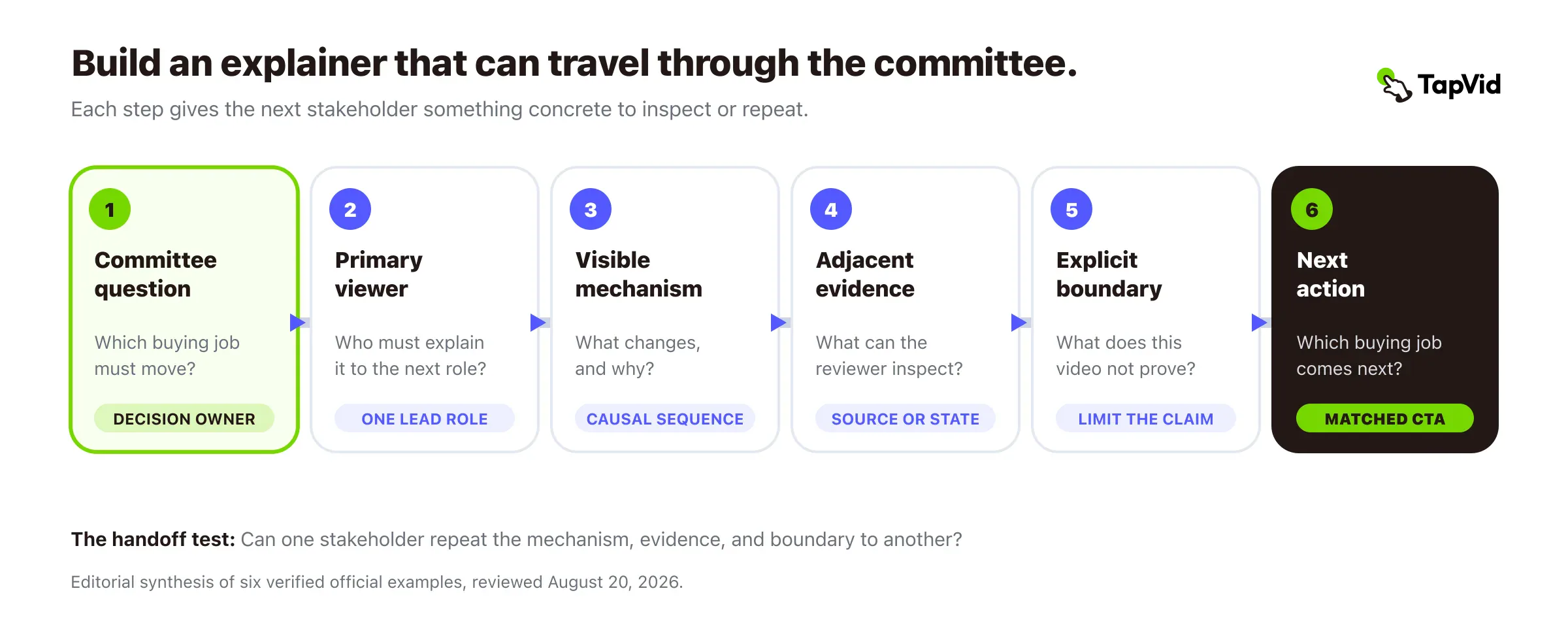
- Start with the committee question and buying job.
- Choose one primary viewer who must understand and repeat the story.
- Show one mechanism: a visual world, analogy, hierarchy, architecture touchpoints, transaction, or worked system.
- Put evidence beside the claim. Decorative motion is not proof.
- Name the boundary and the asset that answers the remaining question.
- End with one stage-matched next action.
Reuse the approved mechanism, supported claim, and explicit boundary. Change proof depth for the role receiving the next cut.
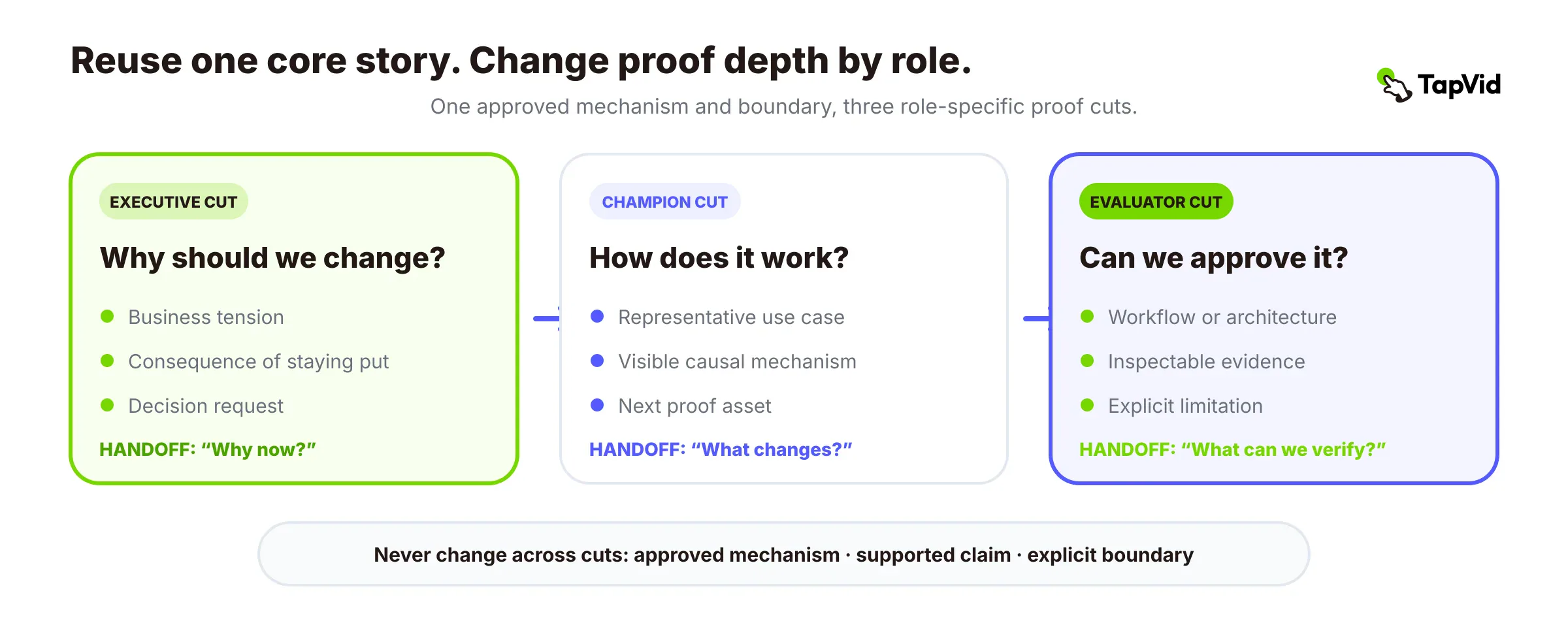
An executive cut can establish the problem and business consequence. A champion cut can show the operating mechanism. An evaluator cut can expose workflow, architecture, records, tests, and limitations. The versions should feel related without asking one video to answer every committee question.
11
Turn a reference into a committee-ready brief
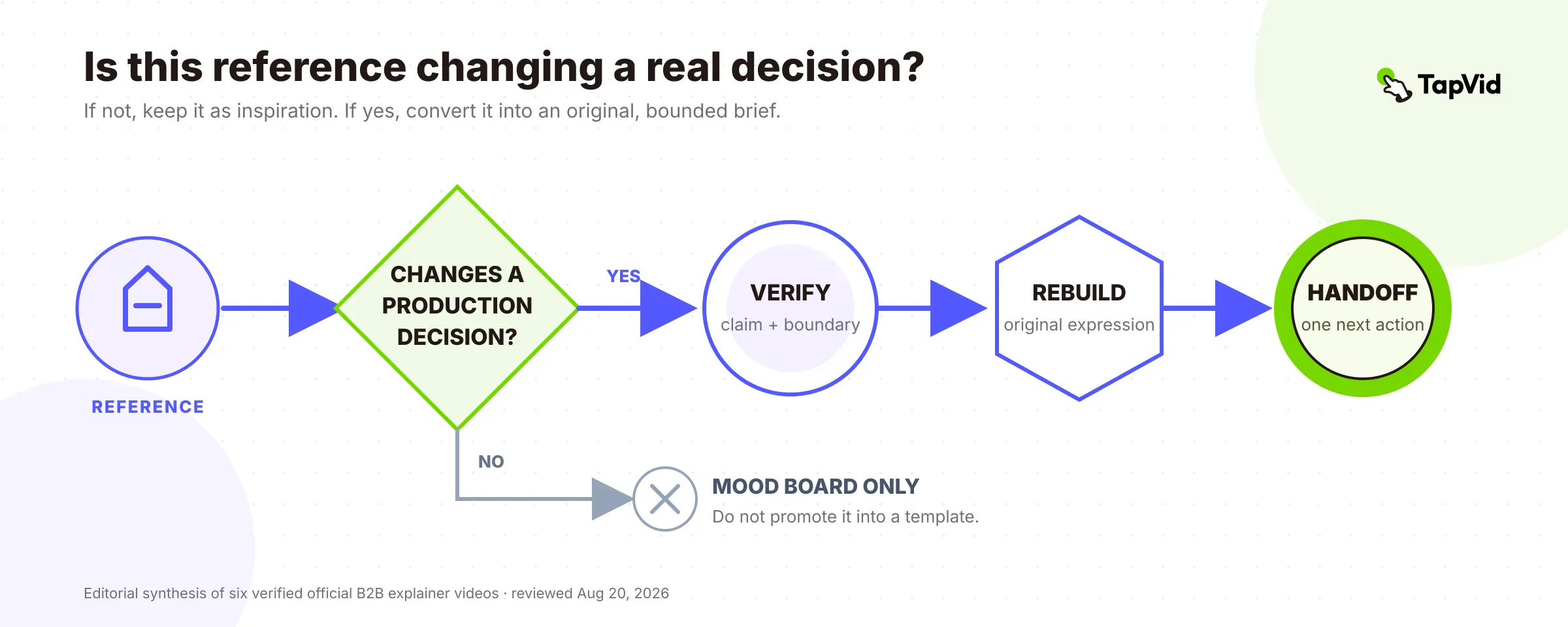
Use a reference only when it changes a production decision.
| Brief field | Required answer |
|---|---|
| Buying job | Which of the six purchase tasks should move forward? |
| Primary viewer | Who must understand and repeat this explanation? |
| Committee handoff | What one sentence should travel to the next stakeholder? |
| Opening problem | Which observable scene or system state creates urgency? |
| Mechanism | What visibly changes because of the product or approach? |
| Evidence | Which source, screen, run, record, or diagram supports the claim? |
| Boundary | What will this video not prove, and which asset answers it? |
| CTA | What is the next stage-matched buying action? |
| Reference decision | Which structural choice are we borrowing? |
| Originality boundary | Which script, assets, characters, brand surface, and claims are excluded? |
A useful reference note is specific: borrow IBM's decision to keep one system visible while adding complexity in causal order. Do not copy its diagram, terminology, presenter treatment, script, or architecture.
12
B2B explainer video FAQ
What makes a B2B explainer different from a general product video?
It must survive cross-functional review. The video should help a specific stakeholder complete a buying job and pass a clear explanation to the next person.
Should one video address every member of the buying committee?
Usually no. Use one overview for shared language, then separate assets for technical fit, value, implementation, security, or approval. Give every video a primary viewer.
How technical should a B2B explainer be?
Use the minimum detail required for the buying job. Supplier selection may require architecture nouns and limits. Removing terms that experts use can reduce clarity.
How long should a B2B explainer video be?
Let the explanation job set the runtime. A short problem or category film may take a minute. A shared architecture model may need several minutes. Set a comprehension test before a duration target.
Can we reuse one explainer across the buyer journey?
Reuse the core language and source material, not necessarily the same edit. Keep the claim, evidence, limitation, and next step aligned in every version.
How do we know whether an example is safe to use as a reference?
Verify the original source, watch the full video, record the decision you are borrowing, and name what you will not copy. Recheck any current product screen, metric, price, policy, or capability before using it as evidence.