
TL;DR
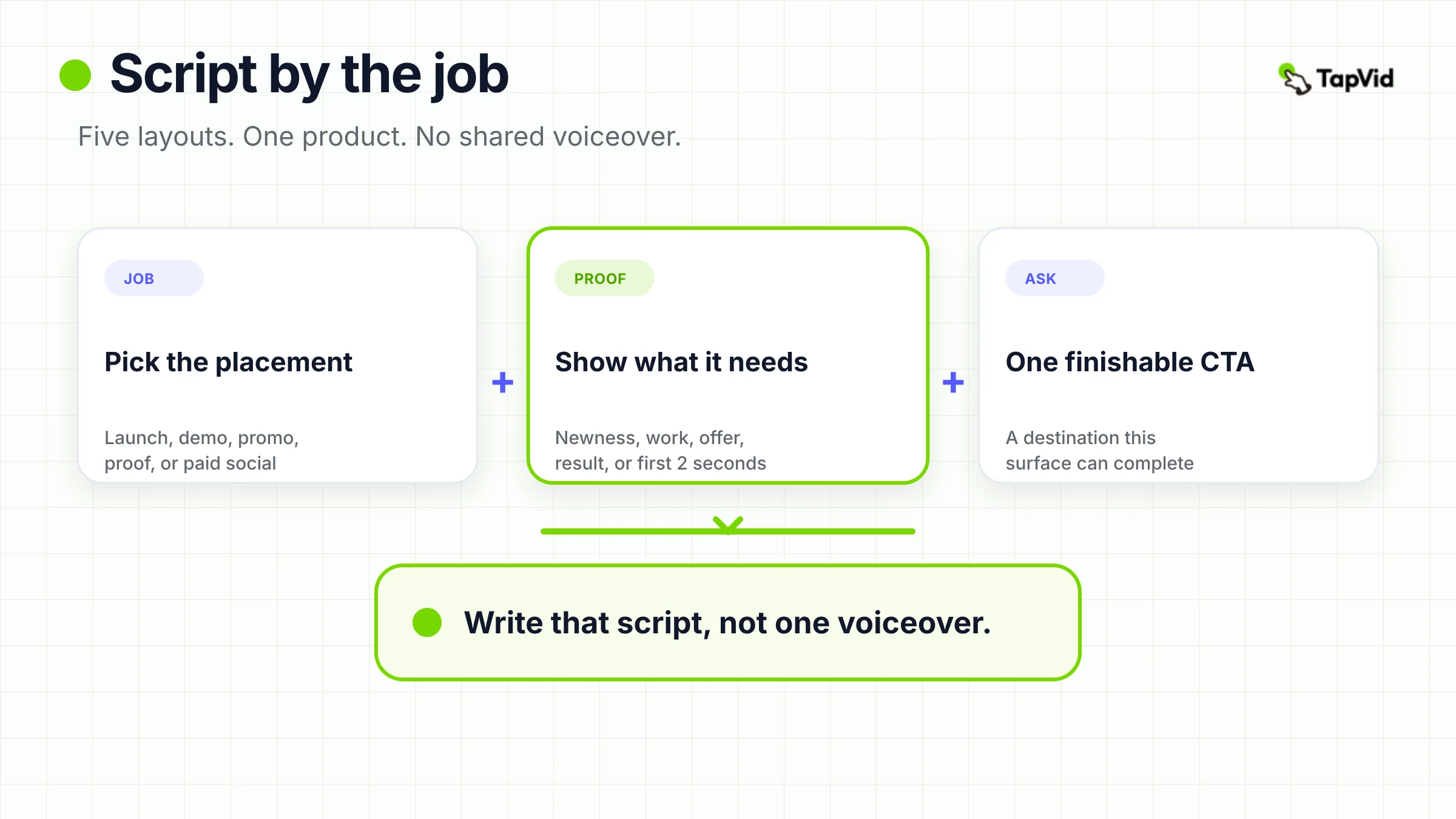
A useful marketing video script example is a job-specific two-column layout, not a generic hook-problem-solution-proof-CTA paragraph. Write five different scripts for the same product: launch shows the new behavior, demo narrates intent before each action, promo carries one offer, customer proof carries one constrained result, and paid social earns the next two seconds. Official videos from Amazon, Slack, and Dollar Shave Club show those jobs in public. They are pattern references, not conversion proof. For how to time and QA one explainer script, use the explainer video script guide.
The Harborstock lines below are invented teaching copy for a fictional inventory product used by independent retailers. They are not a real campaign, and they do not report measured results. Replace every product name, number, and customer claim with approved source material before production. This page is a worked-example library. Pick the job you are shipping this week, copy that layout, and leave the other four alone. Do not average the five scripts into one voiceover.
01
Five marketing video script examples at a glance
Search results for "marketing video script example" often hand you one five-part formula and ask you to stretch it across a launch, a demo, a homepage promo, a testimonial, and a 15-second ad. That is why the draft feels interchangeable. The viewer question changes. The proof changes. The next action changes. The spoken line has to change with them.
Scan this at-a-glance table before you open a blank doc. If you cannot name the job, you do not have a script yet. Runtime is a planning band, not a quality score. A 90-second launch that never shows the new behavior is still a teaser. A 12-second paid-social cut that teaches the mechanism is still a launch in the wrong place.
| Job | Runtime | Must prove | First-line test | Official pattern |
|---|---|---|---|---|
| Launch | 45-75 seconds | One new behavior, end to end | After one watch, can they name the new action? | Amazon Go: enter, take, leave |
| Demo | 60-90 seconds | Intent, then the action, then the after-state | Does every click have a buyer reason first? | Slack: a person inside the work |
| Promo | 30-60 seconds | One offer plus one visible reason | Does the last line match the page button? | No extra player. Match the page. |
| Customer proof | 30-45 seconds | One result plus the condition that produced it | Is the constraint on screen, not in the caption? | No extra player. One named limit. |
| Paid social | 6-15 seconds | One pattern interrupt plus one destination | Does the muted first still still make a claim? | Dollar Shave Club: claim, offer, destination |
If two rows look equally possible, stop. Open the chooser in the next section and pick one job. Do not average the five rows into one voiceover.
02
Which marketing video script to write this week
Use this chooser when two jobs look possible at the same time. The at-a-glance table names the proof. This table names the viewer question and the wrong script you should refuse.
| Job | Viewer question | Script must prove | Runtime to plan | Wrong script |
|---|---|---|---|---|
| Launch | What is new, and what do I do now? | One new behavior, end to end | 45-75 seconds | A feature tour of the old product |
| Demo | Can I see the work happen? | Intent, then the action, then the after-state | 60-90 seconds | A click narration with no buyer reason |
| Promo | Why should I care on this page? | One offer plus one visible reason | 30-60 seconds | A compressed explainer |
| Customer proof | Did this work for someone like me? | One result plus the condition that produced it | 30-45 seconds | A stack of unsourced percentages |
| Paid social | Should I stop scrolling? | One pattern interrupt plus one destination | 6-15 seconds | The first 20 seconds of the launch cut |
If two jobs share a sentence, split the videos. A launch line that also tries to close a paid-social click usually does neither. Keep finished-video references on the product launch, product demo, promotional, and video marketing example pages. This page owns the spoken and visual jobs on the page.
03
Launch script: make the new behavior visible
A launch script has one job: make the new behavior understandable without assuming the viewer already lives in your category. Amazon's official Introducing Amazon Go video does that by walking a customer through enter, take, and leave. The checkout is absent on purpose. The journey is the claim. Study that sequence, not the production scale.
The Amazon Go video is an official Amazon upload, fetched as live on 20 August 2026. It is a pattern, not a conversion study. Do not steal the store, the checkout-free magic, or the production scale. Steal the order of proof: a person enters, takes something, and leaves. A software launch still needs that equivalent path on a screen the viewer can follow. If the viewer cannot describe the new behavior after one watch, the script is a teaser.
Write a launch only when the product or workflow is new to the audience. If they already understand the tool and the page only needs an offer, write a promo. If they need to operate a control, write a demo.
Harborstock launch script, 60 seconds, about 135 spoken words:
| Time | Audio | Visual job | Do not copy |
|---|---|---|---|
| 0:00-0:07 | Friday afternoon, the bestseller is gone, and the next delivery is Monday. | One empty shelf, one waiting customer, one phone with a late supplier text. | A logo sting or "we are excited to announce." |
| 0:07-0:18 | Most shops catch that stockout in a spreadsheet, after the sale is already lost. | A messy count sheet beside the same empty shelf. | A category lecture about retail software. |
| 0:18-0:42 | Harborstock watches the same SKU across the till and the shelf. When it hits the reorder point, it sends the supplier order before the gap appears. | Till to on-hand count to reorder point to sent order. One continuous path. | A montage of unrelated dashboards. |
| 0:42-0:52 | The next Friday, the same SKU is on the shelf before the weekend rush. | The same aisle, stocked, with the same SKU label readable. | A new problem that the opening never raised. |
| 0:52-0:60 | Create the first reorder rule for your top 20 SKUs. | One named action on a reviewable rule screen. | "Learn more" plus a menu of five links. |
The launch script borrows Amazon Go's job, not its store. Show the before-state, the mechanism that removes the old workaround, and the same location after the change. Keep one CTA. QA it muted: if a viewer cannot point to the new behavior, rewrite the middle, not the logo. If you need a longer keynote or a physical-product film, steal the proof pattern from the launch examples page and keep this script as the 60-second master.
04
Product demo script template: narrate intent before the click
A demo script fails when it describes the interface. "Now I click New Invoice" teaches the cursor. "I need to send this month's invoice to my largest client, so I open New Invoice" teaches the work. Slack's official You've Probably Heard of Slack video keeps a person inside the workflow instead of leaving the product as a silent screen recording. The interface appears because the work needs it.
The Slack video is an official Slack upload, fetched as live on 20 August 2026. It is a brand-and-workflow piece, not a timed feature tutorial. The transferable move is a person inside the work. Do not copy Slack's brand-film tone or its category joke. If the buyer must follow exact clicks, record the screen. If the buyer must understand why the click exists, write intent first.
A usable demo names the buyer constraint before the first control. "This shop bills 40 SKUs a week" is the reason the next click exists. Without that line, the same click is a tour.
Copy the six-beat product demo script template below before you write the timed version. Fill every bracket from an approved source pack. If you cannot supply the visual proof for a row, remove the claim or capture the missing asset before production.
| Beat | Fill-in line | Required visual proof |
|---|---|---|
| Buyer constraint | [buyer or user] needs to [job], but [specific constraint] gets in the way. | The real before-state or approved problem evidence |
| Demo contract | In the next [runtime], I will show how to [one product action] so you can [buyer outcome]. | One named action, not a feature menu |
| Intent before action | Because [reason], I open [approved screen or asset] and choose [control]. | The exact screen, product, or control being named |
| Mechanism | [Product] uses [approved input] to [literal product behavior]. | The input, transformation, and resulting state in order |
| After-state | Now [approved after-state] is visible, so [buyer] can [next job]. | The promised result in the same workflow |
| One CTA | [Do one next action] with [product or offer]. | One matching button, URL, or handoff |
Harborstock demo script, 90 seconds, about 210 spoken words:
| Time | Audio | Visual job | Do not copy |
|---|---|---|---|
| 0:00-0:08 | Independent shops lose the weekend because the reorder lives in someone's head. | A closed shop, then a manager counting after hours. | "Hi, I'm Alex, and today I'll show you Harborstock." |
| 0:08-0:20 | If the count is late, the supplier order is late, and Friday looks empty again. | The same SKU going to zero on a handwritten list. | A generic "inefficient processes cost money" line. |
| 0:20-0:28 | In the next minute, I'll send one reorder from the till count, not from memory. | One promised action on screen, no feature list. | A promise to "explore the platform." |
| 0:28-0:40 | This shop bills 40 SKUs a week. I want the bestseller protected first, so I open that SKU. | One SKU record, not the whole catalog. | A tour of settings, users, and integrations. |
| 0:40-1:15 | I set the reorder point at eight units. Harborstock uses last week's till data, drafts the supplier order, and waits for one confirmation. I send it. | Reorder point to draft order to confirm to sent. Narrate why before each control. | "Here you can see our beautiful dashboard." |
| 1:15-1:25 | The same SKU now has a delivery date instead of a guess. | After-state: date on the SKU, not a new module. | A second product story. |
| 1:25-1:32 | Create your first reorder rule at harborstock.example. | One URL, one action. | Book a demo, watch pricing, and subscribe. |
Give the walkthrough about 60 percent of the runtime. Cut setup and recap first if the read exceeds two minutes. If the after-state is a new module the opening never mentioned, the demo changed jobs mid-script. For finished demo patterns, see the product demo video examples.
05
Promo script: one offer, one proof, one ask
A promo script sits on a page that already has context: a homepage, a campaign landing page, or an email. It does not need to teach the category. It needs one reason to stay and one action that the nearby page can complete. If you find yourself explaining the mechanism in three steps, you are writing a launch or a demo.
A promo dies when it reopens the category for twenty seconds. The page already has a headline. The video should not restart the problem from zero. It should make one offer visible and one next step unavoidable.
Harborstock homepage promo, 35 seconds, about 80 spoken words:
| Time | Audio | Visual job | Do not copy |
|---|---|---|---|
| 0:00-0:06 | Stop finding stockouts after the customer does. | The empty-shelf still from the launch, already readable as a poster frame. | A 10-second brand film. |
| 0:06-0:18 | Harborstock turns till counts into supplier orders before the shelf goes empty. | One before/after of the same SKU, no extra features. | "All-in-one inventory suite." |
| 0:18-0:28 | Independent shops use it on the SKUs that actually run out. | Two labeled SKU cards, not a customer logo wall. | An unsourced "trusted by 10,000 retailers." |
| 0:28-0:35 | Start with your top 20 SKUs. | The same CTA as the page button. | A different offer than the landing page. |
The nearby page supplies the rest. Finished campaign films live on the promotional video examples page. The transferable rule is smaller: if the page says "Start free," the last line cannot say "Talk to sales." If the spoken CTA and the visible button disagree, one of them is lying to the viewer.
06
Customer-proof script: one result, one constraint
A proof script is not a shorter promo. It asks the viewer to believe a result, so the script must carry the condition that makes the result honest. Unsourced percentages turn the video into advertising even when a customer appears on camera.
The Harborstock 18-SKU result is a teaching shape, not a customer quote. Before production, replace it with a named customer, a dated condition, and an approved number. If legal cannot approve the number, cut the number. Keep the condition. A constrained story is still proof. An unsourced percentage is not.
Harborstock customer-proof script, 40 seconds, about 90 spoken words. The numbers are invented teaching copy:
| Time | Audio | Visual job | Do not copy |
|---|---|---|---|
| 0:00-0:07 | We used to find the stockout when a regular asked for it. | The retailer in the aisle, not a studio backdrop. | A host summarizing the quote. |
| 0:07-0:18 | After we put reorder rules on 18 SKUs, those shelves stayed stocked through two weekends. | The 18-SKU list, then the same two aisles. | "We grew revenue 300 percent." |
| 0:18-0:30 | It did not fix seasonal products we still count by hand. | One seasonal display left out of the rule list. | Hiding the limitation. |
| 0:30-0:40 | If your stockouts cluster in a small SKU set, start there. | CTA that matches the proof, not a new offer. | Using the quote to sell an unshown feature. |
No extra testimonial embed is added beyond the three verified players. Treat every number as a placeholder that legal and the named customer must approve. If you cannot put the constraint on screen, you do not have proof. You have a slogan with a face.
07
Paid-social script: the first two seconds do the work
A paid-social script is not a cropped launch. It has to work muted, in a vertical safe area, and before the viewer agrees to hear the category. Dollar Shave Club's official Our Blades Are F***ing Great ad opens on a blunt product claim and spends the rest of the runtime making the offer plain: what you get, what it costs, and where to go. Humor is the delivery system, not the job.
The Dollar Shave Club video is an official brand upload, fetched as live on 20 August 2026. It is a 2012-era paid-social and pre-roll pattern, not a 2026 media-mix study. Do not copy the profanity, the warehouse stunt, or any price comparison. Copy the job: one claim a muted viewer can read, one offer, one destination.
Write the first two seconds as a still and read them with the sound off. If the claim disappears, the opening failed. Do not crop the launch to get there. The launch needs the empty shelf, the path, and the restocked aisle. Paid social needs one still and one destination.
Harborstock 12-second paid-social script, about 28 spoken words:
| Time | Audio / on-screen | Visual job | Do not copy |
|---|---|---|---|
| 0:00-0:02 | Your Friday stockout is a spreadsheet problem. | Big type on the empty-shelf still. No logo. | A 3-second ident. |
| 0:02-0:08 | Harborstock reorders the SKU before the shelf goes empty. | Till count flipping to a sent order. | A 20-second mechanism lesson. |
| 0:08-0:12 | Start with 20 SKUs. Link in the ad. | One action, one destination, text inside the safe area. | Follow, subscribe, and book a call. |
Keep the same approved claim as the launch. Only the amount of proof changes. For social cuts from existing material, see how to make social media videos.
08
Why these scripts are not explainer scripts
An explainer script teaches one mechanism to one viewer. The explainer video script guide already owns that job: a six-question brief, 60- and 90-second templates, a timed read, and a two-column production contract. Do not republish that system here.
A marketing script changes because the placement changes:
| Decision | Explainer script | Marketing-job script |
|---|---|---|
| Opening | Name the situation the viewer already has. | Name the job of this placement: newness, work, offer, result, or stop-the-scroll. |
| Middle | Spend the most time on the mechanism. | Spend the most time on the proof that placement requires. |
| Proof | Resolve the same problem you opened. | Launch shows the new behavior; demo shows the after-state; promo shows one reason; proof shows one constrained result; paid social may show no proof at all. |
| CTA | One next step after understanding. | One next step the surface can complete. |
| Reuse | One master, then local variants. | Five masters from one source pack, not five crops of one voiceover. |
Lock the source pack before anyone writes a line. For Harborstock that pack is four fields: the empty-shelf still, the till-to-order path, the 18- or 20-SKU constraint, and one CTA family. The five scripts share those fields. They do not share a voiceover. If a line works in every cut, it is probably a slogan, not a script.
QA each script by reading it aloud against a timer. If you skip a visual job, the editor will invent one. If two placements need the same sentence, you probably need one video, not two crops.
TapVid is useful after the script is approved, not before. The official script to video page, read on 20 August 2026, describes pasting a finished script so each beat becomes a motion-graphics scene, then refining one scene without rebuilding the whole video. The official AI product demo video generator page, read the same day, says TapVid does not record a live screen, does not create an interactive click-through, and does not approve claims for you. This article does not include a TapVid run. If you need exact clicks, record the screen. If you need a presenter, use a presenter workflow. If you need the approved lines on screen, keep the script as the source of truth.
09
Frequently asked questions
What is a marketing video script example at a glance?
The five-row table at the top. Pick the job, then open that section and copy the two-column layout. Do not average the five rows into one script.
What is an example of a marketing video script?
A timed two-column table for one job. The Harborstock tables are teaching copies. The Amazon, Slack, and Dollar Shave Club videos are public patterns, not scripts to recite.
How long should a marketing video script be?
Use a timed read. Launch 45-75 seconds, demo 60-90, promo 30-60, proof 30-45, paid social 6-15. A 60-second read is usually 120-150 spoken words; labels and on-screen text need extra hold time.
What is the difference between a marketing video script and an explainer script?
An explainer teaches one mechanism. A marketing script is written for a placement. The explainer page owns the writing system. This page owns the five job layouts.
How do you write a 15-second ad script?
Write the first two seconds as a muted still. Keep one claim, one product action, and one destination. Do not crop the launch voiceover.
Do I need a two-column script?
Yes if someone else will produce the video. Audio without a visual job forces the editor to guess. Add source and approver columns when claims or UI labels are involved.
Can I reuse one script for launch, demo, and ads?
Reuse the source pack, not the voiceover. If two placements need the same sentence, you probably need one video.