
TL;DR
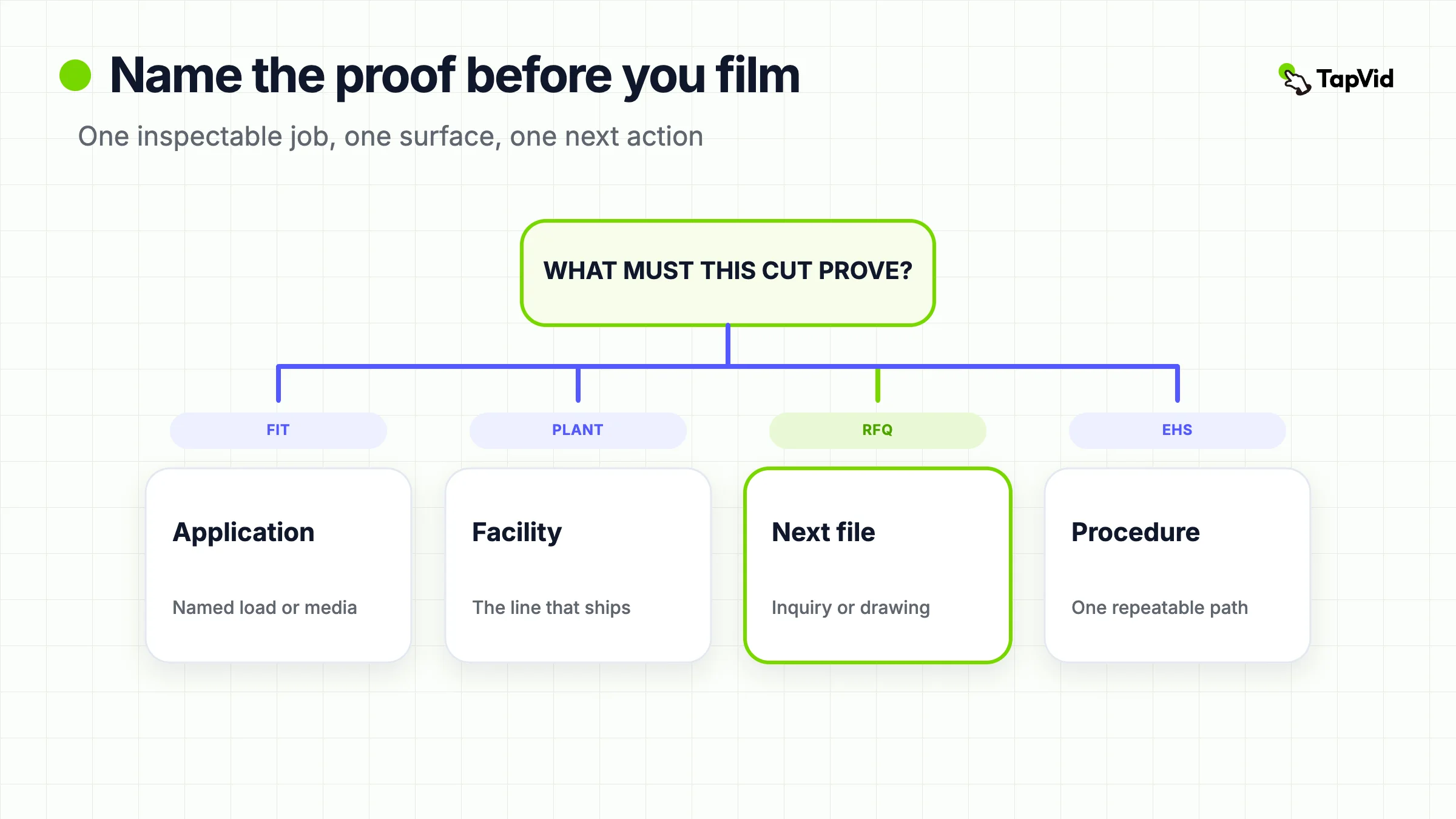
Industrial video marketing is a proof system for plant buyers, not a brand film with a factory thumbnail. Assign every video one inspectable job, one reuse surface, and one next action before anyone books a crew or opens a generator. Film the line only when the viewer must see a condition a datasheet cannot show. Measure whether sales can reuse the cut. Views are a start. They are not an RFQ.
Industrial video marketing is how a manufacturer, distributor, or industrial service company uses video to help another company inspect capability before a visit, a bid, or a purchase order. The viewer is usually an engineer, a plant manager, a procurement lead, or an EHS owner. They are not deciding whether they like your brand. They are deciding whether your part, process, or plant will survive their conditions.
That is a narrower job than B2B video marketing. The B2B page owns a cross-industry committee system: one buying job, one surface, one next action. This page owns the industrial proof those jobs have to carry. A SaaS demo can show a workflow on a laptop. An industrial cut has to show application fit, facility credibility, a specification that must stay literal, or a procedure a second shift can repeat.
Keith Lacy's industrial video marketing guide, dated 2026-03-28 and read on 2026-09-03, opens with the same commercial failure: teams spend on production quality before they decide what the video must do. Keep that diagnosis. The missing object is not a better drone shot. It is a written proof job.
Read the B2B committee system first
01
Industrial video jobs at a glance
Start with the condition the next viewer must be able to inspect. If two jobs sit in one brief, split the project before anyone writes a shot list or books a plant day.
| Proof job | Primary viewer | Next action the video should make easier | Default surface | Do not ask this cut to do |
|---|---|---|---|---|
| Show application fit | Applications or design engineer | Confirm the product can run under a named load, media, or duty cycle | Product page, YouTube, sales follow-up | A full catalog or every SKU variant |
| Make the plant inspectable | Procurement or quality | Decide whether a remote supplier visit is still required | Capabilities page, bid package, email | Recruiting culture or brand mood |
| Move an RFQ past the spec sheet | Mixed buying group | Send a scoped inquiry or request a drawing package | Landing page, booth follow-up, proposal | Pricing you have not approved |
| Standardize one procedure | Operator, technician, or EHS | Complete one lockout, setup, or inspection path | LMS, shift huddle, QR at the station | A marketing hero or a trade-show loop |
| Pre-qualify a booth conversation | Show visitor with a live problem | Stay for a scoped discussion instead of a brochure grab | Booth screen, tablet, post-show email | A 12-minute capabilities documentary |
The pattern is consistent. One proof, one viewer, one next action, one surface. A facility tour that also tries to demo a machine, close an RFQ, onboard a technician, and hire a welder is four briefs wearing one thumbnail.
For cross-industry committee language, stay on B2B video marketing. For official explainer patterns that travel through a software committee, use B2B explainer video examples. This page does not rebuild those routers. It only asks which industrial proof those patterns would have to carry if the product were hardware.
02
What industrial video marketing is, and how it differs from generic B2B video
Industrial video marketing is the use of demos, walk-throughs, process explainers, RFQ cuts, and procedure modules to help a technical buyer see how a product or plant behaves in the real world. StudioNorth, read on 2026-09-03, calls the useful version an extension of the product experience rather than a brand story in video format. Keep that mechanism. Drop the agency slogan.
Generic B2B video can succeed by naming a costly current state and asking for a meeting. Industrial video usually has to survive a second viewer who was not in the first conversation. An engineer forwards a clip into a buying folder. A quality lead pauses on a weld, a tolerance check, or a clean-room door. A procurement owner asks whether the plant in the video is the plant that will ship the order. If the cut only works while a salesperson talks over it, it is a meeting prop, not a marketing asset.
10 Louder, read on 2026-09-03, is right that industrial products are inherently visual and that a datasheet cannot replace seeing a line run. The useful limit sits next to that claim. Visual is not the same as inspectable. A glossy aerial of a roof does not tell an engineer whether the machine holds tolerance at their cycle time. A smiling team shot does not tell procurement whether incoming inspection is real.
This page also refuses a common collapse. Industrial video marketing is not industrial video production by another name. Marketing names the proof job, the reuse surface, and the stale trigger. Production chooses whether that proof is filmed on the floor, captured from existing footage, or built from an approved source pack. B2B video production already owns that production-model choice for a wider B2B set. Use it after the industrial job is named, not instead of naming it.
03
Why plant buyers treat video as inspectable proof
Plant buyers treat video as a substitute for a visit they cannot schedule yet. They want to pause, replay, and argue with the frame. That is closer to field engineering than to advertising.
GlobalSpec and TREW Marketing's 2025 State of Marketing to Engineers, read on 2026-09-03, reports that technical buyers spend 60 percent of the buying process online on average. In the same report, 73 percent routinely turn to vendor websites and online technical publications, and 70 percent of respondents who watch work-related video do so most often on YouTube. Those figures describe research behavior. They do not prove that any one supplier video created an order.
The same survey asked what content technical buyers find most valuable when researching a significant work purchase. Datasheets led at 79 percent. Technical publication articles followed at 61 percent. Product demo video was selected by 35 percent, instructional or how-to video by 29 percent, and case study by 25 percent. Read that order as a hierarchy, not as a reason to skip video. The datasheet still owns the literal values. Video earns a place when it makes those values visible in motion, in a fixture, or in a procedure.
That hierarchy also sets the honesty rule. If the video invents a specification the datasheet does not support, the engineer will find the conflict and discount the supplier. If the video hides the duty cycle, the media, or the failure mode the buyer asked about, it is a highlight reel. StudioNorth is useful here when it says a demo should show real conditions, instrumentation, procedures, limitations, and trade-offs. Treat that as an attributed design standard. It is not a promise that every plant will allow those shots.
The adjacent limit is independence. The same GlobalSpec report says 66 percent of technical buyers find product reviews most valuable when an independent source publishes them, and 86 percent seek independent sources at least some of the time. A supplier-made demo can still be useful. It cannot pretend to be a third-party test. Label vendor footage as vendor footage. Put customer permission next to any named result. If you do not have that permission, do not write the result into the narration.
04
Build an RFQ packet, not a capabilities reel
Most industrial teams already have a format menu. Product demo. Facility tour. Process explainer. Testimonial. Safety module. Trade-show loop. Lacy and 10 Louder both rank product demonstration and facility footage as the workhorses. The menu is not the strategy. The packet is.
Write one RFQ packet per product family or process cell before you add more formats.
- One application cut. Show the product doing one named job under conditions close to the buyer's. Close-ups of the interface, the output, and the check that proves the output. One machine, one media, one duty cycle.
- One plant-trust cut. Show only the zones that prove capacity, quality, or traceability for that family. Incoming inspection, the cell that makes the part, the record the quality lead would ask to see.
- One next-step cut. A 45 to 90 second version that ends on a single action: request a drawing package, book an applications call, or download the current datasheet. Not "learn more."
- One exclusion line. Write what this packet will not prove. It will not prove every alloy. It will not prove a customer result you cannot name. It will not prove that a remote viewer can skip a site audit.
Levitate Media's manufacturing video production guide, dated 2026-07-16 and read on 2026-09-03, lists RFP responses, trade-show loops, website embeds, and distributor enablement as the places a capabilities video has to work. Keep the placement list. Change the unit of work. A single cinematic factory film that is asked to fill all four slots usually fills none of them well. A packet can share footage. It cannot share the job.
Customer video belongs in the packet only when a peer can hear a peer. Film on the customer's floor when you have access and a signed release. Ask for a before-and-after number the customer will defend. Feature both the decision-maker and a technical user when both exist. If you cannot get that, omit the testimonial. A stock actor in a hard hat is not industrial social proof.
Training and EHS modules are part of the industrial set, but they are not marketing by default. Corporate training videos owns the internal program: ownership, versioning, and whether the module changes work. This page only asks whether a procedure module is the proof job you actually need. If the viewer is a new operator, do not dress the module as a brand film. If the viewer is a prospect, do not use an internal lockout video as your homepage hero.
For format examples outside the plant, use B2B video examples. Borrow the job-to-format match. Do not copy a software swipe file onto a machining cell.
05
When you must film the line, and when a datasheet pack is enough
This is the decision most industrial budgets get backwards. Teams book a plant day because video sounds expensive, or they refuse every shoot because a plant day sounds impossible. The test is simpler. What must the viewer see that a current datasheet, drawing, approved photo, or existing clip cannot show?
Film the line when the proof lives in a physical condition.
- Sound, vibration, or cycle time that a still frame cannot carry.
- Installation clearance, maintenance access, or changeover that a drawing leaves ambiguous.
- A failure mode, interlock, or recovery path the buyer will ask about in the first technical call.
- Scale or cleanliness that a remote procurement lead treats as a go or no-go for a supplier visit.
- A customer process you have permission to show on their floor.
Stay off the line when the proof already exists in approved materials.
- Model numbers, parameters, and envelope dimensions that must stay literal.
- A process that is documented, but filming it would expose proprietary tooling or a customer's part.
- A spec update that changes one line in a datasheet and should not trigger another full plant day.
- An RFQ follow-up that only needs the current photo pack, the approved narration, and one call to action.
- A safety or SOP change that should update one module, not rebuild a capabilities film.
Levitate is explicit that a working plant fights lighting, noise, and access, and that EHS, operations, and engineering have to approve the plan before a crew arrives. Video For Manufacturing, read on 2026-09-03, adds the hiring test: if a production partner talks about drone beauty before they ask about lead quality, sales enablement, or training bottlenecks, they are selling a look. Both points are production constraints. They become marketing constraints the moment you treat a plant day as the default.
Write the film-or-not sentence into the brief.
We will film the line because the viewer must inspect [this condition], which is absent from [these current materials]. We will not film [these zones] because of [IP, customer, or EHS]. If that condition later appears in an approved photo, drawing, or clip, we will retire the shoot requirement for the next update.
If you cannot finish that sentence, you do not have a plant-day brief. You have a wish for footage.
10 Louder argues that a smartphone and a lavalier can start a program. That can be true for a testimonial or a narrow how-to. It is not a reason to send an untrained crew into a live cell, and it is not a reason to skip review of model numbers. Low-cost capture does not lower the accuracy bar.
06
Put each proof job on the surface the buyer already uses
Distribution fails in industrial programs for a boring reason. The finished file sits on a YouTube channel with no search title, or it sits on a homepage hero that a returning engineer cannot find again. The buyer already has a path. Put the video on that path.
YouTube is the default research surface for work-related video in the GlobalSpec 2025 sample: 70 percent watch there most often, and YouTube remains the most valued social platform for work in that report. Use a title an engineer would type, a description that repeats the model family and the application, and chapters that match the proof. A three-year-old demo can still work if the machine and the claim are still current. Retire it when the spec or the process changes.
The product page and the bid package are the highest-value owned surfaces. Embed the application cut next to the datasheet and the CAD download, not in a separate "media" graveyard. GlobalSpec still ranks datasheets and CAD as more commonly valued than video. That is an argument for adjacency, not replacement. The engineer should be able to check the literal value and then watch the motion that makes the value visible.
LinkedIn is a discovery and reminder surface, not the archive. Short clips from the same packet can travel as native video. They should point back to the inspectable cut, not try to carry the whole RFQ. Paid targeting by title and industry can make sense when the account list is known. Organic reach on a teaser is not proof that the buying group watched the proof.
Email, the booth, and the sales conversation are reuse surfaces. A looping booth cut should pre-qualify the conversation, then the follow-up email should send the longer application cut, not another sizzle. Lacy is right that a precise email to a small qualified list can outperform a pretty file on an empty channel. The adjacent limit is consent and CRM hygiene. Do not invent a pipeline story from an open rate.
If the same footage has to serve a distributor, give them the application cut and the exclusion line. A partner who cannot name what the video does not prove will oversell it.
07
Count reusable proof, not last-click revenue
Industrial cycles are long and multi-threaded. Last-click revenue from a video view is usually a story. Build a stack you can defend, then stop at the layer you can actually observe.
Layer 1 is use. Did the target account or the named opportunity open the cut? Did a sales or applications owner attach it to a deal, a bid, or a follow-up? If nobody on the selling side can find the file, the program is not a measurement problem yet. It is a library problem.
Layer 2 is progression. After the application cut, did the viewer open the datasheet, the CAD file, or the RFQ form on the same page? After the plant-trust cut, did a remote audit get scheduled or cancelled for a stated reason? After the booth loop, did the badge scan turn into a scoped meeting? These are leading indicators. They are not closed-won.
Layer 3 is influence language in the deal. Did a stakeholder quote a scene, a tolerance check, or a procedure in an email you are allowed to keep? Did legal or quality ask for the current version rather than an old MP4 on someone's desktop? That is qualitative evidence. Record it as qualitative. Do not convert one quote into an ROI percentage.
Lacy and StudioNorth both warn against view-count theater. Keep the warning. For deeper instrumentation and attribution methods, use video marketing analytics. For published ROI statistics and their limits, use video marketing ROI. This page will not rebuild those databases, and it will not transfer a consumer or SaaS lift number onto a capital-equipment cycle.
Vendor pages often recycle third-party percentages about faster cycles or higher landing-page conversion. If you cannot open the original method page and match the population to industrial buyers, do not put the number in a board slide. A missing number is more honest than a borrowed one.
08
The failures that waste a plant day
The expensive industrial video is rarely the one that looks rough. It is the one that looked finished and still could not be reused.
The brand-film substitution. A mood piece about precision and people, with no named application, no inspectable check, and no next action. Brand video production owns that model. Do not commission it under an RFQ brief.
The one-tour-forever program. One facility overview is asked to be the demo, the bid insert, the booth loop, the recruiting piece, and the training library. Sales stops sending it because it is too long for the moment they have. Marketing keeps citing the production spend as proof the program exists.
The unreviewed spec. A model number, a capacity, or a certification appears on screen and does not match the current datasheet. The engineer finds it. Trust drops further than if you had posted the PDF alone.
The IP leak. A proprietary fixture, a customer's part, or a process window appears because nobody from operations or legal signed the shot list. 10 Louder lists proprietary process, customer confidentiality, and unsafe conditions as footage you should not show. Treat that as a minimum clearance list, not as optional polish.
The EHS afterthought. The crew arrives without PPE rules, restricted zones, or a shutdown window. The plant loses a shift. The footage still misses the cell that mattered. Levitate treats access planning as a precondition. So should the brief.
The stale file. A spec changes, a process is rebalanced, a customer withdraws permission, or an EHS step is rewritten. The old MP4 stays on the product page because nobody owns retirement. Write a stale trigger on the day you publish: who can retire the cut, what change forces a rerun, and where the current file lives.
The hire-us detour. Agency pages in this keyword often jump from strategy to a rate card. Video For Manufacturing is useful when it asks whether the partner can explain success in sales, training, or recruiting terms. It is not a reason to make every proof job a crew day. Some jobs need a specialist plant shoot. Some jobs need a current source pack and a reviewer.
09
Use existing specs and photos when a shoot is the wrong next step
Some industrial proof jobs do not need another day on the floor. The datasheet is current. The product photos are approved. The narration is already in a quote, a catalog page, or a process document. The missing object is a cut a buyer can watch before they send an RFQ, not a second visit to the same cell.
TapVid is built for that asset-led case. The official industrial video production page, read on 2026-09-03, describes a self-serve workflow that starts from a specification PDF, product photos or existing footage, a product URL, or approved copy. The page says supplied model numbers, parameters, photos, and wording are used as source material rather than prompts to invent a new piece of hardware. Review the script and scene plan before generation. When one spec or photo changes, rerun that scene and review the affected section.
That placement has a hard edge, and the same official FAQ states it in plain language. TapVid is not an industrial video production company. It does not replace a studio that films on site, shoots OSHA training, or delivers a plant tour on your behalf. Isolated scene reruns are not a zero-error promise. A human still has to check every model, spec, and call to action before the file goes to a buyer.
Use the feature page when the proof job is "explain this part or process from materials we already trust." Use a plant day when the proof job is "show a condition those materials cannot show." Use B2B video production when you still need to choose among agency capture, screen recording, and asset-to-video as operating models. Do not let a generator, a crew, or a calendar decide the job.
10
Industrial video marketing FAQ
What is industrial video marketing?
It is the use of video to help a technical buyer inspect one industrial proof, such as application fit, plant credibility, a literal specification, or a repeatable procedure, then take one next action. It is not a factory-themed brand film.
How is industrial video marketing different from B2B video marketing?
B2B video marketing assigns a committee job, a surface, and a next action across industries. Industrial video marketing specifies the plant proof that job must carry: a condition, a cell, a datasheet value, or a procedure a second viewer can replay.
Do we need a cinematic facility film first?
No. A facility cut is useful when a remote buyer must judge whether a visit is still required. It is the wrong first spend when sales still lacks a one-application demo or an RFQ follow-up that matches the current spec.
When should we film the plant versus reuse a spec sheet and photos?
Film when the viewer must see a physical condition that current approved materials cannot show. Reuse a datasheet, photo, URL, or approved script when the values must stay literal, the process cannot be shown, or only one line changed. The official industrial video production workflow is for that second case.
Where should industrial videos be published?
Put the inspectable cut on the surface the buyer already uses: YouTube for technical search, the product or capabilities page next to the datasheet, a bid or RFQ packet, a booth loop with a short follow-up, and the email sales actually sends. LinkedIn is usually a pointer, not the archive.
How do we measure industrial video without last-click revenue?
Count whether the selling team can find and attach the current cut, whether viewers move to a datasheet, CAD file, or RFQ, and whether a stakeholder reused a scene in a deal conversation. Do not convert those signals into a closed-won percentage you cannot defend. Deeper metric catalogs live on video marketing analytics.
Is TapVid an industrial video production company?
No. The official product page says TapVid is a self-serve tool you operate with your own datasheet, product photos, existing footage, and approved wording. It does not replace on-site filming, OSHA training, or a plant tour. Check every model and spec before a buyer sees the file.