
TL;DR
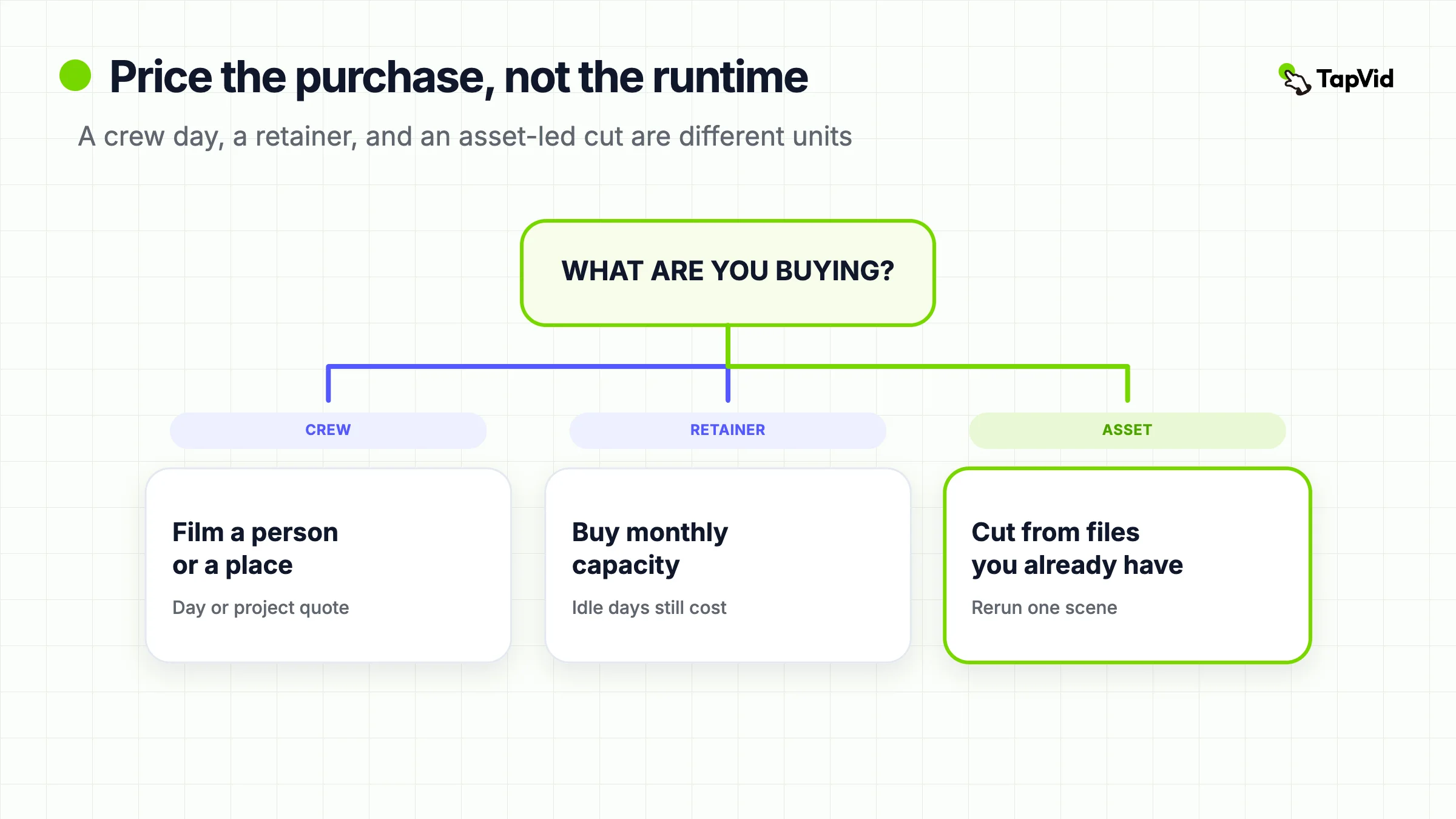
Corporate video cost is a purchase-class decision before it is a price. A talking-head day, a production-company project, a monthly retainer, and a cut built from files you already have are different units and should not be averaged. Published 2026 guides put most professional projects in a few-thousand to about $50,000 band, and they put a first useful video closer to $5,000 to $15,000. Those numbers are advertised scopes, not invoices. Freeze the job, the files you already have, and the revision and rights unit. Then compare quotes on the same brief. Runtime is a weak price signal.
Search "corporate video cost" and the first honest answers disagree on purpose. StudioBinder's 2026 pricing guide opens at $500 to well over $500,000. Vidico says most projects land between $3,000 and $50,000, with many SaaS and tech teams spending $5,000 to $20,000 for a scripted, crewed, graded piece. Moonb prices by finished minute at $1,000 to $5,000 and puts a normal two-minute video at $2,000 to $10,000. Those pages are not measuring the same purchase. One is a solo day in your conference room. One is a multi-day brand film. One is a monthly production subscription. If you average them, you get a number nobody quoted.
This page is a buying guide for the person who has to approve a budget or read two quotes. It is not a studio rate card, and it is not a market survey. Every dollar figure below is a published range from a named 2026 page, checked on 3 September 2026. It is not a median invoice. If the job is an animated explainer with official provider prices, leave this page and use the explainer video cost study. If you still need to choose agency work versus a repeatable asset-to-video path, use B2B video production. Stay here when the question is what the quote is actually buying.
01
At a glance: five purchase classes and what the number means
Use this table before you ask anyone "how much for a two-minute corporate video." The useful first cut is the purchase class, not the runtime.
| Purchase class | What you are buying | Published 2026 shape | Fits when | Breaks when |
|---|---|---|---|---|
| In-house time and gear | Staff hours, rentals, and lost work, not a vendor invoice | StudioBinder: $500 to $5,000 per video, mostly internal labor | Recurring internal updates you already know how to shoot | The job needs a crew, a permit, or craft you do not have |
| Freelancer or small crew | One or two people for a day plus a basic edit | StudioBinder: $2,000 to $15,000 per video. Moonb: $500 to $2,500 a day, or $500 to $5,000 a project | One testimonial, a CEO message, or a single-location interview | You need multi-day logistics, original score, or campaign versions |
| Production company project | Crew, planning, and post as one scoped quote | Vidico mid-range: $5,000 to $20,000. StudioBinder mid-company: $15,000 to $75,000. Shootsta one-off 2 to 3 minutes: $6,000 to $18,000 | A homepage, launch, or recruitment film with a frozen brief | The brief is still a debate, or you will need the same film every month |
| Retainer or subscription | Capacity across a month, not one hero file | Vidico: retainers and subscriptions claimed 20% to 40% lower per video. Shootsta subscription: $2,500 to $8,000 per finished video | You will ship a steady queue and can use the unused days | You make a handful of videos a year and would pay for idle capacity |
| Asset-led cut | A reviewable video from approved copy, stills, UI, or existing footage | Not a crew day rate. Cost is the tool or vendor plus your review time | The proof already lives in files you can sign | The claim needs an unfilmed person, place, or event |
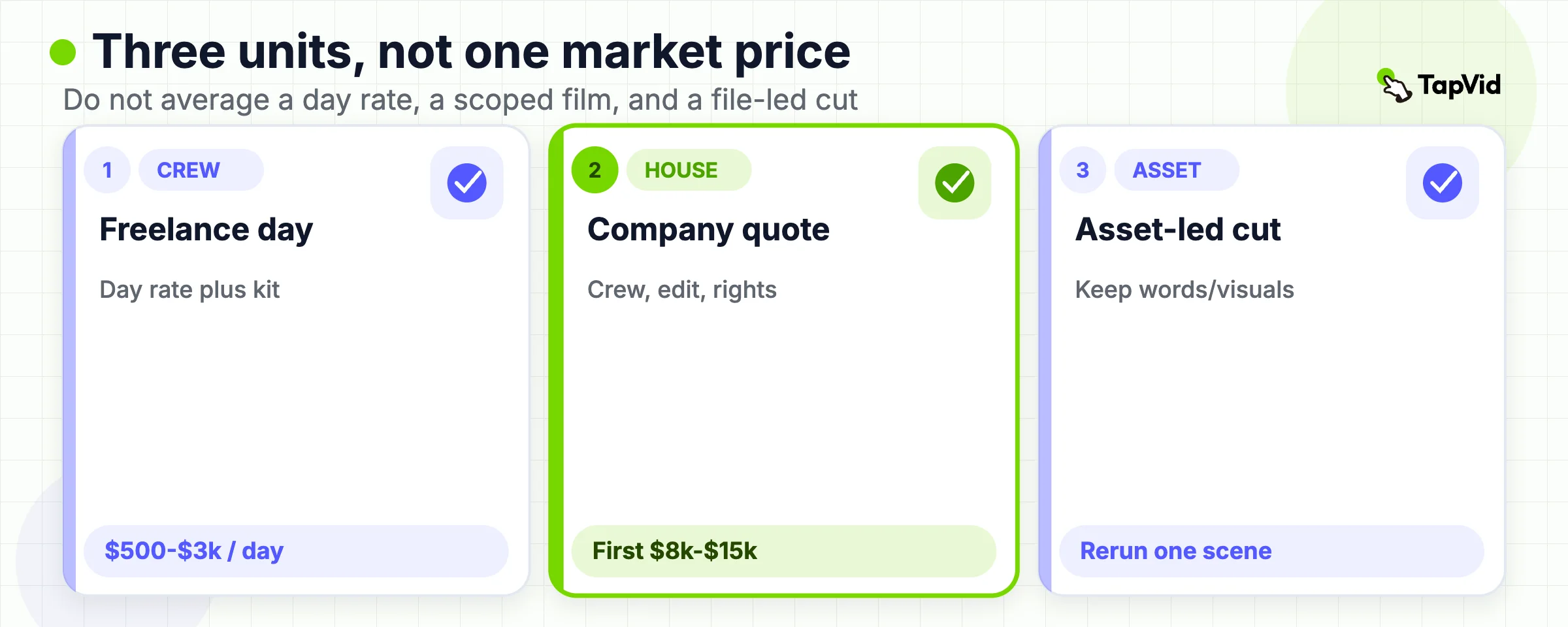
The rows are not quality ranks. A $6,000 interview can be the right film. A $60,000 campaign can be the wrong one if the job was a policy update. Chroma House makes that point without a tidy table: a higher invoice often means more days, locations, and deliverables, not a better sentence.
If you are an owner-operator choosing a path you can change later, the closer page is small business video production. This table is for corporate buyers who already know they need a company video and now have to price the purchase.
02
Why corporate video cost is not a per-minute number
Finished-minute rates are easy to paste into a spreadsheet and easy to misuse. Vidico publishes $1,000 to $10,000 per finished minute and immediately warns that a 30-second spot can cost more per minute than a five-minute training cut, because density, talent, and finish are not linear. Moonb prices $1,000 to $5,000 per finished minute and says the same thing in plainer language: a 20-second brand spot can outspend a five-minute interview. DMAK calls per-minute pricing a useful reference that becomes misleading when two vendors are quoting different scopes.
The cost moves with decisions that happen before anyone starts a clock.
- Scope, not length. StudioBinder's main levers are crew size, location, shoot days, post-production, and talent. A locked script in your own office is a different job from two cities, a presenter, and custom motion.
- Who shows up. One videographer with a good microphone is not a director, camera, sound, and lighting package. Vidico's production phase is 30% to 50% of many budgets because those people occupy the same day.
- What happens after the card comes down. Vidico puts post-production at 25% to 40% of the total. That is editing, grade, graphics, sound, captions, and the revision rounds most first-time buyers forget to count.
- The billing unit. A day rate, a fixed project fee, a monthly retainer, and a software plan cannot be divided into a shared "cost per video" unless you also name volume, unused capacity, and who owns project management.
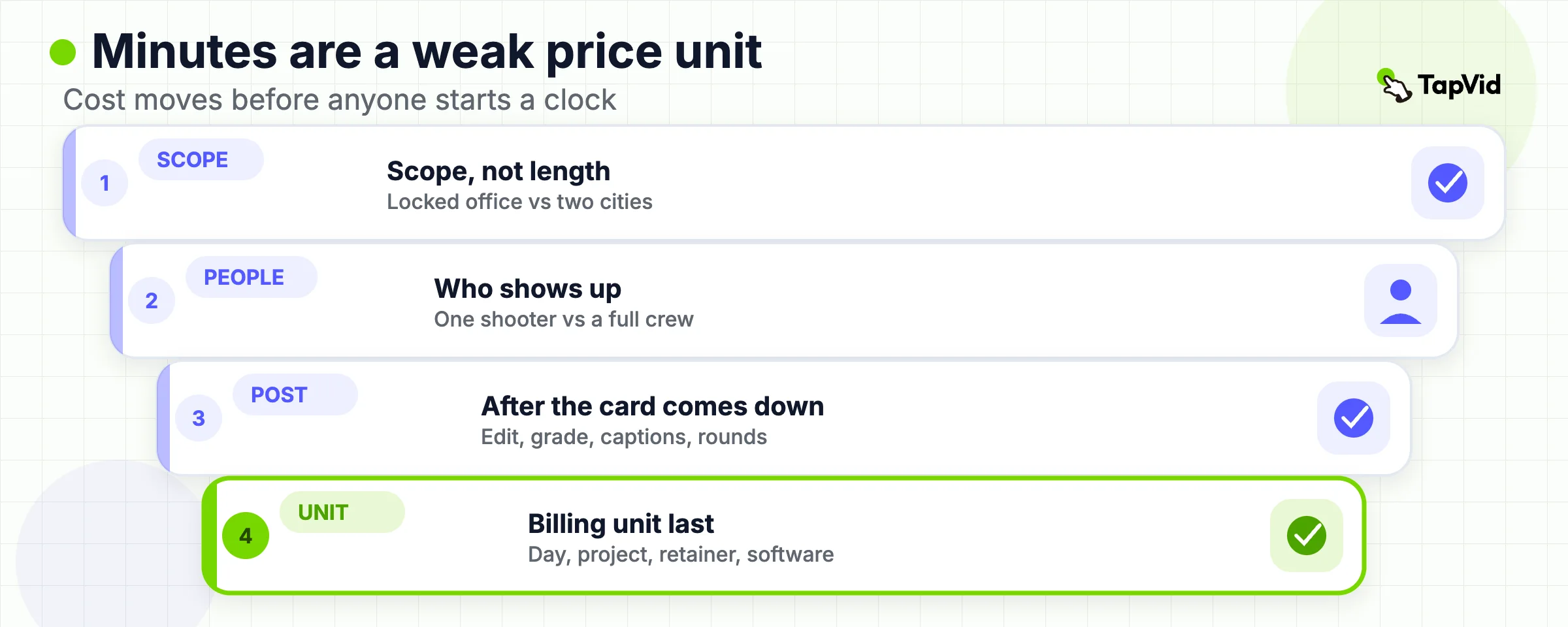
StudioBinder's two-minute FAQ is the cleanest warning on the current SERP: $2,000 to $150,000, with length mattering less than crew and days. If a vendor will only quote per minute, ask them to restate the same number as a scoped project: days, people, included rounds, and what happens when legal changes one line.
03
What published 2026 corporate video cost ranges look like by job
The next cut is the job. A testimonial, a training module, a recruitment film, and a brand documentary can share a company logo and still buy different days. The table below keeps each band attached to the page that published it. Do not merge the rows into one "average corporate video cost."
| Job | Published project band | Source, checked 3 September 2026 | What usually drives the number |
|---|---|---|---|
| Customer testimonial or case interview | $1,500 to $10,000 (StudioBinder). $3,000 to $15,000 (Vidico). $1,000 to $5,000 (Moonb, by use). Shootsta on-location testimonial: $4,000 to $11,000 | StudioBinder, Vidico, Moonb, Shootsta | Comfort of the speaker, locations, and how much you cut for sales |
| Leadership or talking-head update | Vidico basic: $1,500 to $5,000. DMAK executive interview: $5,000 to $10,000. Shootsta single-camera 2 minutes: $3,000 to $9,000 | Vidico, DMAK, Shootsta | Coaching, second camera, and whether the room is already quiet |
| Training or internal module | StudioBinder: $500 to $15,000 per module. Vidico: $3,000 to $25,000. Moonb: $1,000 to $3,000 per finished minute | StudioBinder, Vidico, Moonb | Script accuracy, SME time, and how many modules share one shoot |
| Product demo or live-action explainer | StudioBinder: $3,000 to $50,000. Vidico product demo: $5,000 to $20,000. Moonb product or explainer: $3,000 to $15,000 | StudioBinder, Vidico, Moonb | Whether the product can be shown in one room, or needs animation |
| Animated explainer | Vidico: $5,000 to $40,000. Moonb: $2,000 to $8,000 per finished minute. DMAK: $5,000 to $50,000+ | Vidico, Moonb, DMAK | Style, illustration, and revision of pictures that do not exist yet |
| Recruitment or culture | Moonb: $3,000 to $12,000. DMAK campaign: $5,000 to $25,000. Vidico brand or culture: $10,000 to $100,000+ | Moonb, DMAK, Vidico | How many people, sites, and whether you are hiring or branding |
| Homepage or brand film | Moonb website hero: $5,000 to $20,000. StudioBinder brand and culture: $10,000 to $100,000+. Shootsta paid brand film: $30,000 to $150,000+ | Moonb, StudioBinder, Shootsta | Days, locations, talent, and how public the file will be |
| Event recap | Moonb: $2,000 to $8,000. Shootsta full-day recap: $4,500 to $12,000 | Moonb, Shootsta | Camera count and how fast the cut has to land |
| Enterprise series or training library | DMAK internal series: $10,000 to $100,000+. DMAK training library: $25,000 to $250,000+ | DMAK | Volume, versioning, and accessibility, not one hero runtime |
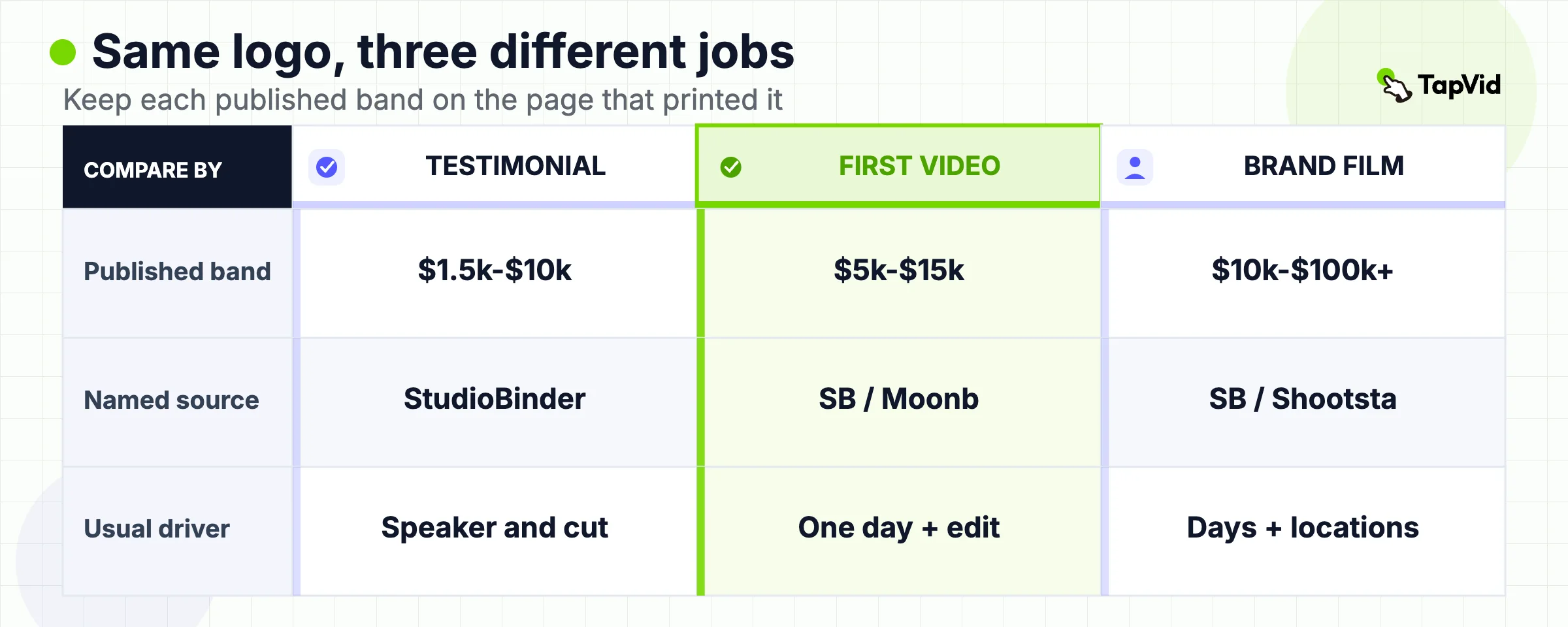
Two rows need a hard boundary. Animated explainer prices on this page are orientation only. The comparable official-page dataset, including advertised custom ranges and self-service monthly plans, already lives on how much an explainer video costs. Do not take a Vidico or DMAK explainer band and treat it as that study's median.
Recruitment and culture also split. A honest office walk-through is closer to Moonb's lower band. A multi-site documentary is closer to Vidico's upper brand range or DMAK's campaign row. If the film has to carry a meaning the company will still defend next year, the production-model page is brand video production, not this table.
The two official films below are format examples, not priced invoices. Watch them as jobs, not as runtimes. The CDC module is a training film: one locked teaching beat, graphics, and a voice that can be revised when the standard changes. NASA's Explorers Wanted film is a recruitment piece: multiple speakers, locations, and a hire ask. Those are different purchases even if both finish near two minutes. Neither file is a TapVid output, and neither publisher printed the invoice behind it.
Decide the job in one sentence before you shop the row. "After watching, this audience should believe or do this bounded thing, because they saw this proof." If the sentence contains a hire, a product mechanism, and a brand manifesto, you are pricing three videos.
04
What a first $8,000 to $15,000 video usually includes
StudioBinder tells first-time buyers to plan $5,000 to $15,000 for a freelancer or small crew, one day, professional sound, and a basic edit, and to avoid a brand film as the first project. Moonb calls $5,000 to $15,000 the usual first proper brand or product video: a small crew for a full day, color and sound, a licensed track, and a round or two of revisions. Shootsta's sample for a two-minute, one-location US corporate video is $5,600 to $12,200 on a project quote, or $3,000 to $5,500 if the same scope sits on a subscription after brand setup is already paid.
Those three pages overlap enough to be useful, and they still do not describe an average invoice. They describe a common first bundle: one job, one location, your people on camera, a locked script, and a small set of extras.
Moonb's worked $8,000 example is the most concrete line-item picture on the current SERP. Treat it as one studio's illustration, not a tariff.
| Line | Moonb's published split on an $8,000, two-minute live-action brand video | What moves it |
|---|---|---|
| Pre-production | $800 to $1,500 | How locked the message is before the crew arrives |
| Crew, one day | $2,500 to $4,000 | How many people you actually need |
| Gear | $500 to $1,500 | Camera, light, and sound package |
| Location and permits | $0 to $1,000 | Your office versus a rented room |
| On-camera talent | $0 to $2,000 | Staff versus hired presenter |
| Edit, color, mix | $1,500 to $3,000 | Polish and included rounds |
| Music and light motion | $300 to $1,000 | Licensed track and lower thirds |
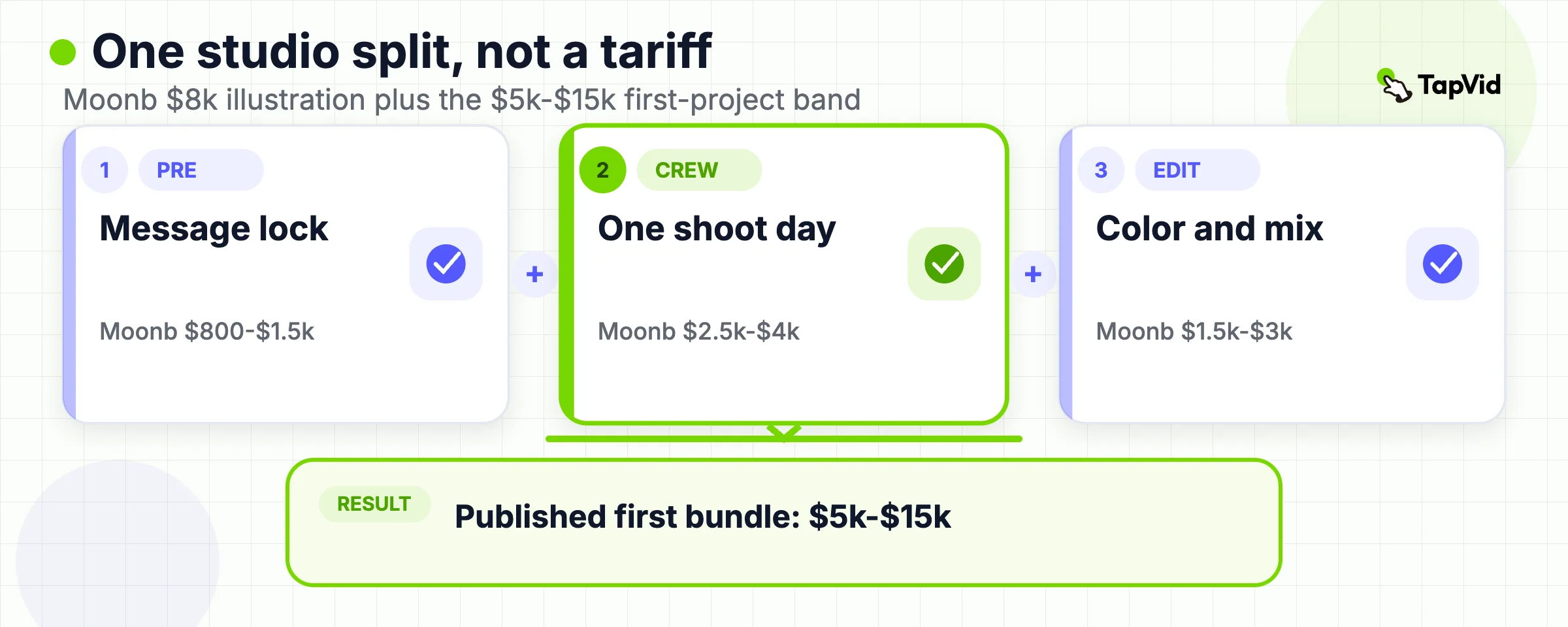
Shootsta's sample for a similar US job is built the same way, with different labels: pre-production $1,200 to $2,500, half-day shoot $1,800 to $3,500, two edit days $1,400 to $3,200, graphics $500 to $1,500, captions $200 to $500, and project management plus one revision $500 to $1,000. If a quote comes in at half of those totals, ask which row disappeared. Captions, music licenses, and a second aspect ratio are the usual missing lines.
Spend the first budget on a file you can publish and reuse. StudioBinder's advice is specific: a strong testimonial or a clear explainer beats a thin brand film. A first video that cannot survive a legal read, or that cannot be recut for a homepage and a social slot, is more expensive than the invoice shows.
05
The lines that turn a quote into an invoice
The number on page one of the proposal is rarely the number finance posts. The pages above agree on the extras even when they disagree on the headline band.
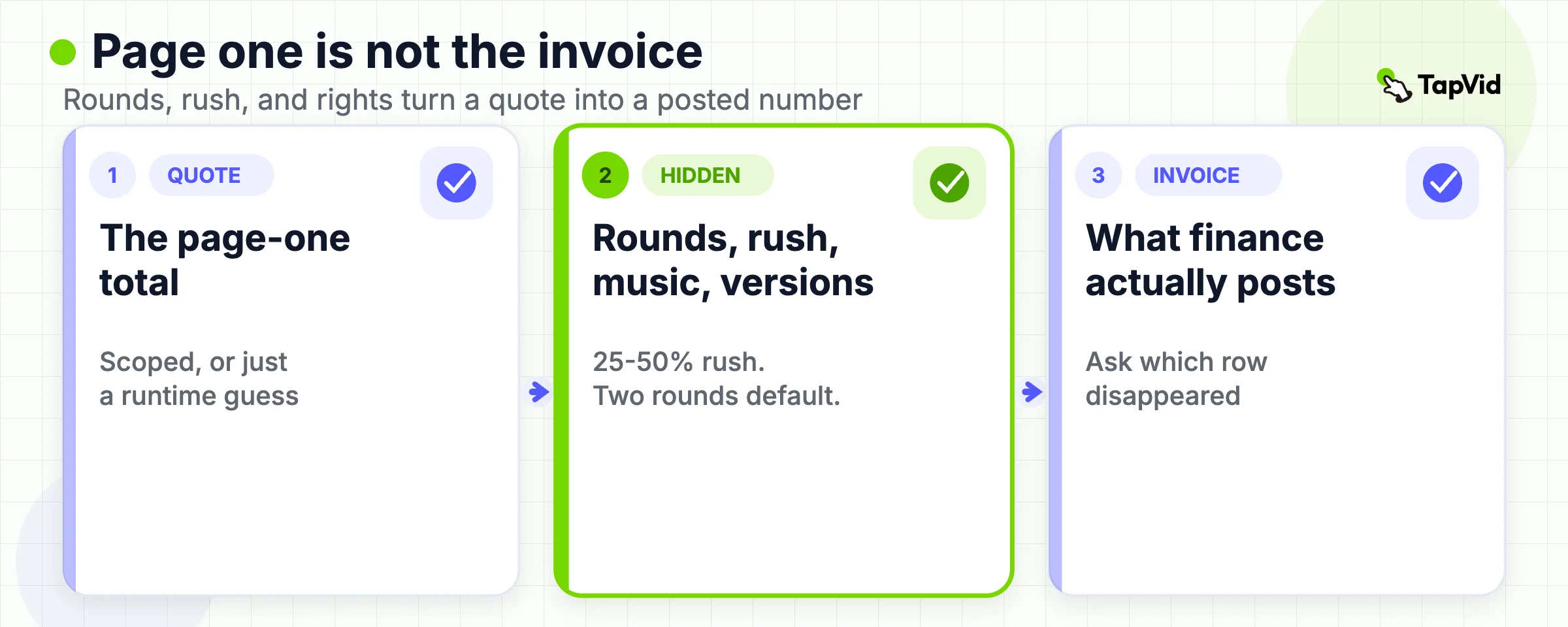
- Revisions past the included rounds. Two rounds is the common default. Vidico prices extra editing at $75 to $150 an hour. Shootsta says a video that collects three stakeholder passes can add $1,500 to $4,000. The expensive part is not the editor. It is three reviewers who never signed the same script.
- Rush. Vidico and Moonb both publish a 25% to 50% premium when the calendar is compressed. A calm four-to-eight-week project (Vidico's published professional window) is cheaper than the same film due next Friday.
- Music and usage. StudioBinder puts stock tracks around $20 to $150, then $50 to $500 in the hidden-cost list. Vidico's stock range is $30 to $1,000, with custom composition from $2,000. Moonb is blunter: "I found one on YouTube" is how brands collect claims. If an actor or licensed clip is on camera, ask how long and where you may run the file. A one-year web license is not a paid-media license.
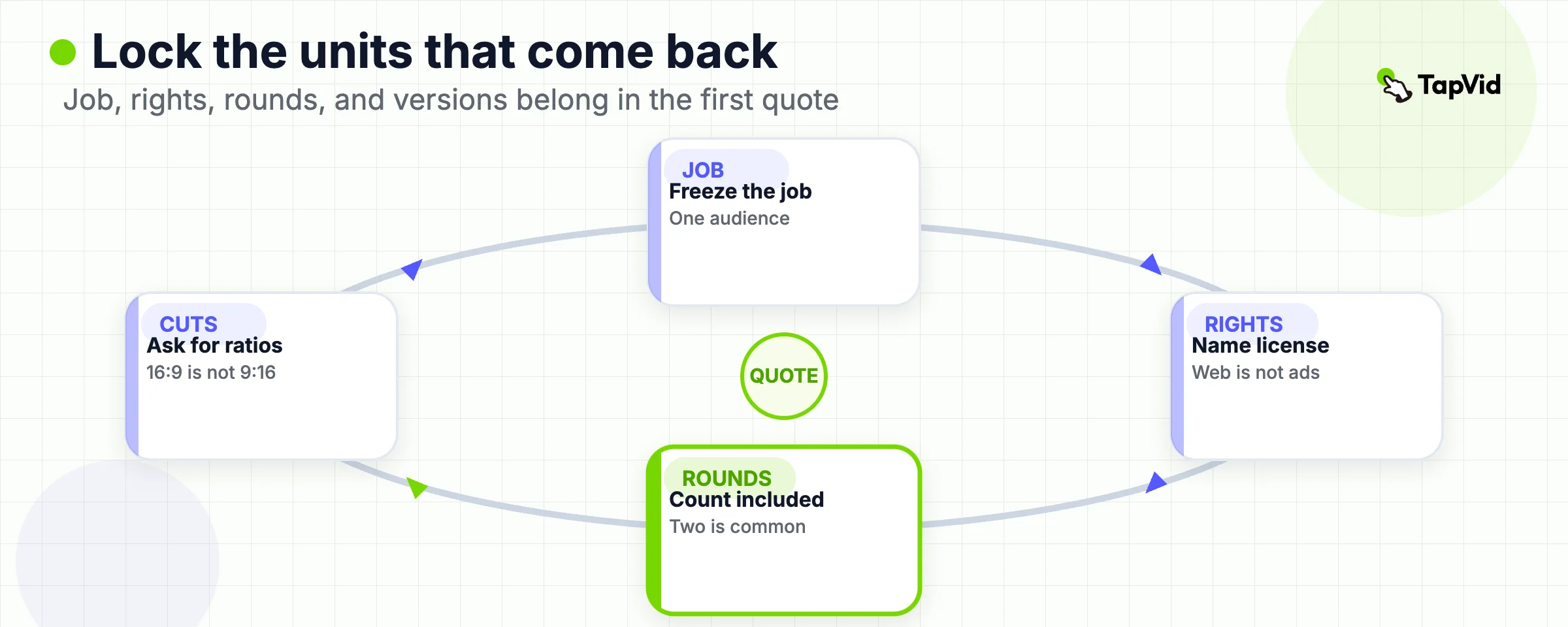
- Versions. The 16:9 homepage cut is not the 9:16 ad. Each ratio is edit time. Ask for the formats you will actually use in the first quote. Adding them after picture lock is how a "simple recut" becomes a new job.
- Travel, permits, and union rules. Shootsta is the US-specific source here. NYC and LA crew days run higher. IATSE or similar rules can add 20% to 40% plus overtime. SAG-AFTRA session and use fees on a national 30-second commercial can sit at $8,000 to $25,000 in talent cost alone on that page. If your project does not need that talent pool, do not buy it by accident.
- The update after launch. Vidico prices a later content update at $2,000 to $5,000 when a product screen, price, or policy changes. If the claim in the film will move this quarter, a locked live-action hero is a future invoice. That is a production-model problem. Brand video production treats revision risk as something you price before day rates. This page only needs the buying rule: if the facts will change, do not pay cinema money for a sentence you will have to rip out.
Ask for an itemized quote that names those lines. A low total that hides them is not a saving. It is a change order waiting for a Slack thread.
06
Compare two quotes on the same brief
Do not send "need a corporate video, two minutes, how much?" to five vendors and pick the middle number. You will get five different scopes wearing the same words. Send one brief. Require one reply shape.
Write the brief as a one-page contract.
- The single job sentence, plus the audience and the placement.
- Runtime target and the formats you need on delivery day.
- The source pack: approved claims, logo files, existing footage, product stills, and what is blocked.
- Who appears on camera, and whether they are staff or hired talent.
- Locations you already control.
- Reviewers by name, and the date the script must be locked.
- A budget band. Moonb is right that hiding the number makes the studio guess high.
Then require every quote to answer the same six fields.
- Exact deliverables. Duration, aspect ratios, captions, and whether raw files are included.
- Included labor. Script, storyboard, crew roles, edit, grade, sound, graphics, and project management.
- Revision unit. Number of rounds, what counts as a round, and the hourly rate after that.
- Calendar. Start date, shoot date, first cut, and what pauses the clock.
- Add-ons. Extra language, cutdown, rush, travel, and a later factual update.
- Rights. Who owns the master, how long talent and music may run, and which channels are covered.
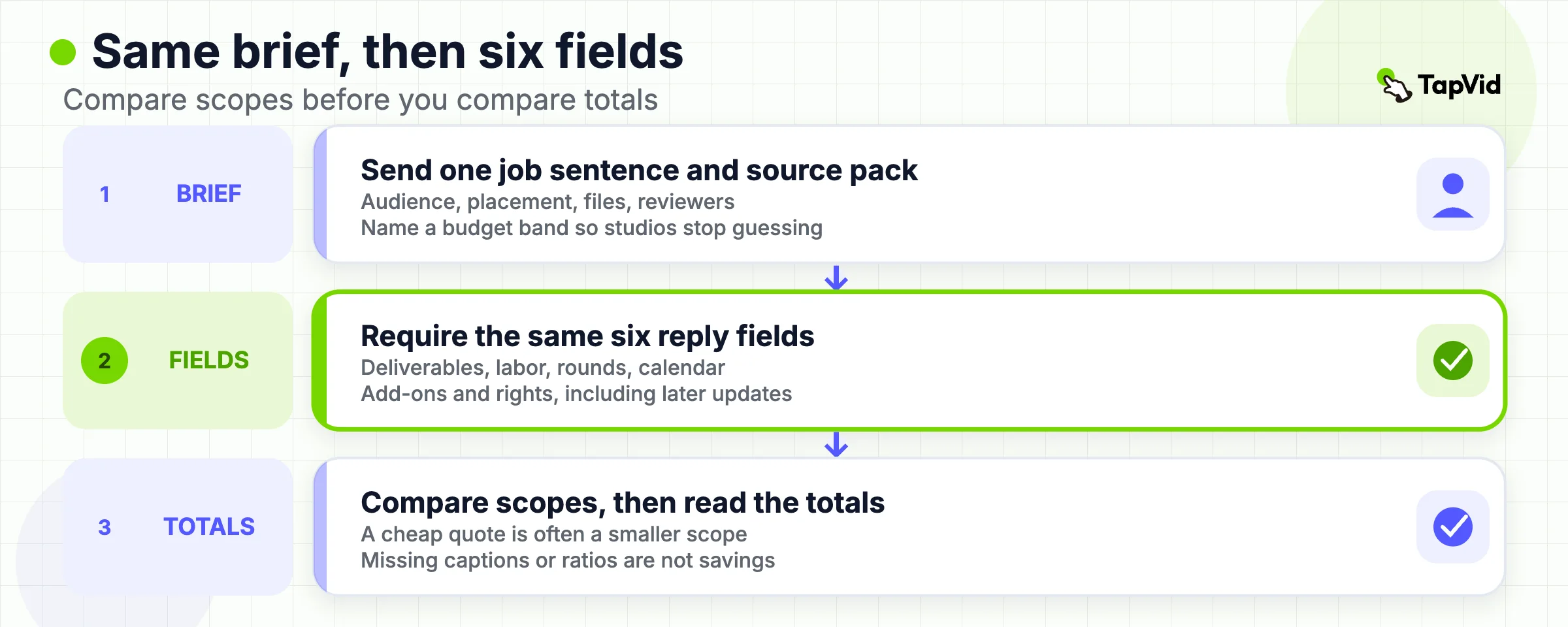
StudioBinder, Moonb, and Shootsta all warn that a cheap quote is often a smaller scope. Compare the six fields before you compare the totals. A $7,000 quote with one vertical cut, two rounds, and a one-year music license is not cheaper than a $9,500 quote that already includes those lines.
If two production companies return comparable scopes and you still cannot choose, the remaining question is operating model, not taste. That decision belongs on B2B video production: whether you are buying a service engagement or a workflow you can run again when the product page changes.
07
When a crew day is the wrong spend
A crew day is the right spend when the proof is a person, a place, or an event that does not exist in your files. A customer saying the product in their own words. A factory process you cannot diagram honestly. A founder who has to be seen, not illustrated. Those jobs justify the ranges in the tables above.
A crew day is the wrong spend when the meaning already lives in an approved script, a PDF, a help article, UI captures, product stills, or a previous interview. Paying a full crew to reshoot a sentence you can edit in a file is how corporate video budgets get a reputation for waste. Vidico's own hidden-cost note is the tell: updating a live-action product shot after the interface changes is a rebooking problem. The cheaper design is to keep claims in a form you can revise locally.
Use this router.
- The job needs faces, rooms, or a live event you do not have on disk: price a freelancer or production company against the frozen brief.
- The job is a flagship brand film with locations and craft you cannot run internally: use brand video production to pick the model, then come back here only to read the quote.
- The job is a 60 to 90 second company explainer and you still need to name the job: start with corporate explainer video.
- The job is an animated explainer you might buy from a studio or a software plan: use the explainer video cost study. Do not reuse this page's live-action bands.
- The job is training that has to stay accurate after the SOP changes: the program design sits on corporate training videos. Price only the module you will actually maintain.
- The proof is already in approved files, and you need a reviewable cut without another shoot day: use an asset-led path.
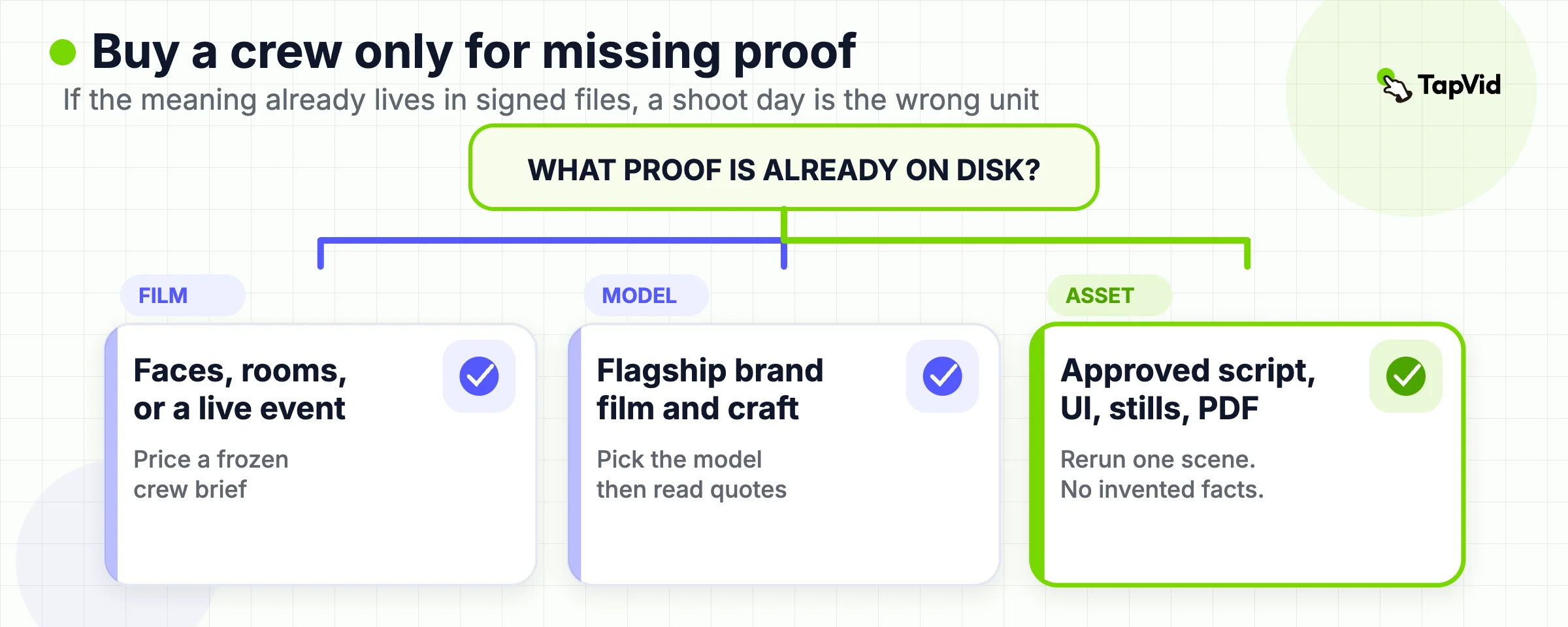
TapVid belongs only on that last branch. On the AI explainer video generator page, the product takes approved scripts, PDFs, URLs, screenshots, and brand assets, keeps supplied wording and source visuals intact, and lets you rerun the scene that changed instead of rebuilding the whole file. That is a source-to-video workflow. It is not a substitute for a filmed testimonial, a permitted location day, or a campaign that needs actors. If you do not have a signed source pack, you do not have an asset-led project. You have a research gap.
Do not pick software because a monthly plan looks cheaper than a $12,000 quote. Pick it when the facts you must not invent already exist, and when the next change will be a caption, a screenshot, or a number rather than a new shoot. The cheap visible number is still the wrong number if the file cannot be corrected when the product changes.
08
Frequently asked questions
How much does a 2-minute corporate video cost?
Published 2026 pages do not agree on one number, because they are not selling one purchase. StudioBinder's FAQ is $2,000 to $150,000. Vidico puts a professional two-minute video at $2,000 to $20,000 and says the common scripted, crewed, graded example falls between $8,000 and $15,000. Moonb puts a normal two-minute video at $2,000 to $10,000. Shootsta's one-location US sample is $5,600 to $12,200 on a project quote. Use those as advertised scopes. Length is not the lever. Crew, days, post, and rights are.
What should I budget for a first corporate video?
StudioBinder's first-project advice is $5,000 to $15,000 for a freelancer or small crew, one day, and a basic edit, aimed at a testimonial or explainer rather than a brand film. Moonb's "solid first video" band is $3,000 to $8,000, with $5,000 to $15,000 as the usual first homepage-ready piece. Start at the job and the files you already have, then pick a purchase class. A first film that tries to recruit, sell, and explain the company in one master is how the invoice grows.
Is there an average corporate video cost?
Not one you should use to approve a purchase. Vidico's "most projects" band is $3,000 to $50,000. Moonb's per-minute band is $1,000 to $5,000. DMAK's interview row starts at $5,000 to $7,500. Those are published ranges from vendor guides, not a sampled median invoice. If someone quotes an average without naming the purchase class, the job, and the included rounds, treat it as marketing copy.
How much does a corporate training video cost?
Vidico publishes $3,000 to $25,000, with simple screen-and-voice work at $3,000 to $8,000 and a multi-module series with graphics and professional narration at $8,000 to $25,000. StudioBinder's training and onboarding row is $500 to $15,000 per module. DMAK's enterprise training library row is $25,000 to $250,000+ because volume, LMS packaging, and accessibility dominate. Price the module you can update. A beautiful training film that cannot accept a policy edit is a second purchase.
Why do two quotes for the same runtime differ so much?
They are quoting different scopes. One quote may include script, two cameras, licensed music, captions, two aspect ratios, and two revision rounds. The other may include a half day and a first cut. StudioBinder, Vidico, Moonb, and DMAK all treat complexity, not minutes, as the driver. Normalize the six fields in the comparison section before you decide the cheaper vendor won.
Can AI video tools replace a production company?
Not for every corporate job. Vidico limits AI tools to internal updates, drafts, and high-volume work where polish is secondary, and keeps brand campaigns, customer-facing product films, and real testimonials on professional production. Moonb says current AI video still reads as synthetic on customer-facing work. Use software when you already have approved source material and need a reviewable cut you can revise by scene. Use a crew when the proof has to be a real person or place. The explainer video cost study is the page for software versus custom animation prices.