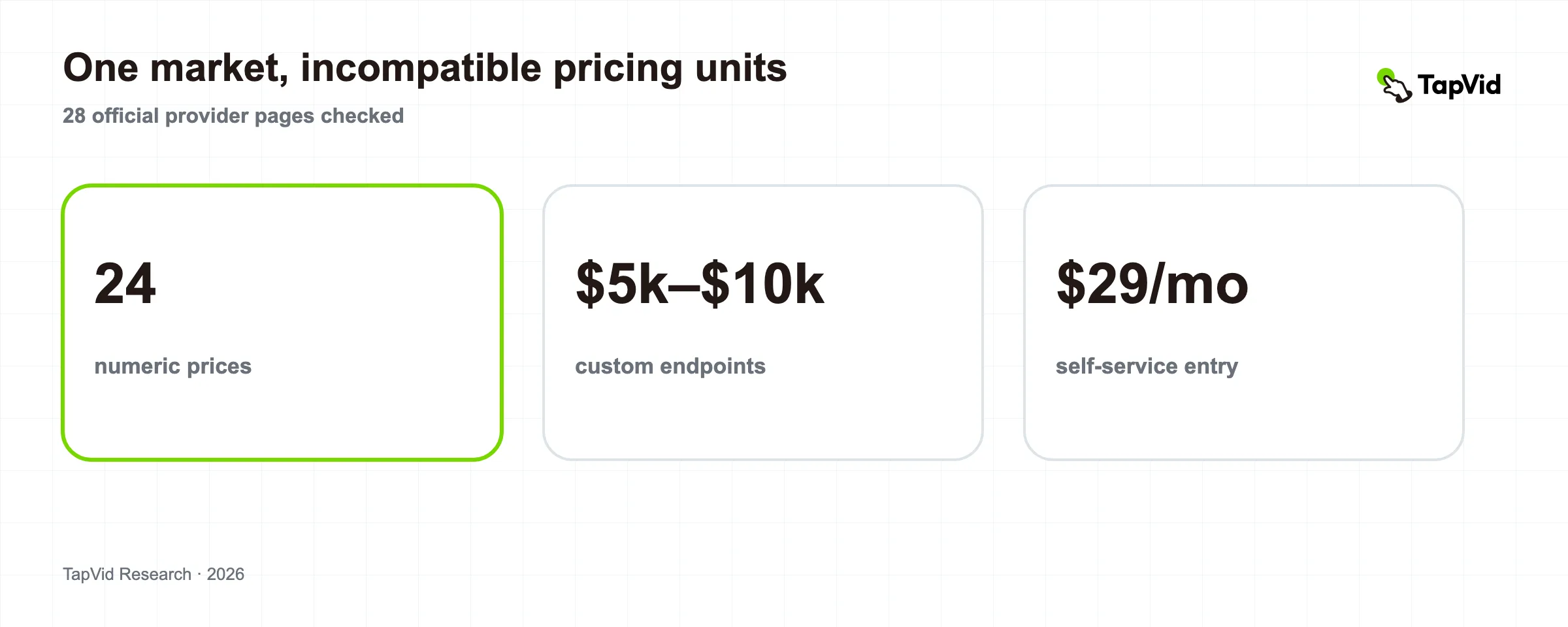

Explainer video cost is often reduced to one dramatic range. That shortcut hides four different purchases: a custom production project, freelance labor, an ongoing creative service, and self-service software. Their prices use different units and should not be averaged together. We checked the official pages of 28 providers on September 2, 2026: 12 studios or agencies, one freelancer marketplace, and 15 AI or self-service tools. Twenty-four exposed a numeric price we could verify. Among seven providers with a bounded custom-animation range, the median published lower endpoint was $5,000 and the median upper endpoint was $10,000. Among eight self-service tools with a verified month-to-month paid entry price, the median was $29 per month. Those numbers describe advertised page values, not final invoices or cost per finished video. The useful conclusion is not that one route is always cheaper. It is that buyers should compare scope, revision rules, and billing units before comparing price tags.
01
Explainer video cost benchmark: key findings from 28 official provider pages
Explainer video cost benchmark: key findings from 28 official provider pages
28
providers were checked
The sample included 12 professional studios or agencies, one freelancer marketplace, and 15 AI or self-service tools.
TapVid first-party pricing-page datasetChecked 2026-09-02
24
providers exposed a verifiable numeric price
One provider showed services without a public amount, while three pricing pages did not expose a current numeric amount in accessible page text.
TapVid first-party pricing-page datasetChecked 2026-09-02
$5,000
median lower endpoint
among seven bounded custom-production ranges
TapVid first-party pricing-page datasetChecked 2026-09-02
$10,000
median upper endpoint
among those same seven ranges
TapVid first-party pricing-page datasetChecked 2026-09-02
| Value | Metric | Context | Source | Verified |
|---|---|---|---|---|
| 28 | providers were checked | The sample included 12 professional studios or agencies, one freelancer marketplace, and 15 AI or self-service tools. | TapVid first-party pricing-page dataset | 2026-09-02 |
| 24 | providers exposed a verifiable numeric price | One provider showed services without a public amount, while three pricing pages did not expose a current numeric amount in accessible page text. | TapVid first-party pricing-page dataset | 2026-09-02 |
| $5,000 | median lower endpoint | among seven bounded custom-production ranges | TapVid first-party pricing-page dataset | 2026-09-02 |
| $10,000 | median upper endpoint | among those same seven ranges | TapVid first-party pricing-page dataset | 2026-09-02 |
| $29/month | median paid entry price | among eight self-service tools with verified month-to-month pricing | TapVid first-party pricing-page dataset | 2026-09-02 |
| 5–6 weeks | median published professional timeline | Seven providers exposed a numeric production schedule; timing is analyzed separately in our video production timeline study. | TapVid first-party pricing-page dataset | 2026-09-02 |
Source: TapVid public research dataset; verified 2026-09-02.
The source type is first-party-test. This was a purposive market snapshot, not a random vendor survey. Prices are advertised values, not negotiated or paid invoices.
02
The custom-production price benchmark
Seven studios or agencies published both a lower and upper bound for a custom animated-video project or clearly described scope. We excluded starting prices, monthly creative subscriptions, non-public prices, and a high-end live-action route from the percentile calculation.
| Advertised endpoint | N | Minimum | Q1 | Median | Q3 | Maximum |
|---|---|---|---|---|---|---|
| Lower bound of provider-published range | 7 | $2,000 | $3,750 | $5,000 | $5,500 | $20,000 |
| Upper bound of provider-published range | 7 | $3,000 | $6,500 | $10,000 | $20,000 | $25,000 |
This does not mean the median explainer video transaction was $5,000 or $10,000. It means the median lower endpoint among seven advertised bands was $5,000, while the median upper endpoint was $10,000. We preserve both distributions because turning every range into a midpoint would create a synthetic price nobody quoted.
The seven bounded ranges also cover different scopes. Some are 60-second examples, one covers 30–60 seconds, one covers 90 seconds, and others describe standard production more broadly. They are useful for understanding published budget bands, not for ranking providers as if every package were identical.
03
Published custom explainer price examples
The narrowest comparable subset still spans several multiples.
| Provider | Published price used | Scope | Revision/timeline note | Official source |
|---|---|---|---|---|
| Breadnbeyond | $2,000–$3,000 | Simple 60-second 2D explainer | Unlimited revisions; 5–7 weeks | Breadnbeyond |
| Blue Carrot | $2,500–$3,000 | Approximate full-cycle 60-second animation | 4–8 weeks general timeline | Blue Carrot |
| Creamy Animation | $5,000–$10,000 | Standard professional 60-second custom explainer | Around 6 weeks | Creamy Animation |
| Epipheo | $5,000–$25,000 | Essential tier; 30–60 seconds; 2D or motion graphics | Two revision rounds; 4–6 weeks | Epipheo |
| Kasra Design | $5,000–$10,000 | 90-second 2D, 2.5D, or isometric animation | 4–6 weeks for 2D/2.5D | Kasra Design |
| Explainify | $6,000–$15,000 | Published range for a 60-second custom 2D B2B explainer | Revision rounds included; count not stated | Explainify |
| Demo Duck | $20,000–$25,000 | Higher-end animated explainer | 8–10 weeks production | Demo Duck |
Some of these pages describe a provider's own package; others present a provider-authored scope range. The dataset labels that distinction rather than implying every row is a binding quote.
04
Starting prices are entry points, not averages
Three professional providers published only a starting price or a different purchasing unit:
- Wyzowl published a $2,700 starting price for an animated explainer.
- Yum Yum Videos said its custom 60-second explainer production starts at $8,000.
- Vidico published an ongoing creative subscription starting around $5,000 per month, not a single-project price.
Sandwich published a typical starting point of $200,000 for high-end live-action/product production and explicitly stated that it does not make animated explainers. We retained it as evidence of a different production route but excluded it from custom-animation statistics.
The right way to use a starting price is to ask what scope begins there. It cannot establish an average, a maximum, or the likely final invoice for a project with different requirements.
05
What freelancer pricing tells you—and what it does not
Upwork's official explainer-video freelancer page showed a $17–$32 hourly marketplace range. It also published example project bands: $300–$800 for a 30–60 second whiteboard video, $800–$2,500 for a 60–90 second standard 2D explainer, and $2,500–$5,000 for 60–120 seconds of premium motion graphics.
Source: TapVid public research dataset; verified 2026-09-02.
We did not multiply the hourly range by an assumed number of hours. We also did not merge the example packages into the studio distribution. Marketplace rates vary by freelancer, geography, process, portfolio, and what the client supplies. A $17 hourly profile and a $2,500 project package are different observations, not interchangeable units.
For buyers, the missing question is often coordination. A freelancer may be a strong fit when one person's style matches the brief and the client can own scripting, feedback, and asset preparation. The rate alone does not tell you who will manage those tasks.
06
AI explainer video tool prices
Eight AI or self-service tools exposed a verified paid entry price on month-to-month billing.
| Tool | Paid month-to-month entry | Published paid range used | Important unit difference | Official source |
|---|---|---|---|---|
| Renderforest | $12/mo | $12–$59/mo | Credits plus template exports | Renderforest |
| Fliki | $28/mo | $28–$88/mo | Credit-based text-to-video plans | Fliki |
| Synthesia | $29/mo | $29–$89/mo | Generated video minutes | Synthesia |
| HeyGen | $29/mo | $29–$149/mo | Credits, seats, and plan-specific duration limits | HeyGen |
| Pictory | $29/mo | $29–$199/mo | Video-minute allowances and team scope | Pictory |
| Biteable | $29/mo | $29–$99/mo | Export and maximum-duration limits | Biteable |
| Elai.io | $29/mo | $29–$125/mo | Rendering minutes and seats | Elai.io |
| Vyond | $99/mo | $99–$199/mo | Credits and maximum video duration | Vyond |
The median entry price in this eight-tool subset was $29 per month; Q1 was $28.75 and Q3 was $29. Four other products—Animaker, Colossyan, Steve AI, and AI Studios—showed an annual-billing monthly equivalent in the captured page state. Their entry prices ranged from $10 to $59 per month effective, with a median of $19.50. We kept them separate because an annual commitment is not the same purchase as month-to-month access.
The clustering around $29 is a pricing-page observation, not a cost-per-video result. Included credits, generated minutes, model access, avatars, export rules, seats, and maximum durations differ. Dividing the subscription price by a marketing estimate of “videos per month” would produce a false comparison.
Three official pricing pages—those for invideo AI, VEED, and Lumen5—were accessible during collection but did not expose a current numeric plan amount in verifiable page text. We left their price cells blank rather than carrying forward a remembered or third-party figure.
07
Revision rules can change the practical cost
The first price is not the only economic variable. Provider pages showed materially different approaches to changes:
- Wyzowl and Breadnbeyond advertised unlimited revisions in the stated production offering or package.
- Epipheo's Essential tier included two rounds.
- Elai.io stated that rendering an edited video consumes minutes again.
- Synthesia stated that only newly changed generated seconds are charged when editing an existing video.
These policies are not directly comparable. A studio revision includes professional labor and scheduling; a software revision may consume credits or generated seconds and require the user to do the editing. The point is narrower: if the product, price, interface, or legal wording is likely to change, the revision unit belongs in the budget.
For repeatable product explainers, design the video so a local change can remain local. If one interface screen or specification changes, rebuilding unrelated approved scenes increases both time and risk. Our video editing workflow guide covers the review and versioning side of that decision.
08
How to budget the right production route
How to budget the right production route
A studio or agency is appropriate when the job depends on bespoke art direction, original illustration, character work, live action, a large campaign system, or specialist production management.
Compare quotes only after the providers respond to the same brief.
Freelance production can fit a clear, bounded brief when the client already has approved copy, source assets, one decision-maker, and a matching creative reference.
Budget for project management and review even if those tasks do not appear on the invoice.
An AI or template workflow fits teams that need recurring product explanations, updates, localizations, or variations from existing materials.
The key cost question becomes the unit: credits, seconds, minutes, exports, seats, models, or a combination.
Start with what the video must prove, then choose the purchase. Define the job of an explainer video and whether motion graphics fit the material before comparing production quotes.
Choose custom production when the value is original craft
A studio or agency is appropriate when the job depends on bespoke art direction, original illustration, character work, live action, a large campaign system, or specialist production management. Compare quotes only after the providers respond to the same brief.
Ask each provider to state:
1. the exact duration and format; 2. whether research, scripting, storyboard, illustration, voiceover, music, captions, and source files are included; 3. the number and scope of revision rounds; 4. the production timeline and what pauses it; 5. the cost of another language, cutdown, aspect ratio, or rush delivery; 6. the rights and terms that apply to the final assets.
Choose a freelancer when you can own the process
Freelance production can fit a clear, bounded brief when the client already has approved copy, source assets, one decision-maker, and a matching creative reference. Budget for project management and review even if those tasks do not appear on the invoice.
Choose self-service software when repeatability matters
An AI or template workflow fits teams that need recurring product explanations, updates, localizations, or variations from existing materials. The key cost question becomes the unit: credits, seconds, minutes, exports, seats, models, or a combination.
TapVid is an Explainer Video Engine built around supplied assets and approved wording. The workflow is designed for teams that want product images, interface captures, names, numbers, and claim-to-visual relationships to remain reviewable before export. You can test that route with the AI explainer video generator.
Do not choose software only because its monthly entry price is lower. Choose it when your team can provide the product truth and wants to produce the repeatable part without waiting for a new custom engagement each time.
09
Methodology
We captured one row per provider on September 2, 2026. The sample contained 28 independent providers: 12 professional studios or agencies, one freelancer marketplace, and 15 AI or self-service tools capable of producing explainer-style videos.
Only official provider pricing, service, FAQ, help-center, or first-party guide pages were accepted. Search snippets, affiliate roundups, review sites, and a competitor's claim about another provider were excluded. If an official page did not expose a verifiable current numeric amount, the price remained blank.
We kept purchasing units separate:
- `per_project` for a fixed or ranged production engagement;
- `per_hour` for marketplace labor;
- `per_month` for month-to-month software or service access;
- `per_month_effective_billed_annually` for a monthly equivalent that requires annual billing.
Starting prices retained an empty maximum. We did not infer a 60-second price from monthly credits, convert hourly rates into project estimates, or divide a subscription by an assumed output count. Free plans were not used as the minimum paid price.
Quartiles use the Type-7 linear-interpolation method. Bounded custom-production statistics include seven rows with both a lower and upper project range. Month-to-month AI statistics include eight rows with verified monthly billing. Every figure in the headline and statistical tables comes from these predeclared subsets.
Download the full 28-provider CSV. It preserves every unit, missing value, scope note, official source URL, and verification date used in this analysis.
10
Limitations
- The sample was purposive and favors providers with discoverable official pages. It is not statistically representative of every vendor.
- Advertised prices are not final invoices. Taxes, rush work, extra languages, premium voice talent, additional formats, source files, and revisions may change the amount.
- Provider-authored guides may describe a typical scope rather than a binding tariff. The dataset labels those rows.
- Dynamic, geo-personalized, and promotional prices may differ by visitor, currency, or billing toggle.
- The study does not measure output quality, factual accuracy, satisfaction, or business results.
- The price snapshot supports a 2026 cross-section, not a year-over-year change claim.
- The dataset should be refreshed before any major article update because public prices change.
11
References and citation
Cite this research
Recommended citation (APA)
Chen, K. (2026, September 2). Explainer video cost in 2026: 28 providers analyzed (Version 1.0). TapVid Research. https://tapvid.ai/blog/how-much-does-an-explainer-video-cost
BibTeX
@techreport{chen2026explainerVideoCost,
  author = {Kenneth Chen},
  title = {Explainer Video Cost in 2026: 28 Providers Analyzed},
  institution = {TapVid Research},
  year = {2026},
  month = {September},
  url = {https://tapvid.ai/blog/how-much-does-an-explainer-video-cost},
  note = {Version 1.0}
}
Data and source register
- Explainer-video provider pricing dataset (CSV)Checked 2026-09-02
Version 1.0
This report keeps source links beside the claims they support. The methodology and limitations sections define the sample, measurement window, calculation rules, and boundaries. Use the canonical URL and version below when quoting the findings; use the linked public data files to reproduce or audit the calculations.
12
Frequently asked questions
How much does a 60-second explainer video cost?
In our September 2026 official-page snapshot, comparable published 60-second examples ranged from $2,000–$3,000 for a simple 2D package to $5,000–$10,000 for a standard professional custom explainer, while one 30–60 second higher-end tier extended to $25,000. These are advertised scopes, not a market-wide average.
What is the average explainer video cost?
Our dataset does not support a market average because the sample is purposive and the offers use different units. Among seven bounded custom-production ranges, the median lower endpoint was $5,000 and the median upper endpoint was $10,000. Those are medians of advertised endpoints, not median invoices.
How much do AI explainer video tools cost?
Among eight self-service tools with a verified month-to-month paid entry price, the median was $29 per month. Plan inclusions differ enough that this should not be converted into an average cost per finished video.
Why do explainer video quotes vary so much?
The quote can include different levels of strategy, scripting, illustration, voiceover, sound, animation, project management, revisions, localization, source files, and rights. Duration alone does not normalize those differences.
Is a cheaper explainer video always better for recurring content?
No. A low sticker price can still create rework if the workflow does not preserve the correct assets, exact wording, and local changes. Compare the revision unit and the team's own labor, not only the invoice or subscription.
13
The buying takeaway
There is no honest single price for “an explainer video” until the buyer defines what is being purchased. In the 28-provider snapshot, bounded custom-animation ranges had median lower and upper endpoints of $5,000 and $10,000, while month-to-month self-service entry prices centered at $29. Those numbers belong to different markets.
For a fair comparison, send the same evidence-backed brief to every custom provider, keep starting prices separate from bounded ranges, and price expected revisions. For software, compare credits, minutes, exports, seats, models, and change costs. The cheapest visible number is rarely the complete production decision.