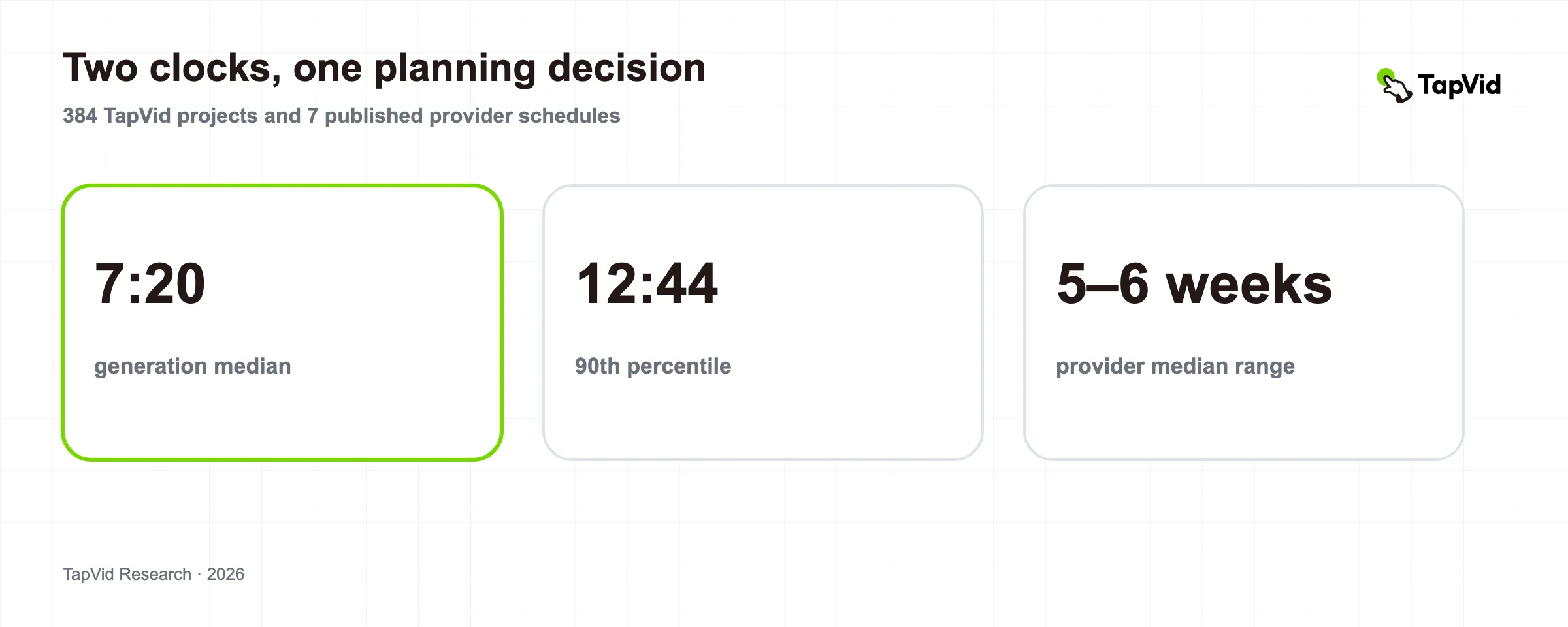

A video production timeline is not one clock. A studio quote usually measures weeks from kickoff to delivery. An AI product metric may measure only the generation stage after a project has already reached the render queue. Treating those numbers as interchangeable produces a fast comparison and a bad planning decision. We analyzed two deliberately separate samples. First, we reviewed 384 external-user TapVid projects that reached their first video-generation action between July 11 and August 9, 2026. The median generation-stage time was 7 minutes 20 seconds, while 90% completed within 12 minutes 44 seconds and 95% within 14 minutes 53 seconds. Second, we checked 28 official provider pages on September 2, 2026. Seven professional providers published a numeric production timeline; the median lower endpoint was 5 weeks and the median upper endpoint was 6 weeks. These results do not prove that an AI workflow replaces a studio. They show why teams should split a timeline into intake, production, review, revision, and delivery before choosing a route.
01
Key findings
Key findings
7:20
median generation-stage time
Half of the measured projects completed the recorded stage in 440 seconds or less.
TapVid production telemetry methodologyChecked 2026-09-02
12:44
90th percentile
Nine in ten completed in 764 seconds or less.
TapVid production telemetry methodologyChecked 2026-09-02
14:53
95th percentile
Nineteen in twenty completed in 893 seconds or less.
TapVid production telemetry methodologyChecked 2026-09-02
The TapVid sample contained 384 first-generation projects from external users. The measured interval ran from the creation time to the last modification time of each project's first `video_gen` action. It did not include the time spent preparing a brief, reviewing a script, revising scenes, or exporting the final file.
| Value | Metric | Context | Source | Verified |
|---|---|---|---|---|
| 7:20 | median generation-stage time | Half of the measured projects completed the recorded stage in 440 seconds or less. | TapVid production telemetry methodology | 2026-09-02 |
| 12:44 | 90th percentile | Nine in ten completed in 764 seconds or less. | TapVid production telemetry methodology | 2026-09-02 |
| 14:53 | 95th percentile | Nineteen in twenty completed in 893 seconds or less. | TapVid production telemetry methodology | 2026-09-02 |
| 74:53 | longest recorded interval | The extreme tail is one reason we report percentiles rather than only an average. | TapVid production telemetry methodology | 2026-09-02 |
Source: TapVid public research dataset; verified 2026-09-02.
The source type is first-party-test. The sample covers external-user first-generation projects from July 11 through August 9, 2026; n=384. The known limitation is that `modify_time` can be updated after the underlying generation finishes, which may overstate some durations. The figures should therefore be read as a production pilot, not a service-level guarantee.
In a separate public-market sample, seven professional providers published a numeric timeline in weeks. Across those pages, the lower endpoint ranged from 4 to 8 weeks and the upper endpoint ranged from 6 to 10 weeks. The median published range was 5 to 6 weeks. These are advertised schedules, not observed project completion times.
Source: TapVid's September 2026 provider dataset, source type first-party-test, 28 official provider pages checked; seven exposed a numeric professional-production timeline; verified 2026-09-02.
02
The published studio timeline benchmark
We recorded the timeline exactly as each provider described it and did not fill missing values. The seven pages below were the only ones in the 28-provider sample that gave a numeric professional-production timeline.
| Provider | Published timeline used in the dataset | Scope note | Official source |
|---|---|---|---|
| Wyzowl | About 6 weeks | Animated explainer; typical 60–90 seconds | Wyzowl |
| Epipheo | 4–6 weeks | Essential tier; 30–60 seconds; 2D or motion graphics | Epipheo |
| Demo Duck | 8–10 weeks production | The provider separately says a schedule including feedback can reach 10–12 weeks | Demo Duck |
| Breadnbeyond | 5–7 weeks | Timing varies with workload and feedback | Breadnbeyond |
| Blue Carrot | 4–8 weeks | General explainer timeline | Blue Carrot |
| Kasra Design | 4–6 weeks | Published for 2D and 2.5D production | Kasra Design |
| Creamy Animation | Around 6 weeks | Standard custom explainer | Creamy Animation |
The lower endpoints have a first quartile of 4 weeks, a median of 5 weeks, and a third quartile of 6 weeks. The upper endpoints have a first quartile of 6 weeks, a median of 6 weeks, and a third quartile of 7.5 weeks. We used the Type-7 percentile method and represented a point estimate such as “about 6 weeks” as both a 6-week lower and upper endpoint.
The result does not mean every professional explainer takes six weeks. The sample is small and purposive, the scopes differ, and several providers did not publish a timeline at all. What the result does establish is narrower and useful: buyers who rely on public provider pages will commonly encounter schedules measured in weeks, and feedback can sit inside or outside the advertised production window.
03
What the 384-project AI sample measures
The TapVid pilot measures one production stage: the first recorded video-generation action after a project reaches that point in the workflow. It is not “prompt to approved final video.”
The inclusion rules were:
1. The project belonged to an external user; internal domains and known test accounts were excluded. 2. The project had at least one `video_gen` action in the July 11–August 9, 2026 window. 3. Only the first generation action for each project was included. 4. Duration was calculated from that action's creation timestamp to its modification timestamp.
A nearby system-health snapshot, covering July 10–August 8, provides context but is not the same cohort. In that window, 412 external-user projects reached video generation. Of those, 382 had no recorded retry or failed chat message, or 92.72%. We call that a system-clean first run, not a creative-quality pass. Thirty-five projects, or 8.50%, later showed a `video_edit` card; among those edited projects, the mean was 2.57 edit actions. An edit may reflect preference, factual correction, or ordinary iteration, so it cannot be interpreted as a model failure rate.
The two windows are kept separate because late-arriving records can change historical snapshots slightly. Publishing them side by side is more honest than forcing them into one apparently precise cohort.
04
Why “minutes versus weeks” is not the conclusion
The 7:20 median and the 5–6 week provider median do not cover the same work.
A professional production timeline can include discovery, script development, illustration, storyboard approval, voiceover, animation, sound, several review rounds, and project management. The TapVid number starts much later. It observes a generation action after the team has supplied enough information for the system to render.
The defensible comparison is therefore about where the elapsed time lives:
| Timeline stage | Professional production | Asset-led AI production |
|---|---|---|
| Intake | Briefing, discovery, stakeholder interviews | Supply the approved script, product assets, references, and constraints |
| Planning | Script and storyboard rounds | Review the brief, script, and scene plan before rendering |
| Generation | Designers or animators build scenes | The system renders the planned scenes |
| Review | Stakeholders annotate a cut | A human checks assets, exact wording, numbers, and claim-to-visual correspondence |
| Revision | The production team schedules and executes changes | A user requests a local scene or copy change where the workflow supports it |
| Delivery | Mastering and handoff | Export or share after approval |
AI mainly compresses the mechanical production stage. It does not eliminate the need to decide what the video should say or to verify what it shows. A weak brief can still create a fast, polished, unusable result.
05
Build a realistic video production timeline
Use five clocks instead of one delivery date.
1. Intake clock
Measure the time required to collect approved copy, product images, interface captures, logo files, brand rules, and evidence for every claim. If the assets are scattered across inboxes, the project is already late before production begins.
For a product explainer, lock three things at intake:
- the assets that must remain recognizable;
- the names, numbers, prices, specifications, and legal wording that must remain literal;
- the relationship between each claim and the correct visual.
Our product video production guide explains how to structure that source packet.
2. Decision clock
Measure how long stakeholders need to approve the audience, scope, script, scene order, and call to action. A generation tool cannot shorten a week spent waiting for three owners to disagree in comments.
Give one person authority to resolve wording and one person authority to approve product truth. Set a response window before production begins. If a legal or pricing owner must review exact language, put that review before animation rather than after it.
3. Production clock
This is the stage most vendor pages advertise and the stage the TapVid pilot measures most directly. Define its start and stop events in writing. “Kickoff to delivery,” “approved storyboard to first cut,” and “render request to generated video” are different metrics.
4. Revision clock
Budget by decision round, not by an optimistic assumption that the first draft will be final. Separate factual corrections from preference changes. A wrong price or product image is a release blocker; changing an animation curve usually is not.
Structure the project so one local correction can remain local. Our video editing workflow guide gives a review model for scene-level changes.
5. Delivery clock
Include caption review, final audio checks, output versions, export, upload, and channel-specific approval. A render is not delivered merely because a file exists.
06
Choose a route by deadline and evidence
Choose a route by deadline and evidence
Use a professional studio when the job depends on original art direction, filming, bespoke character work, or a campaign process that needs specialist strategy and project management.
The public sample suggests planning in weeks, not days, and reserving time for feedback outside the nominal production window.
Use an asset-led AI workflow when the product truth already exists in approved scripts, screenshots, images, recordings, and documents, and the team needs repeatable explainers on a shorter cycle.
TapVid's role is to turn those supplied materials into a reviewable video without treating creative generation as permission to rewrite the product.
Use a hybrid route when the video needs one filmed or bespoke hero sequence but the surrounding versions, localizations, or product updates can be produced from approved assets.
The important choice is not “human or AI.” It is which parts require original production and which parts should stay tied to source material.
Use a professional studio when the job depends on original art direction, filming, bespoke character work, or a campaign process that needs specialist strategy and project management. The public sample suggests planning in weeks, not days, and reserving time for feedback outside the nominal production window.
Use an asset-led AI workflow when the product truth already exists in approved scripts, screenshots, images, recordings, and documents, and the team needs repeatable explainers on a shorter cycle. TapVid's role is to turn those supplied materials into a reviewable video without treating creative generation as permission to rewrite the product. You can try that workflow with the AI explainer video generator.
Use a hybrid route when the video needs one filmed or bespoke hero sequence but the surrounding versions, localizations, or product updates can be produced from approved assets. The important choice is not “human or AI.” It is which parts require original production and which parts should stay tied to source material.
07
Methodology
The study combines two different datasets and never merges them into one speed ratio.
TapVid telemetry. The main pilot includes 384 external-user projects with a first `video_gen` action from July 11 through August 9, 2026. Internal company domains and known test accounts were excluded. Only the first generation action per project was included. The observed duration is `modify_time - create_time` for that action. We report P50, P90, P95, and the maximum. The source system is T+1. No email address, prompt, project ID, title, URL, or uploaded asset was extracted for this article.
Source: TapVid public research dataset; verified 2026-09-02.
Provider pages. On September 2, 2026, we checked 28 official pricing, service, FAQ, or help pages: 12 professional studios or agencies, one freelancer marketplace, and 15 AI or self-service tools. Seven professional providers published a numeric timeline in weeks. We retained the providers' own scopes and did not estimate missing values. The full provider selection and price findings are documented in our explainer video cost research.
Percentiles. Provider quartiles use the Type-7 linear-interpolation method. A point estimate was treated as the same lower and upper value. TapVid project percentiles were calculated over project-level first-generation durations.
Verification date. All figures and provider pages in this article were checked on September 2, 2026.
Downloadable data. Download the aggregated TapVid generation-time table, the adjacent system-health snapshot, and the 28-provider pricing and timeline snapshot. The telemetry files contain only aggregate statistics and no user-, project-, prompt-, or asset-level data.
08
Limitations
- The TapVid sample is product telemetry from one explainer-video engine, not a random sample of every AI video product or creator.
- The TapVid clock measures a generation action, not the full elapsed time from idea to approved delivery.
- The action modification timestamp may move after generation, which can overstate some durations. The long tail requires a frozen rerun before this pilot is promoted to a recurring benchmark.
- The provider sample is purposive. It represents official pages a buyer may encounter, not every production company.
- Published provider timelines are advertised estimates, not independently observed completion times.
- Scope differs across providers. A 30-second motion-graphics package and a 90-second custom animation should not be treated as identical work.
- Neither dataset measures creative quality, factual accuracy, customer satisfaction, or business results.
09
References and citation
Cite this research
Recommended citation (APA)
Chen, K. (2026, September 2). Video production timeline: Data from 384 AI projects and 7 providers (Version 1.0). TapVid Research. https://tapvid.ai/blog/video-production-timeline
BibTeX
@techreport{chen2026videoProductionTimeline,
  author = {Kenneth Chen},
  title = {Video Production Timeline: Data From 384 AI Projects and 7 Providers},
  institution = {TapVid Research},
  year = {2026},
  month = {September},
  url = {https://tapvid.ai/blog/video-production-timeline},
  note = {Version 1.0}
}
Data and source register
- TapVid AI generation-time dataset (CSV)Checked 2026-09-02
- Explainer-video provider dataset (CSV)Checked 2026-09-02
Version 1.0
This report keeps source links beside the claims they support. The methodology and limitations sections define the sample, measurement window, calculation rules, and boundaries. Use the canonical URL and version below when quoting the findings; use the linked public data files to reproduce or audit the calculations.
10
Frequently asked questions
How long does video production take?
The answer depends on what the clock includes. In our September 2026 review, seven professional providers published schedules whose median lower and upper endpoints were 5 and 6 weeks. In a separate 384-project TapVid pilot, the first generation stage had a median recorded duration of 7 minutes 20 seconds. Those figures are not interchangeable because the professional schedule includes more production work.
How long does an explainer video take to make?
The seven public professional timelines in our sample ranged from 4–6 weeks at the shorter end to 8–10 weeks for a longer production schedule. Feedback can extend the calendar. An asset-led AI workflow can render in minutes once the brief, script, and source materials are ready, but preparation and review still take time.
Why do video projects miss their deadlines?
The production step is only one source of delay. Missing assets, unresolved copy, slow stakeholder review, scope changes, extra formats, and late factual corrections can add more elapsed time than rendering or animation. Track those clocks separately.
Is AI video generation instant?
No. In the TapVid pilot, half of first generation actions completed within 7:20, 90% within 12:44, and 95% within 14:53. Queue conditions, requested output, project complexity, and later record updates can affect the observed time.
What should a video production schedule include?
At minimum: asset and fact intake, script and scene approval, production or generation, factual and visual review, revision, export, and delivery. Name the owner and expected response time for every approval gate.
11
The planning takeaway
Do not ask a provider or tool for one timeline number until both sides agree on its start and stop events. The best production plan exposes five clocks—intake, decisions, production, revision, and delivery—and assigns an owner to each.
The current evidence supports a practical distinction. Professional custom production is publicly planned in weeks. Once the source packet and scene plan are ready, an asset-led generation stage can run in minutes. Accuracy still depends on what the team supplies and what a human verifies before export.