
Most lists of types of video content mix three different decisions: the business job, the storytelling form, and the delivery format. A product launch can also be an explainer, a cinematic piece, a 3D animation, and a social video. Treating those labels as competing options creates a taxonomy that looks tidy but fails when a team has to brief or batch production. We audited 64 production-ready briefs in TapVid's curated Good Case library on September 4, 2026. Every record in the corpus contained a full brief, a generation link, a public share link, and an MP4 attachment. The most common business-use label was education or explanation, assigned to 31 records. The most common overlapping editorial tags were Explainer and 3D Animation, each attached to 33 records. Fifty-one of the 64 videos used a 16:9 production ratio. This is original first-party research, but it is not a survey of the whole video market. The library deliberately preserves finished cases considered useful by TapVid's team, so the distribution reflects curation and product fit. The value is in the structure: it shows why content type should be recorded on separate axes before a team chooses a production route.
01
Key findings from 64 production-ready video briefs
Key findings from 64 production-ready video briefs
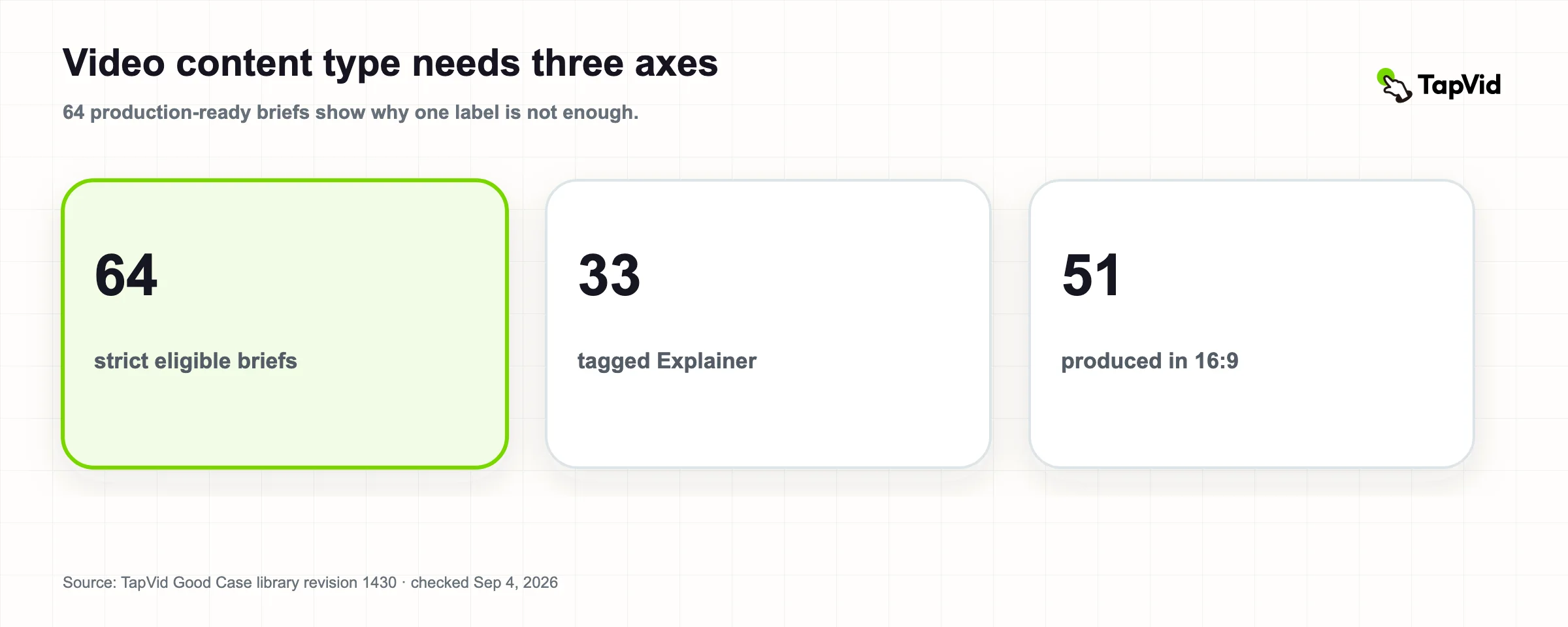
64
strict eligible briefs
Every included record had a full brief, generation link, public share link, and MP4 attachment.
TapVid types of video content datasetChecked 2026-09-04
33
briefs tagged Explainer
Explainer was tied with 3D Animation as the most common overlapping editorial tag.
TapVid types of video content datasetChecked 2026-09-04
51
videos produced in 16:9
Horizontal delivery represented 79.7% of this curated corpus.
TapVid types of video content datasetChecked 2026-09-04
| Value | Finding | What it means |
|---|---|---|
| 64 | strict eligible briefs | Every included record had a full brief, generation link, public share link, and MP4 attachment. |
| 33 | briefs tagged Explainer | Explainer was tied with 3D Animation as the most common overlapping editorial tag. |
| 51 | videos produced in 16:9 | Horizontal delivery represented 79.7% of this curated corpus. |
The aggregate dataset is available as a downloadable CSV. It contains counts and shares only. It does not expose prompts, project IDs, customer names, email addresses, generation URLs, share URLs, filenames, or individual titles.
Source: TapVid types of video content dataset, Good Case library revision 1430, checked September 4, 2026.
Verification date:
- 2026-09-04
02
Video content type is not one field
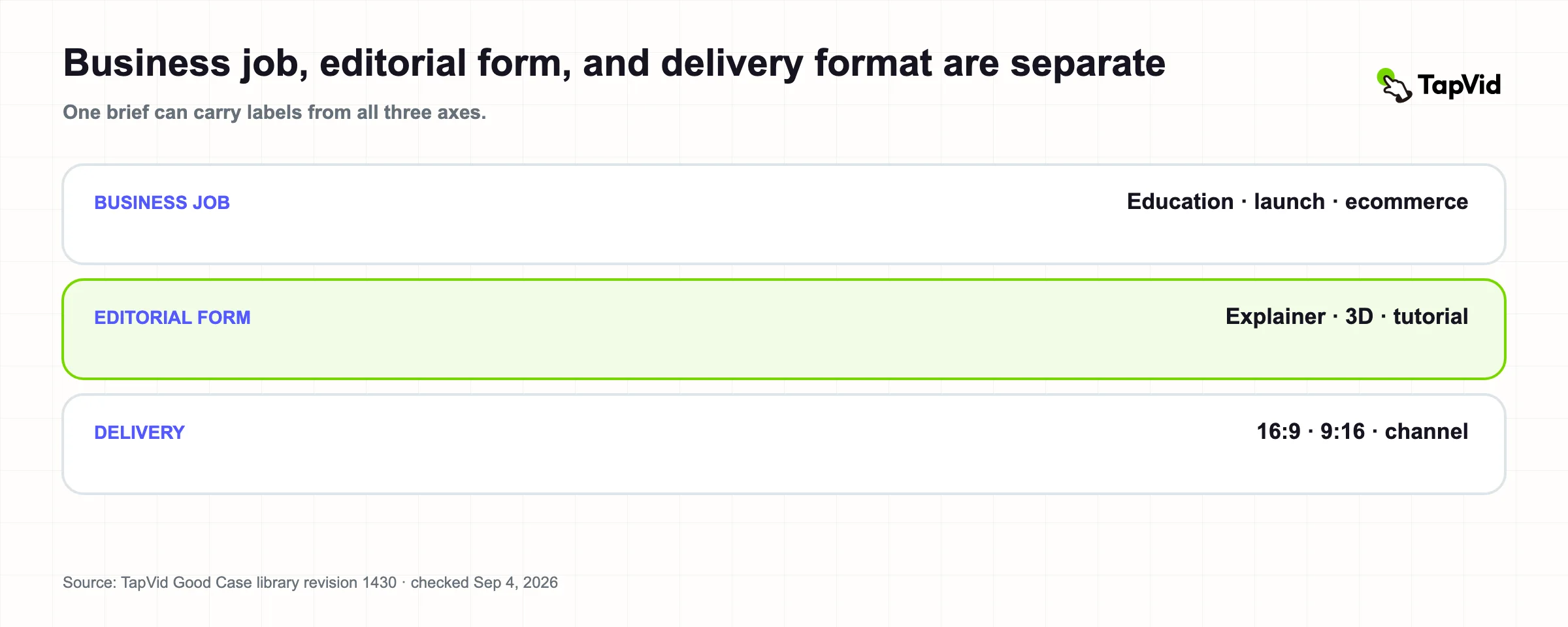
A useful production taxonomy separates at least three questions.
1. What business job does the video do? The answer might be education, product launch, ecommerce, B2B explanation, sales enablement, or news commentary. 2. How does the video communicate? The answer might be explainer, tutorial, documentary, cinematic, talking head, or data-led animation. 3. Where and how will it be delivered? The answer might be a horizontal product-page video, a vertical social ad, a sales follow-up, or a long-form lesson.
Those axes can coexist. In the audited corpus, a single brief could legitimately carry Product Launch, Explainer, 3D Animation, Professional, and Social Media tags. The tags were therefore counted as overlapping attributes, not forced into a 100% pie chart.
This distinction matters for production. “Make a product launch video” identifies a business moment, but not whether the viewer needs a six-second reveal, a one-minute feature explanation, a founder narrative, or a technical architecture walkthrough. “Make it cinematic” describes treatment, but not the claim that must remain accurate. “Make it vertical” describes a canvas, but not the story.
03
Business-use distribution in the curated corpus
| Business-use label | Briefs | Share of 64 |
|---|---|---|
| Education / explainers | 31 | 48.4% |
| Marketing / product launch | 10 | 15.6% |
| Lifestyle how-to | 8 | 12.5% |
| Unclassified | 5 | 7.8% |
| News / finance commentary | 4 | 6.3% |
| B2B | 2 | 3.1% |
| Ecommerce | 2 | 3.1% |
| Creative short | 1 | 1.6% |
| Sales enablement | 1 | 1.6% |
The table should not be read as market share. The library is curated, not randomly sampled, and some categories were introduced or applied more consistently than others. It does show the dominant job represented in this production set: helping a viewer understand a subject, product, or process.
That finding is consistent with the practical role of an Explainer Video Engine. When the source contains approved product images, screenshots, diagrams, figures, or written claims, production needs to preserve three forms of accuracy: the assets themselves, the literal information, and the relationship between a line of explanation and the correct visual. A broad label such as “marketing video” does not capture those review requirements.
04
The editorial tags reveal hybrid formats
Source: TapVid public research dataset; verified 2026-09-04.
| Editorial tag | Briefs | Share of 64 |
|---|---|---|
| Explainer | 33 | 51.6% |
| 3D Animation | 33 | 51.6% |
| Social Media | 19 | 29.7% |
| Cinematic | 15 | 23.4% |
| Product Launch | 15 | 23.4% |
| Long Video | 15 | 23.4% |
| Professional | 14 | 21.9% |
| Tutorial | 12 | 18.8% |
| Documentary | 12 | 18.8% |
| Pixel game | 5 | 7.8% |
| Talking Head | 1 | 1.6% |
| Interactive | 1 | 1.6% |
| Article to Video | 1 | 1.6% |
Because these tags overlap, their percentages sum to more than 100%. That is the point. A production taxonomy should allow a team to say, for example, “B2B product launch + explainer + 3D animation + 16:9,” rather than choosing one label and losing the rest of the brief.
The tie between Explainer and 3D Animation is especially instructive. One label describes the communication job; the other describes a visual technique. Neither replaces the other. A 3D animation can reveal a product, teach a scientific process, or serve as a decorative brand film. An explainer can use 3D, charts, supplied screenshots, kinetic type, a presenter, or no generated imagery at all.
05
Aspect ratio is a delivery constraint, not a content type
The corpus contained 51 horizontal 16:9 videos and 13 vertical 9:16 videos. The 79.7% horizontal share reflects this library's mix of longer explanations, product presentations, and website-ready cases. It does not mean 16:9 is universally better.
Ratio belongs in the delivery layer because the same underlying explanation may need several outputs. A product team may use a 16:9 master on a landing page, a 9:16 cut for TikTok or Shorts, and a square crop for a feed placement. Safe zones, text density, and shot composition change across those versions even when the product claim stays fixed.
For repeatable production, lock the content truth before adapting the canvas. Keep the approved copy, product asset IDs, prices, model numbers, and legal language stable. Then make the spatial decisions required by each placement. This is safer than asking a generative system to reinterpret the whole product for every aspect ratio.
06
A practical taxonomy for content teams
Use four fields in every video brief:
| Field | Question | Examples |
|---|---|---|
| Business job | What decision or action should the video support? | Understand a feature, evaluate a product, launch a SKU, complete a task |
| Communication form | How will the viewer learn or be persuaded? | Explainer, tutorial, demo, documentary, presenter, comparison |
| Evidence model | What must appear exactly as supplied? | Product images, UI states, quotes, figures, legal copy, live screen actions |
| Delivery format | Where will the video be used? | Product page, paid social, YouTube, sales email, webinar follow-up |
The evidence model is the field most generic lists omit. It determines the production route. If the core proof is a live cursor sequence, record the real interface. If the proof is an approved product image and exact specification, use an asset-led workflow that does not redraw them. If the job is atmosphere rather than literal product truth, a cinematic generative sequence may be appropriate.
07
How to choose among common types of video content
Source: TapVid public research dataset; verified 2026-09-04.
Choose an explainer when the viewer needs a mental model: what the product does, why a process works, or how several facts connect. Choose a tutorial when success is an observable task the viewer can repeat. Choose a product demo when the real interface or physical behavior is the evidence. Choose a product launch video when the audience needs to understand what changed and why it matters now. Choose a social video only after naming the business job; “social” identifies distribution, not the message.
For professional content producers, the most reliable brief combines these labels rather than treating them as a menu. A request such as “a 45-second B2B product-launch explainer for LinkedIn, using the approved UI screenshots and exact pricing copy” is production-ready. “Make a cool marketing video” is not.
TapVid turns supplied assets and written copy into reviewable explainer videos. The production logic is accuracy first: product assets remain the supplied assets, literal claims stay verbatim, and each scene can be checked against the intended source before delivery. Teams can then adapt or revise a scene without treating a new format as permission to rewrite the product.
08
Methodology
Source: TapVid public research dataset; verified 2026-09-04.
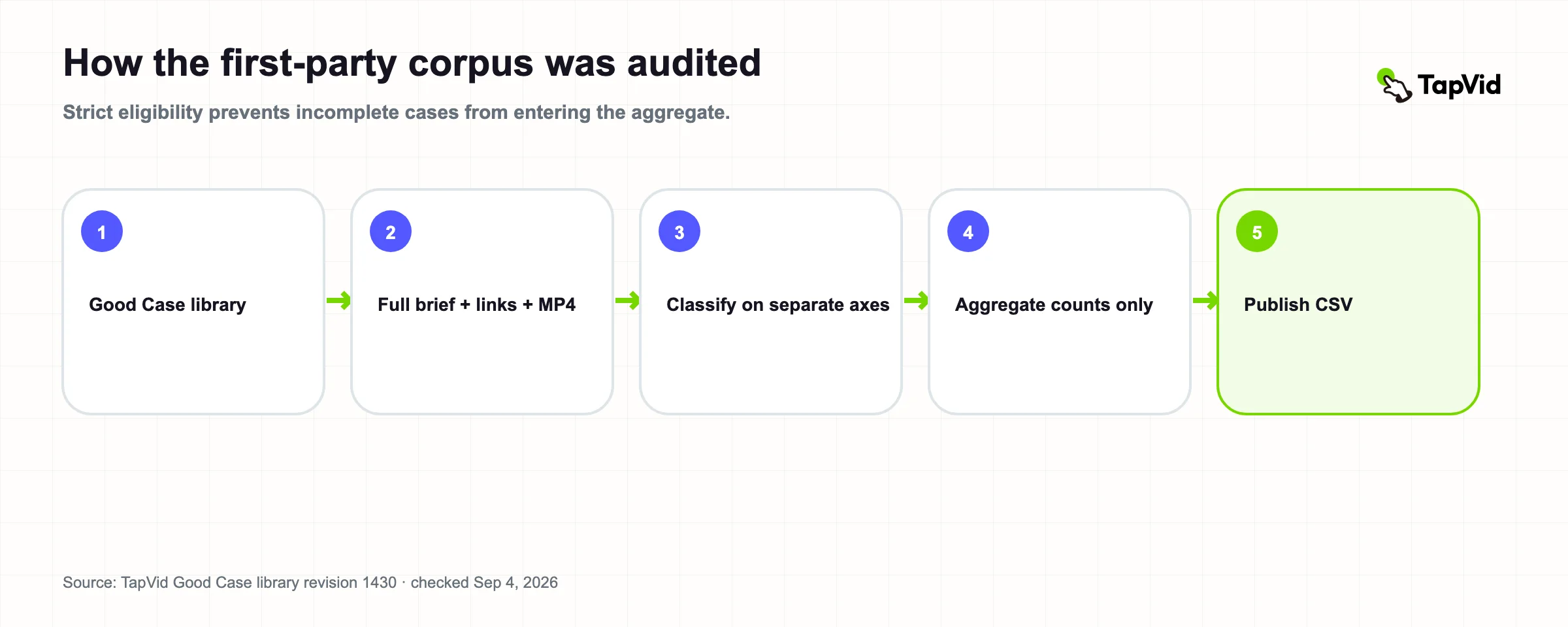
We queried TapVid's internal Good Case library on September 4, 2026. A record entered the strict corpus only when four fields were non-empty: full brief, generation link, public share link, and user-facing MP4 attachment. Sixty-four records met all four conditions.
The single-select business-use field was counted as mutually exclusive. Five eligible records had no value and are reported as Unclassified. The multi-select editorial field was counted as overlapping; one record can contribute to several tags. “Long Video” and “Long video” were normalized into one label. Aspect ratio was taken from the recorded production-ratio field.
The source table revision was 1430. Counts were calculated from the 64 filtered records. Percentages equal count divided by 64 and are rounded to one decimal place. The public CSV contains aggregates only.
09
Limitations
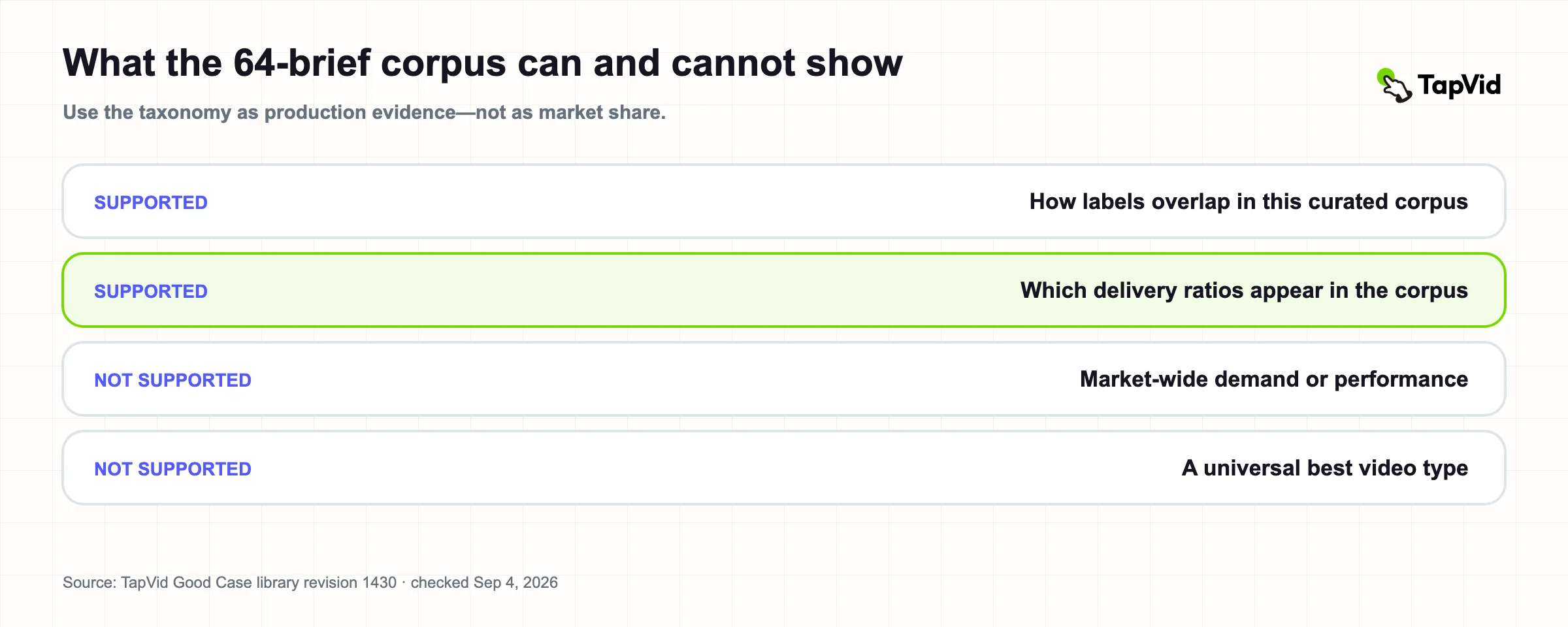
This is a convenience sample from a curated case library, not a random sample of TapVid users or the video industry. Inclusion requires a completed and preserved case, so abandoned ideas and failed or private projects are absent. Tags are curator-assigned and may reflect changing taxonomy practices. Some tags describe business purpose while others describe style, length, or production technique. Counts show what is represented in this library, not demand, effectiveness, revenue contribution, or causal preference.
No conclusion in this article should be used to claim that 51.6% of all business videos are explainers or that 16:9 outperforms vertical video. The defensible finding is narrower: hybrid labels are common in this production-ready corpus, so a one-field content taxonomy loses material instructions.
10
References and citation
Cite this research
Recommended citation (APA)
Chen, K. (2026, September 4). Types of video content 2026: Data from 64 production-ready briefs (Version 1.0). TapVid Research. https://tapvid.ai/blog/types-of-video-content
BibTeX
@techreport{chen2026typesOfVideoContent,
  author = {Kenneth Chen},
  title = {Types of Video Content 2026: Data From 64 Production-Ready Briefs},
  institution = {TapVid Research},
  year = {2026},
  month = {September},
  url = {https://tapvid.ai/blog/types-of-video-content},
  note = {Version 1.0}
}
Data and source register
- TapVid types of video content aggregate dataset (CSV)Checked 2026-09-04
Version 1.0
Download the versioned aggregate: Types of Video Content 2026 dataset.
11
Frequently asked questions
What are the main types of video content?
The useful answer depends on the axis. Business jobs include education, product launch, ecommerce, sales enablement, and news commentary. Communication forms include explainer, tutorial, demo, documentary, presenter, and cinematic video. Delivery formats include product-page, paid-social, YouTube, sales, and webinar video. A production brief often needs one label from each axis.
Can one video belong to several types?
Yes. In this dataset, editorial tags overlap by design. A product launch can also be an explainer, 3D animation, cinematic piece, and social video.
Does this research show which type performs best?
No. It describes a curated production corpus, not campaign performance. Choosing the best type requires a viewer goal, evidence requirement, channel, and outcome metric.
Why does the dataset not publish individual prompts?
The research question can be answered with aggregate counts. Publishing raw briefs or project identifiers would add privacy risk without making the conclusion more reliable.