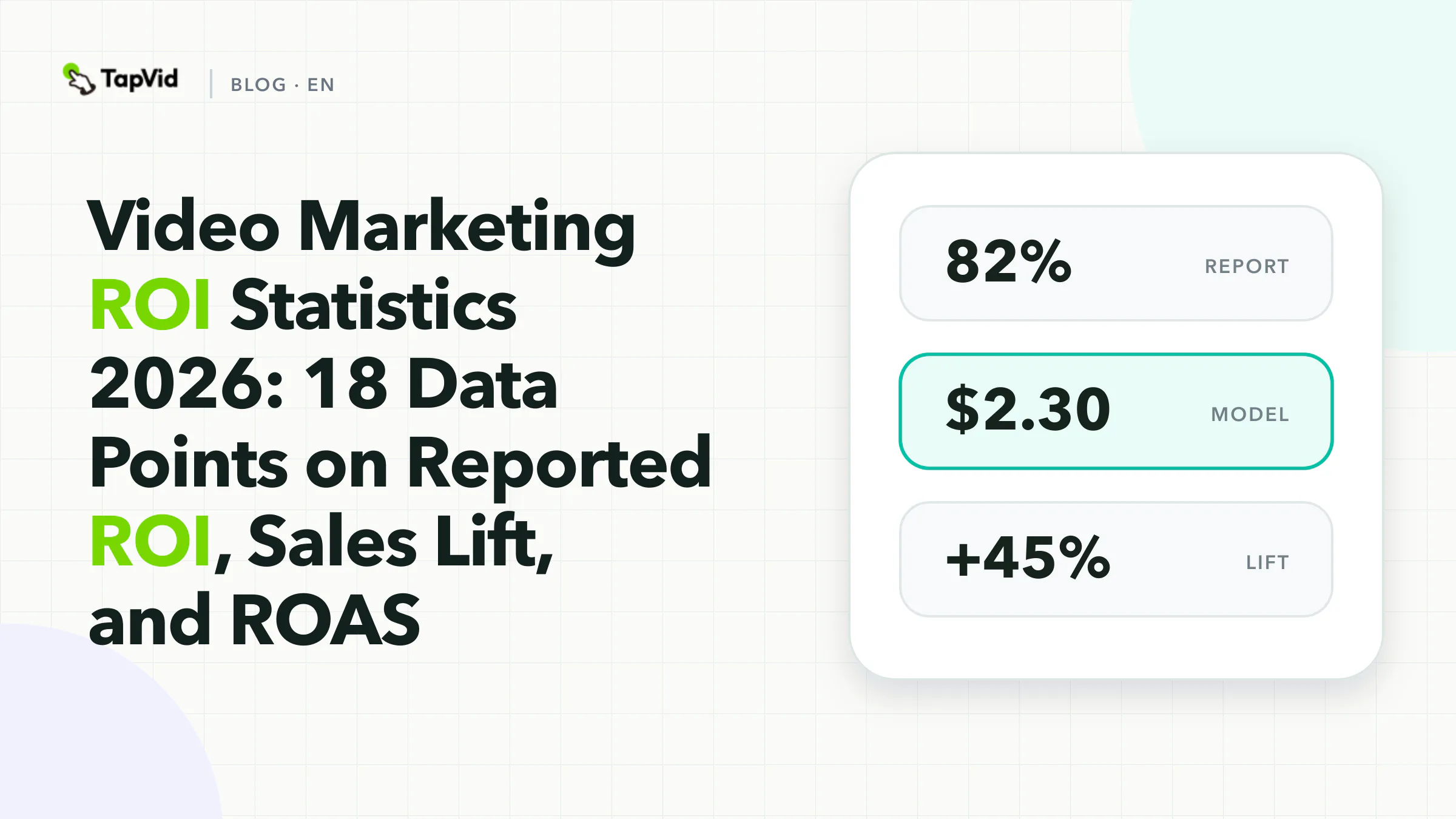

94% of 48 marketers surveyed by Referral Rock said they repurpose content, while the remaining 6% planned to start (Referral Rock). A larger Adobe Express survey found that 70% of 517 small business owners had repurposed content, and 54% named time savings as the main benefit (Adobe Express). The need is also growing: 62% of more than 1,600 marketers surveyed by Adobe in 2025 said content demand had increased at least fivefold in two years (Adobe). This content repurposing statistics roundup traces each figure to original or first-party research and states the sample limits. It shows what the evidence says about adoption, efficiency, formats, AI, and measurement, plus what the available surveys do not prove; the content and video statistics hub connects this evidence with the coordinated research set.
01
Key Takeaways
- 94% of 48 marketers said they repurpose content, according to Referral Rock's most recent available direct survey. The small sample makes this a useful signal, not a population estimate. (Referral Rock)
- 70% of 517 small business owners had repurposed content, according to Adobe Express's most recent available direct small-business study. (Adobe Express)
- 65% of Referral Rock respondents chose repurposing as the most cost-effective workflow, compared with creating new content or updating existing content. This was a perception survey, not a cost audit. (Referral Rock)
- 49% of Adobe Express respondents estimated an 11% to 25% engagement increase, while 35% estimated an 11% to 25% conversion increase. These are self-reported estimates without a control group. (Adobe Express)
- 48% of 894 B2B marketers said insufficient repurposing hindered content scaling in CMI and MarketingProfs' 2024 outlook research. (Content Marketing Institute)
- 37% of 980 B2B marketers called content repurposing a content creation challenge in the 2025 outlook. CMI said this was a new option, so it should not be treated as a direct trend comparison with the earlier scaling question. (Content Marketing Institute)
- One in six small business owners surveyed by Adobe Express had used AI to repurpose content. Among AI users, 56% reported saving one to five hours per week. (Adobe Express)
- 31% of Referral Rock respondents selected video as the most effective repurposing format, more than the 19% who selected social media posts or the 17% who selected conversion into a blog post. (Referral Rock)
- 69% of 894 B2B marketers planned to increase video investment for 2024, while Adobe's 2025 research found that 54% of more than 1,600 marketers saw short-form video demand growing fastest. These are separate studies and should not be combined into a trend line. (Content Marketing Institute, Adobe)
- Some popular repurposing multipliers are not reliably traceable. Ranking pages published claims such as 300% more reach and 60% to 80% less production time without an immediate original study link, so this roundup excludes them (CloudPresent, Digital Applied).
02
Content Repurposing Statistics: Study Quality, Scope, and Claim Limits
The direct evidence base is narrower than many statistics pages imply. Two studies directly survey repurposing behavior with visible sample information: Adobe Express surveyed 517 small business owners, and Referral Rock surveyed 48 marketers (Adobe Express, Referral Rock). Other useful studies describe content demand, B2B workflow pressure, channel use, or investment plans. Those contextual numbers help explain why teams repurpose, but they do not measure the effect of repurposing itself.
The strongest direct adoption figure in this dataset is Adobe Express's finding that 70% of 517 small business owners had repurposed content (Adobe Express). Referral Rock reported a higher 94%, but its 48-person sample is much smaller and its respondent geography is not disclosed (Referral Rock).
| Study | Sample and population | Directly measures repurposing? | Most useful figure | Main limit |
|---|---|---|---|---|
| Adobe Express, 2024 | 517 small business owners | Yes | 70% had repurposed content | Geography and field dates are not disclosed |
| Referral Rock, updated 2024 | 48 marketers | Yes | 94% repurposed content | Small sample and undisclosed geography |
| CMI and MarketingProfs, 2024 outlook | 894 B2B marketers from 1,080 global responses | Partly | 48% cited insufficient repurposing while scaling | Measures a challenge, not adoption or impact |
| CMI and MarketingProfs, 2025 outlook | 980 B2B marketers from 1,186 overall responses | Partly | 37% cited repurposing as a creation challenge | Mostly North America; fielded June 25 to August 16, 2024; new response option |
| Adobe content demand research, 2025 | More than 1,600 marketers | No | 62% saw demand grow at least 5x | Contextual demand data |
| Adobe B2B journeys report, 2025 | 615 B2B practitioners | No | 69% felt pressure to increase asset volume and variety | Contextual B2B pressure data |
Publication year is not the same as data year. The direct repurposing studies are from 2024 or earlier and are labeled as the most recent available direct evidence found during this review (Adobe Express, Referral Rock). A newer article that repeats an older survey does not turn it into 2026 data.
This roundup contains 42 atomic findings from six unique normalized direct research URLs across four source organizations, not 42 independent studies (CMI 2025, CMI 2024, Adobe Express, Adobe content demand, Adobe B2B, Referral Rock). CMI and MarketingProfs supply 14 of 42 findings (33.3%), Adobe Express 10 of 42 (23.8%), Adobe 10 of 42 (23.8%), and Referral Rock 8 of 42 (19.0%). The first three shares exceed the normal 20% concentration guideline. They remain because the retained pages are the strongest direct, intent-matched evidence found; adding weaker sources only to lower the percentages would make the evidence base worse.
The 2026 search results also include confident multipliers that are difficult to trace. Five ranking editorial pages were audited; only one linked the Referral Rock study and disclosed its 48-person sample (Intentsify). Several others named sources without claim-level links or presented strong multipliers without an accessible original study.
No verified source reviewed here supports a universal promise of 300% more reach, 60% to 80% less creation time, 3x to 5x greater reach, or double engagement from content repurposing. Those claims appeared without immediate primary evidence on the reviewed ranking pages and were excluded (CloudPresent, Digital Applied).
Use four checks before quoting a content repurposing number:
- Population: “marketers,” “small business owners,” and “B2B practitioners” are not interchangeable.
- Question: adoption, perceived benefit, measured lift, and future intention describe different things.
- Denominator: an AI-user subgroup should not be reported as the whole survey sample.
- Method: a respondent estimate is not the same as analytics data or a controlled test.
The defensible conclusion is modest: repurposing is widely used in the available surveys, teams associate it with time and cost advantages, and video is a prominent derivative format. The studies do not establish a universal ROI multiplier.
03
Adoption and Content Production Pressure
Adoption appears common in both direct surveys, but content teams still report that repurposing is hard to operationalize. That gap matters more than a single headline percentage. A team can repurpose occasionally while still lacking a repeatable system for choosing source assets, adapting them, approving them, and measuring the derivatives.
70% of 517 small business owners had repurposed content in Adobe Express's survey. Referral Rock found 94% adoption among 48 marketers, with the other 6% planning to begin. (Adobe Express, Referral Rock)
Adobe's 2025 studies show demand and review pressure in different populations: more than 1,600 marketers for demand, approvals, and review time, and 615 B2B practitioners for asset pressure. These are self-reported signals, not observed workflow measurements (Adobe content-demand research; Adobe B2B Journeys report).
| Metric | Value | Source |
|---|---|---|
| Small business owners who had repurposed content | 70% | Adobe Express, 517 respondents |
| Marketers who said they repurpose content | 94% | Referral Rock, 48 respondents |
| B2B marketers who cited insufficient repurposing while scaling | 48% | CMI 2024 outlook, 894 B2B respondents |
| B2B marketers who cited repurposing as a creation challenge | 37% | CMI 2025 outlook, 980 respondents |
| B2B practitioners pressured to increase asset number and variety | 69% | Adobe 2025 B2B report, 615 respondents |
| Marketers who saw content demand grow at least 2x in two years | 96% | Adobe 2025 research, more than 1,600 respondents |
| Marketers who saw content demand grow at least 5x in two years | 62% | Adobe 2025 research, more than 1,600 respondents |
| Marketers who expected demand to grow more than 5x by 2027 | 71% | Adobe 2025 research, more than 1,600 respondents |
The 2025 CMI and MarketingProfs study also found that 54% cited a lack of resources, 76% had a dedicated content marketing team or person, and 54% of respondents with dedicated resources had teams of two to five people. Those figures use the 980-person B2B article base drawn from 1,186 overall responses; respondents were mostly from North America, and fieldwork ran from June 25 through August 16, 2024 (Content Marketing Institute). In Adobe's separate 615-person B2B study, 43% faced pressure to increase content flow (Adobe).
The 48% and 37% CMI figures are not a year-over-year decline. The first asks about insufficient repurposing in content scaling; the second uses repurposing as a newly added content creation challenge (CMI 2024, CMI 2025). Different wording can produce different response rates.
04
Time, Cost, and Workflow Efficiency Statistics
The surveys consistently associate repurposing with efficiency, but most available numbers describe what respondents believe, not what time sheets or finance systems recorded. The evidence supports saying that teams perceive a time and cost advantage. It does not support a universal claim that repurposing cuts production time by a fixed percentage.
65% of Referral Rock's 48 respondents chose repurposing as the most cost-effective option among repurposing, updating, and creating new content. In the same study, 48% chose repurposing as best for the time required (Referral Rock).
Time, Cost, and Workflow Efficiency Statistics · Evidence chart
Open any row for its source, sample, evidence class, and limitation. Each panel uses its own declared scale.
Adobe Express
Small business owners who had repurposed content70%
- Source
- Adobe Express
- Year
- 2024
- Sample
- Adobe Express, 517 respondents
- Evidence class
- First-party survey
- Limitation
- Self-reported result; not an audited time or cost saving.
Small business owners who named time savings as the main benefit54%
- Source
- Adobe Express
- Year
- 2024
- Sample
- 517
- Evidence class
- First-party survey
- Limitation
- Self-reported result; not an audited time or cost saving.
Referral Rock
Marketers who said they repurpose content94%
- Source
- Referral Rock
- Year
- 2024
- Sample
- Referral Rock, 48 respondents
- Evidence class
- First-party survey
- Limitation
- Small sample and undisclosed geography.
Respondents who chose repurposing as most cost-effective65%
- Source
- Referral Rock
- Year
- 2024
- Sample
- 48
- Evidence class
- First-party survey
- Limitation
- Self-reported result; not an audited time or cost saving.
Respondents who chose repurposing as best for time spent48%
- Source
- Referral Rock
- Year
- 2024
- Sample
- 48
- Evidence class
- First-party survey
- Limitation
- Self-reported result; not an audited time or cost saving.
The direct surveys point in the same direction but are not one benchmark: Adobe Express surveyed 517 small business owners, while Referral Rock surveyed 48 marketers. Cost and time findings are respondent perceptions rather than audited savings (Adobe Express; Referral Rock).
| Metric | Value | Source |
|---|---|---|
| Respondents who chose repurposing as most cost-effective | 65% | Referral Rock |
| Respondents who chose repurposing as best for time spent | 48% | Referral Rock |
| Small business owners who named time savings as the main benefit | 54% | Adobe Express |
| Small business owners who said lack of time was the main challenge | 46% | Adobe Express |
| Marketers whose content passed through at least three approval stages | 89% | Adobe content demand research |
| Marketers spending more than 40% of their time on reviews and approvals | 58% | Adobe content demand research |
Broader workflow research points in the same direction. In Adobe's study of more than 1,600 marketers, 89% said content went through at least three approval stages, and 58% said more than 40% of time was spent on reviews and approvals (Adobe).
This is why the source asset and approval path matter. Reuse does not automatically save time if every derivative restarts fact checking, brand review, and legal review from zero.
05
Results, Engagement, and Measurement Statistics
Outcome data is the easiest category to overstate. The strongest direct figures are still self-reported estimates, and none of the direct studies uses a randomized control group. Treat them as planning signals and compare them with your own analytics.
49% of Adobe Express respondents reported an estimated 11% to 25% increase in engagement after repurposing content. Another 35% estimated an 11% to 25% conversion increase. Adobe did not present these as independently audited lifts, so the figures should not be described as guaranteed outcomes. (Adobe Express)
| Metric | Value | Source |
|---|---|---|
| Respondents who chose repurposing for the best results | 46% | Referral Rock |
| Small business owners estimating 11% to 25% higher engagement | 49% | Adobe Express |
| Small business owners estimating 11% to 25% higher conversion | 35% | Adobe Express |
| Small business owners measuring repurposing with website traffic | 62% | Adobe Express |
| Small business owners measuring repurposing with engagement metrics | 50% | Adobe Express |
| B2B marketers citing measurement as a content marketing challenge | 47% | CMI 2025 outlook |
| B2B marketers citing the need to create enough content as a challenge | 39% | CMI 2025 outlook |
Measurement practice is also uneven. Adobe Express found that 62% of small business owners used website traffic to evaluate repurposing and 50% used engagement metrics. More than one-third also considered conversion rates and revenue. (Adobe Express)
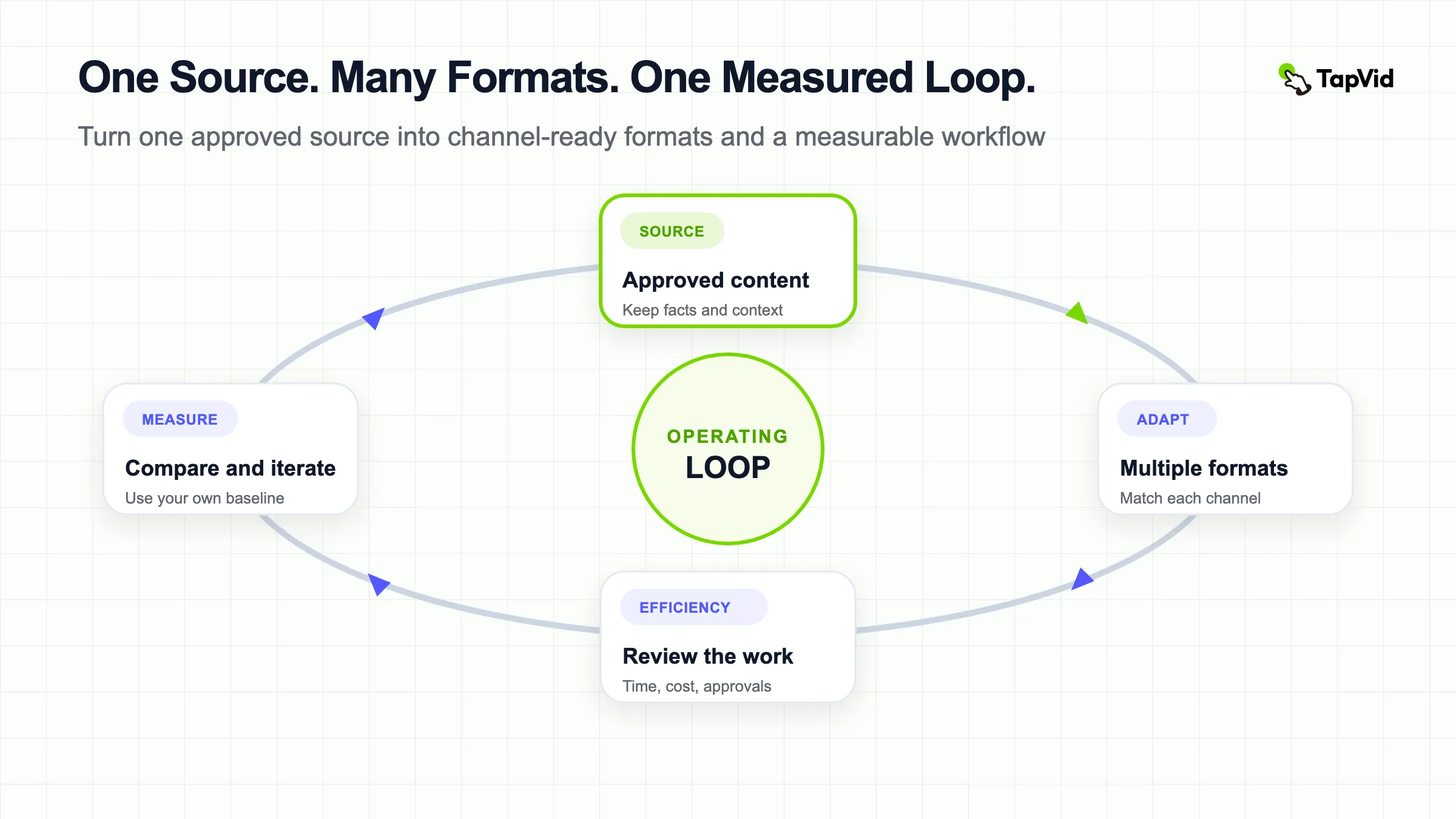
Industry statistics can justify testing a workflow, but a team should judge the workflow with its own baseline. Measure one source asset and its derivatives over a fixed period, then compare them with similar original assets published through the same channels. Use the video marketing ROI evidence to separate reported return from financial measurement, and the video marketing analytics measurement guide to define events and attribution before comparing outcomes.
Track accuracy as well as output. A derivative that changes a product number, model name, price, or legal phrase creates rework even if it ships quickly.
| Metric | Calculation | What it answers |
|---|---|---|
| Asset yield | Approved derivatives divided by source assets | How much usable output did each source produce? |
| Incremental production time | Total derivative hours divided by approved derivatives | Did reuse actually save team time? |
| Information error rate | Derivatives with incorrect facts divided by reviewed derivatives | Were numbers, labels, and claims preserved? |
| First-pass approval rate | Derivatives approved without revision divided by reviewed derivatives | Did the workflow reduce review work? |
| Normalized reach | Unique qualified viewers divided by publishing opportunities | Did the new format reach more of the intended audience? |
| Qualified outcome rate | Qualified actions divided by unique viewers | Did the derivative create useful business action? |
For a research article turned into video, preserve three things: the source chart or product asset should not be redrawn inaccurately, the approved statistic and qualification should stay unchanged, and narration should match the correct visual. TapVid is an Explainer Video Engine built around that correspondence between supplied assets, approved copy, and the resulting scenes. It can help turn a data-rich article into a publishable explainer, but the source owner still decides which claims are approved and which caveats must remain visible.
06
Format and Distribution Statistics
Repurposing is not the same as copying a post across channels. The available data points to format conversion, especially visual and video formats, while B2B research shows that teams distribute content through many channels at once.
31% of Referral Rock respondents selected video as the most effective repurposing method. Social media posts followed at 19%, and turning another medium into a blog post followed at 17%. (Referral Rock)
| Metric | Value | Source |
|---|---|---|
| Marketers who turned content into infographics | 69% | Referral Rock |
| Marketers who packaged content into videos and social posts | 65% | Referral Rock |
| Respondents selecting video as the most effective repurposing method | 31% | Referral Rock |
| B2B marketers using organic social platforms | 90% | CMI 2024 outlook |
| B2B marketers using blogs | 79% | CMI 2024 outlook |
| B2B marketers using email newsletters | 73% | CMI 2024 outlook |
| B2B marketers who planned to increase video investment | 69% | CMI 2024 outlook |
| Marketers seeing short-form video demand grow fastest | 54% | Adobe content demand research |
CMI's 894 B2B respondents used a wide distribution mix: 90% used organic social platforms, 79% blogs, and 73% email newsletters (Content Marketing Institute). Adobe's 2025 demand study adds current context: 54% said short-form video demand was growing fastest (Adobe).
For teams moving from articles to video, TapVid's blog-to-video workflow is the most relevant product path. The related content repurposing tools guide compares workflows by source format and output.
07
AI Content Repurposing Statistics
AI adoption in direct repurposing research was still early, while broader content teams were already using generative tools across their workflows. The denominator matters: figures about AI users are not percentages of every small business owner in the survey.
One in six of the 517 small business owners surveyed by Adobe Express had used AI to repurpose content. Among the AI-using subgroup, 56% said they saved one to five hours weekly (Adobe Express).
| Metric | Value | Source |
|---|---|---|
| Small business owners who had used AI for repurposing | 1 in 6 | Adobe Express |
| AI-using subgroup saving 1 to 5 hours per week | 56% | Adobe Express |
| B2B marketers using generative AI tools in the 2024 outlook | 72% | CMI 2024 outlook |
| B2B marketers using AI to generate graphics | 11% | CMI 2024 outlook |
| B2B marketers using AI to generate video | 5% | CMI 2024 outlook |
| B2B practitioners using generative AI for copy | 34% | Adobe 2025 B2B report, 615 respondents |
| B2B practitioners using generative AI for creative content | 30% | Adobe 2025 B2B report, 615 respondents |
These studies use different populations and questions, so they cannot form a clean adoption trend. They do show a practical tension: teams want speed, but repurposed derivatives still need accurate numbers, labels, product references, and source attribution.
08
Content Repurposing Statistics by the Numbers
| Metric | Value | Source |
|---|---|---|
| Marketers who said they repurpose content | 94% | Referral Rock, 48 marketers |
| Small business owners who had repurposed content | 70% | Adobe Express, 517 owners |
| Average interval before repurposing | 7.5 months | Adobe Express |
| Respondents choosing repurposing for best results | 46% | Referral Rock |
| Respondents choosing repurposing as most cost-effective | 65% | Referral Rock |
| Respondents choosing repurposing as best for time spent | 48% | Referral Rock |
| Small business owners naming time savings as the main benefit | 54% | Adobe Express |
| Small business owners estimating an 11% to 25% engagement lift | 49% | Adobe Express |
| Small business owners estimating an 11% to 25% conversion lift | 35% | Adobe Express |
| B2B marketers citing insufficient repurposing while scaling | 48% | CMI 2024 outlook |
| B2B marketers citing repurposing as a creation challenge | 37% | CMI 2025 outlook |
| Respondents selecting video as the most effective reuse format | 31% | Referral Rock |
| B2B marketers planning to increase video investment | 69% | CMI 2024 outlook |
| Marketers seeing short-form video demand grow fastest | 54% | Adobe 2025 research |
| Small business owners who had used AI for repurposing | 1 in 6 | Adobe Express |
| AI-using owners saving 1 to 5 hours weekly | 56% | Adobe Express |
| Marketers seeing content demand rise at least 5x in two years | 62% | Adobe 2025 research |
| B2B practitioners pressured to increase asset number and variety | 69% | Adobe 2025 B2B report |
09
Sources
- Adobe Express, How small businesses repurpose content, published January 4, 2024, survey of 517 small business owners.
- Referral Rock, 13 Genius Tips To Repurpose Content the Smart Way, updated April 30, 2024, survey of 48 marketers as disclosed by the original page and a ranking page that links to it.
- Content Marketing Institute and MarketingProfs, B2B Content Marketing Outlook for 2024, published October 18, 2023, 894 B2B respondents from 1,080 global responses collected in July 2023.
- Content Marketing Institute and MarketingProfs, B2B Content Marketing Outlook for 2025, published October 9, 2024, 1,186 overall responses; the article reports on 980 B2B respondents, mostly from North America, fielded June 25 through August 16, 2024.
- Adobe, Marketers expect content demand to grow more than 5x, published June 16, 2025, research among more than 1,600 marketers.
- Adobe, 2025 AI and Digital Trends in B2B Journeys, survey base of 615 B2B practitioners.