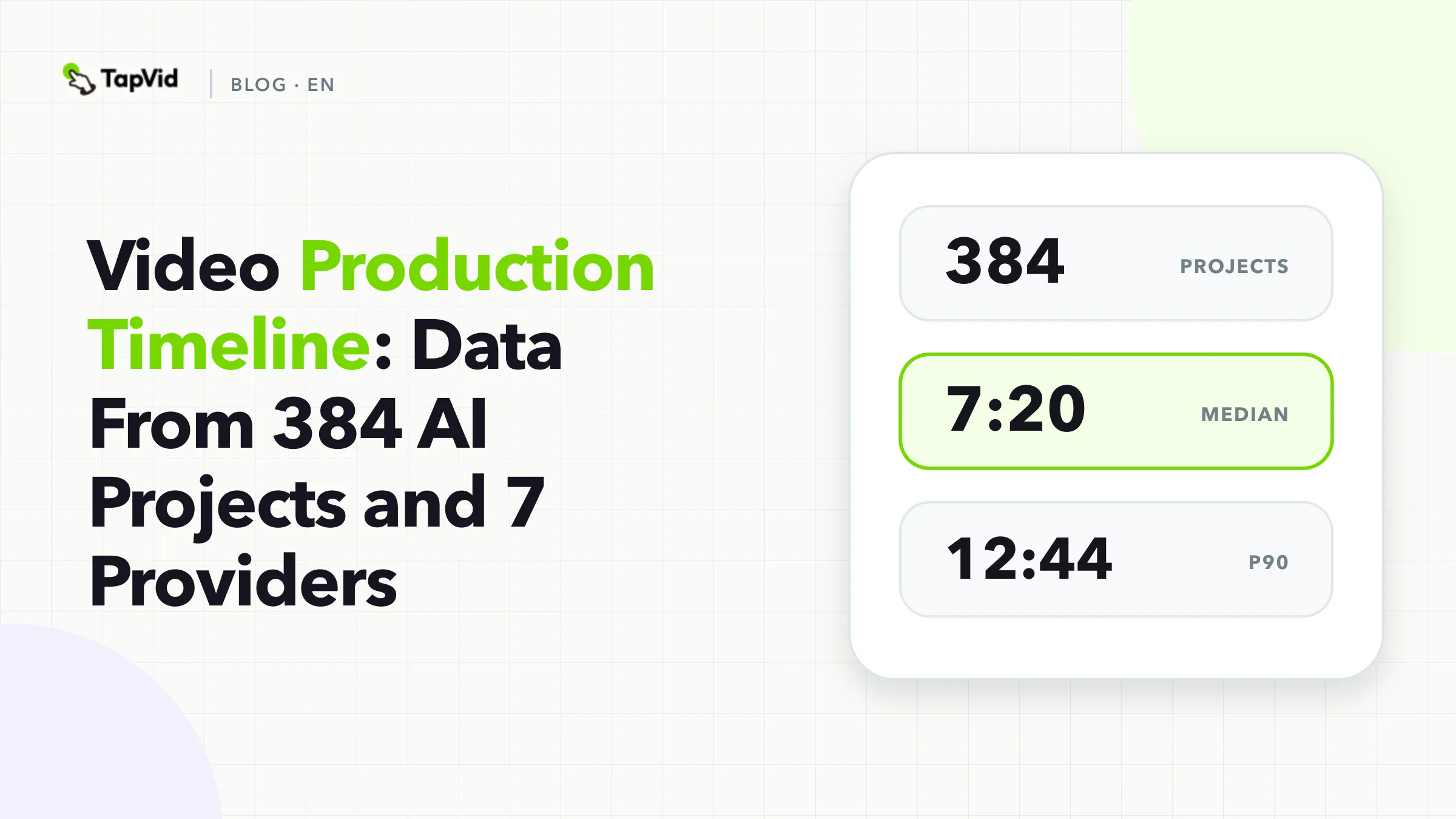
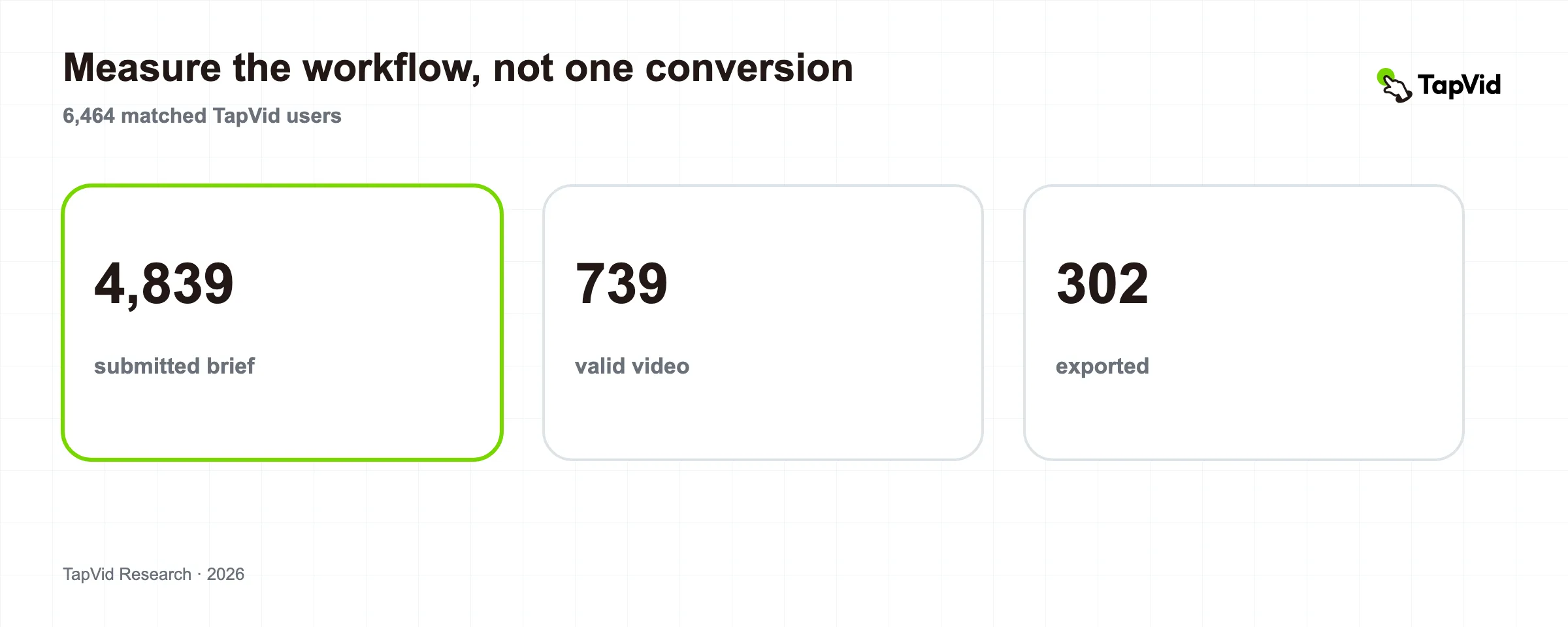

An AI video workflow is often drawn as a clean sequence: enter a prompt, approve a script, generate a video, and export. Real product behavior is less tidy. In a TapVid telemetry snapshot covering May 6 through August 31, 2026, 6,464 matched registered users submitted 4,839 briefs, 3,483 reached the script milestone, 739 received a valid video, and 302 exported. Those numbers do not measure creative quality, and they are not an industry average. They describe one product during a period when eligibility and payment rules changed. Their value is narrower and more useful: they show why an AI video workflow should be measured as a sequence of separately defined milestones, not as a single “generation success rate.”
01
Key findings from the AI video workflow data
Key findings from the AI video workflow data
6,464
Matched registered users
The analysis is user-based, not a count of clicks, renders, or files.
TapVid product telemetryChecked 2026-09-02
4,839
Users who submitted a brief
The initial request is not the main point of friction in this snapshot.
TapVid product telemetryChecked 2026-09-02
739
Users who received a valid video
This apparent gap combines product progression with eligibility and payment policy. It cannot be labeled model failure.
TapVid product telemetryChecked 2026-09-02
302
Users who exported
A valid render and a delivered file are different milestones.
TapVid product telemetryChecked 2026-09-02
| Value | Metric | Context | Source | Verified |
|---|---|---|---|---|
| 6,464 | Matched registered users | The analysis is user-based, not a count of clicks, renders, or files. | TapVid product telemetry | 2026-09-02 |
| 4,839 | Users who submitted a brief | The initial request is not the main point of friction in this snapshot. | TapVid product telemetry | 2026-09-02 |
| 3,483 | Users who completed a script | A free, reviewable intermediate artifact kept most submitters moving. | TapVid product telemetry | 2026-09-02 |
| 739 | Users who received a valid video | This apparent gap combines product progression with eligibility and payment policy. It cannot be labeled model failure. | TapVid product telemetry | 2026-09-02 |
| 692 | Users who watched for more than three seconds | Most users with a valid video opened or played enough of it to trigger the viewing event. | TapVid product telemetry | 2026-09-02 |
| 302 | Users who exported | A valid render and a delivered file are different milestones. | TapVid product telemetry | 2026-09-02 |
| 161 | Users who shared | Sharing is a separate behavior, not a weaker synonym for export. | TapVid product telemetry | 2026-09-02 |
The complete anonymous aggregate is available as a downloadable CSV. It includes the count, denominator, descriptive rate, date window, and interpretation warning for each row.
Source: TapVid product telemetry, May 6–August 31, 2026; verified September 2, 2026.
02
What this study measured
This analysis uses TapVid product telemetry generated on September 2, 2026. The requested range was May 1 through August 31, but the available person-facts window began on May 6 because the endpoint retains a maximum 120-day lookback. Backend data was current through September 1 and is generally available at T+1.
The registration source contained 6,746 external registrations in the window. Of these, 6,464 could be connected to the product event history used by the funnel, a 95.82% match rate. The missing 4.18% is disclosed rather than silently treated as inactivity.
Each published count represents unique users who reached a defined milestone:
- Matched signup: a backend registration connected to the person-level event record.
- Submitted brief: a user submitted a prompt, uploaded file, or URL and successfully created a project.
- Script completed: the workflow completed its script-stage milestone.
- Valid video: a completed generation action was linked to a non-empty file with a positive video duration.
- Watched: the user triggered the watched-for-more-than-three-seconds event.
- Exported: the user had a completed export job.
- Shared: the user had a project-share record.
The valid-video definition matters. In historical audits, counting an action with a completed status without checking the linked media file included a small number of empty or invalid outputs. Requiring a real path and positive duration makes the milestone stricter, although it still does not tell us whether the video met the user’s creative standard.
03
The workflow does not have one conversion rate
Calling the whole sequence a conversion funnel creates a tempting but incorrect story: everyone started with the same intent, every stage was available to everyone, and a missing later event means the preceding system failed. None of those assumptions is safe here.
The 74.86% signup-to-submission rate describes activation among matched registered users. The 71.98% submission-to-script rate describes progress through an intermediate planning stage. The 15.27% submission-to-valid-video rate occurs after a point affected by account eligibility, credits, payment rules, user decisions, generation failures, and the maturity of projects near the end of the observation window.
For that reason, this report does not call the difference between 3,483 script users and 739 valid-video users a model failure rate. A person who completed a free script but did not purchase generation access is observationally indistinguishable from several other paths in this aggregate. The data identifies where measurement must become more specific. It does not identify one universal cause.
The same rule applies after generation. Export, share, and viewing are different actions. A user may watch a draft and decide to revise it. A team may share a review link instead of exporting. An API workflow may retrieve an output without following the same web events. Combining these actions into one invented “delivery rate” would make the headline cleaner and the finding less true.
04
The strongest measured transition happens after a valid video exists
Of the 739 users linked to a valid video, 692 watched for more than three seconds. That is 93.64%. This is the clearest high-progression transition in the snapshot, but it still has a precise meaning: an event fired. It does not establish satisfaction, completion of the entire video, or approval for publication.
The export count is more commercially meaningful. A completed export job existed for 302 valid-video users, or 40.87%. Export is a stronger delivery signal than playback because the user asked the system to create a file. It still is not a quality rating. A user can export a draft, use a share link instead, or leave an approved video inside a collaborative workflow.
This distinction should change how product and content teams instrument AI video. “Generation completed” is a system event. “Exported” is a delivery action. “Approved,” “published,” and “performed well” would require additional evidence. Reporting the first as though it proves the last hides the work that happens between them.
For teams designing an asset-led process, the practical model is the same one described in TapVid’s video production workflow guide: lock the brief and source material, create a reviewable script and scene map, produce, review, and only then deliver. Telemetry should preserve those distinctions instead of collapsing them into a green success state.
05
Mobile and web diverged after submission, but the data cannot explain why
The matched cohort contained 3,601 mobile signups and 2,863 web signups. Their first transition looked similar: 75.56% of mobile signups and 73.98% of web signups submitted a brief, a difference of 1.58 percentage points.
The paths separated later. Among submitters, 69.57% of mobile users and 75.07% of web users reached script completion. Valid-video rates were 8.20% for mobile submitters and 24.36% for web submitters, a descriptive gap of 16.17 percentage points.
Source: TapVid product telemetry, May 6–August 31, 2026; verified September 2, 2026.
It would be easy to headline this as “desktop users are three times more likely to generate a video.” We do not make that claim. Device is mixed with traffic source, geography, project complexity, account eligibility, buyer intent, and the changing payment policy. A mobile visitor may be researching an idea while a desktop visitor arrives with approved product assets and budget. This aggregate cannot separate those explanations.
The defensible conclusion is operational: the mobile-to-video transition deserves a dedicated cohort analysis. A valid follow-up would use registration cohorts with the same observation period, separate pre- and post-policy windows, and control for acquisition source and project settings. Until then, the gap is a diagnostic signal, not evidence that screen size caused the result.
06
A better measurement model for an AI video workflow
This snapshot suggests six rules for teams instrumenting their own workflow.
1. Define the unit before publishing a rate
A user, project, generation action, scene, and export job are different units. One user can create several projects, one project can have several generation attempts, and one export can follow several edits. Put the unit in every table title and denominator.
2. Verify the media object, not only the status
A completed database row is not necessarily a playable video. Pair workflow status with file existence, non-zero size or duration, and deletion state. This prevents system bookkeeping from inflating the apparent output count.
3. Separate planning milestones from paid production
A script can be a useful product outcome even when a user never renders. If eligibility or credits begin after the script stage, compare like-for-like cohorts instead of treating every free-stage user as a failed renderer.
4. Give every cohort the same time to mature
Users who register on the last day of a report have less time to generate and export than users who register on the first day. A production benchmark should freeze a registration cohort and allow a fixed 14- or 30-day observation period before calculating later-stage rates.
5. Track accuracy and approval separately
A useful explainer workflow needs more than a valid file. Asset fidelity, information fidelity, and correct claim-to-asset correspondence should be reviewed before delivery. TapVid is an Explainer Video Engine built around turning supplied assets and written copy into a reviewable video, but this telemetry snapshot does not score those three accuracy layers. A future accuracy study needs field-level ground truth and human review.
6. Treat export as a behavior, not a verdict
Export is close to delivery, which makes it more meaningful than a render event. It does not prove that the file was published, approved by a client, or effective in-market. Those questions require approval logs, publishing events, or campaign outcome data.
07
What the 6,464-user benchmark can and cannot support
Source: TapVid AI video workflow benchmark data, verified September 2, 2026.
The study can support statements about observed TapVid workflow milestones during the stated window. For example: 4,839 of 6,464 matched registered users submitted a brief, and 302 of 739 users with a valid video had a completed export job.
It cannot support these broader claims:
- that 15.27% is the AI video industry’s generation rate;
- that every submitter was eligible to render;
- that a user without a valid video encountered a model failure;
- that export proves satisfaction or commercial use;
- that mobile devices caused a lower valid-video rate;
- that a valid video preserved every supplied product fact or source asset;
- that the observed rates will remain stable after pricing, product, or acquisition changes.
This is a convenience sample from one product, not a random sample of video creators. The cohort also spans policy changes and gives users near the end of the window less time to complete later actions. Those systematic limitations matter more than a narrow statistical confidence interval, so the report emphasizes definitions and bias rather than presenting sampling error as the main source of uncertainty.
08
What this means for teams buying or building AI video tools
Do not evaluate an AI video workflow from a single promise such as “generate in minutes.” Ask what exists before generation, what can be reviewed, what counts as a valid output, how revisions are recorded, and what the system considers delivery.
A professional content team should be able to answer five questions:
1. Can we inspect the supplied script, product images, UI captures, logos, numbers, and claims before rendering? 2. Can each script line be connected to the correct source asset? 3. Can we distinguish a technical generation success from an approved video? 4. Can one incorrect scene be revised without losing the rest of the reviewed work? 5. Can we measure export, approval, and publication as separate events?
TapVid’s product demo video workflow is designed for teams that already have product truth in approved copy and source assets. The goal is not to redraw those facts into something merely similar. It is to keep literal information reviewable while motion and layout make the explanation easier to follow.
09
Methodology and reproducibility notes
Study owner: TapVid. Observation window: May 6 to August 31, 2026. Data generated: September 2, 2026; backend facts current through September 1. Population: external users represented in the matched TapVid registration and product-event facts. Analysis unit: unique user reaching each milestone. Registration coverage: 6,464 of 6,746 backend registrations, or 95.82%. Suppression: no email, user ID, project ID, prompt, URL, filename, customer name, or other user-level record is published. Source classes: backend registration, project/action/video documents, export jobs and shares, plus client playback events. Backend facts are preferred for registration, valid-video, and export milestones. Known limitations: changing payment and eligibility rules, unequal cohort maturity, unmatched registrations, client-event loss, selection bias, device/channel confounding, and no direct quality or satisfaction measure.
The public CSV preserves the exact numerator and denominator behind every percentage. It is intended for citation and independent recalculation, not for identifying individual users.
10
References and citation
Cite this research
Recommended citation (APA)
Chen, K. (2026, September 2). AI video workflow benchmark: 6,464 users analyzed (Version 1.0). TapVid Research. https://tapvid.ai/blog/ai-video-workflow-benchmark
BibTeX
@techreport{chen2026aiVideoWorkflow,
  author = {Kenneth Chen},
  title = {AI Video Workflow Benchmark: 6,464 Users Analyzed},
  institution = {TapVid Research},
  year = {2026},
  month = {September},
  url = {https://tapvid.ai/blog/ai-video-workflow-benchmark},
  note = {Version 1.0}
}
Data and source register
- TapVid AI video workflow funnel dataset (CSV)Checked 2026-09-02
Version 1.0
This report keeps source links beside the claims they support. The methodology and limitations sections define the sample, measurement window, calculation rules, and boundaries. Use the canonical URL and version below when quoting the findings; use the linked public data files to reproduce or audit the calculations.
11
Frequently asked questions
What is an AI video workflow?
An AI video workflow is the ordered path from a source-backed brief through script, scenes, generation, review, and delivery. A useful workflow defines the artifact and pass condition at each stage instead of treating one generated clip as the entire production process.
Does this study show an AI video generation success rate?
No. It reports the share of matched TapVid users who reached a valid-video milestone. Eligibility, payment rules, project maturity, user choice, and technical outcomes are mixed in the aggregate, so the valid-video rate must not be labeled a model success or failure rate.
Why report the median or funnel stages instead of one average?
The stages answer different questions. Submission measures activation, script completion measures planning progress, valid video measures an output artifact, and export measures a delivery action. Combining them removes the information a team needs to improve the workflow.
Is export the same as user satisfaction?
No. Export is a strong behavioral signal that a user requested a deliverable file. Satisfaction would require a rating, approval decision, repeat use, interview, or another direct measure.
Can these numbers be used as industry benchmarks?
They can be cited as a TapVid product-telemetry benchmark for May through August 2026. They should not be presented as a random sample or industry average.