
TL;DR
Startup video production is a path choice under a moving product, a short runway, and a tiny internal bench. Compare agency, freelancer, in-house, and source-material-led work by time, cash, who can lock facts, and whether the next feature change can reuse the same source pack. Buy a studio day when the proof does not exist yet. Hire a freelancer when the brief is already written and you can QA the cut. Build in-house only when someone owns a weekly queue. Use a source-led workflow when the explanation already lives in a deck, a doc, or the live UI. Do not treat a polished master file as a finished system.
Startup video production is the work of turning a current, approved fact into a video someone can ship this week and correct after the product moves. That is a narrower job than startup marketing. Marketing decides whether the homepage needs a story, a demo, or a founder face. Production decides who makes the file, how long the queue is, and whether a renamed plan or a new screenshot forces a reshoot.
It is also a different page from small business video production, which routes local and SMB work by vendor queue, and from B2B video production, which decides whether a buying-committee asset should be an agency service. Use this page when the company is still changing weekly, the team is founder-heavy, and the expensive risk is a video that looks finished and is already wrong.
01
Four startup production paths compared
Start with the constraint you cannot move. For most early teams that constraint is not taste. It is how fast the product, the pricing page, or the pitch narrative will change after the first export. The table below is a production router. If one brief asks for a launch film, a demo, and a hiring clip, split the jobs before anyone books a day.
Production router. Not a TapVid workspace.
| Path | Best fit | Typical published cash band | Time and revision reality | Can the next product change reuse it? |
|---|---|---|---|---|
| Agency or studio | A one-time launch, pitch, or brand film whose proof needs a crew, a location, or a managed process | Levitate's seed band starts near $5,000 for one video. Knowlify places traditional agency work in high four to five figures, often 4 to 16 weeks | Weeks, not days. Included rounds are limited. Extra notes after picture lock are billed | Often no. The usual deliverable is a master file, not a living source pack |
| Freelancer | One defined task: an edit of footage you already have, a half-day interview, or a motion pass on a locked script | Knowlify's how-to page lists freelancer work from about $200, with quality that varies by person | Fast when they are free. The project pauses if they get sick or a larger client appears | Only if you keep the project file, raw clips, fonts, and a priced recut rule |
| In-house | A weekly queue you already staff: founder updates, changelog clips, recruiting snippets | Cash can look cheap. The real cost is founder hours and context switching | No vendor hold. Your calendar is the queue. Changes are free and slow | Yes, if the same person still owns the timeline next month |
| Source-material-led | Explainers, feature updates, onboarding, and sales clips whose proof already lives in a deck, a doc, screenshots, or approved copy | Tool or credit cost instead of a shoot day. Knowlify's self-serve and done-for-you rows sit from free to about $1,000 for one animated video | Review time, not a location hold. A scene change should not rebuild the whole cut | Yes, when names, numbers, and supplied visuals stay bound to scenes you can rerun |
Those cash and time bands are published vendor ranges, not TapVid quotes. Levitate Media's August 2026 guide puts a pre-seed or seed first video near $5,000, a Series A multi-asset day at $10,000 to $15,000, and a $30,000+ band on brand-positioning work. Bunker Hill Media publishes a lean founder or explainer band at $3,000 to $7,000 and a multi-video package at $7,000 to $12,000. Knowlify's 2026 how-to puts traditional agencies at high four to five figures and 4 to 16 weeks, freelancers from about $200, and a done-for-you animated path from about $1,000 in roughly 72 hours. Treat every number as a check against your own bids. A local day rate can sit outside these bands.
The column most founders skip is the last one. A cheap first video that cannot be opened again is an expensive second video.
02
The constraint is the next product change
Most wasted spend starts with a milestone sentence. Lemonlight's April 2026 founder note describes the pattern: the company hits a stage, someone says the brand needs a video, and a brief appears with no job behind it. The file looks fine. Then it sits on the homepage and does nothing, or worse, it states a feature that shipped last month and was renamed this week.
A startup is not an established brand repeating a known story. Lemonlight's useful distinction is that established brands use video to reinforce recognition they already have. Startups use video to introduce a product that still moves. That changes the production question. The first export is not the expensive event. The expensive event is the second export, when the UI, the price, or the ICP sentence has changed and the old master cannot absorb it.
Name three facts before anyone talks about cameras:
- The one viewer decision the video must produce. Book a demo. Open the waitlist. Understand the workflow well enough to stay on the page.
- The proof that must be inspectable on screen. A live UI state. A current metric the company will defend. A founder claim legal will keep.
- The change you already expect in the next 30 to 90 days. A new plan name. A replaced screenshot. A tighter ask in the deck.
If the proof does not exist yet, you need capture. If the proof already exists in a pitch deck, a landing page, a changelog, or a product doc, a crew day is optional. Knowlify's how-to is right on the raw-material point: the script can start from the deck or the site. The page then sells its own studio. Keep the first half and ignore the default winner. The decision is whether those source files stay attached to the finished video.
Bunker Hill's November guide is also right that many teams wait because the product is "not ready." Waiting for version 2.0 does not freeze the calendar. Sales calls, investor forwards, and hiring loops keep happening. The fix is not a cinematic film of an unfinished product. The fix is a path that can tell today's truth and accept next week's correction without another kickoff.
This page does not start with funding-stage format menus. Levitate's pre-seed / Series A / Series B stack is a useful planning heuristic, not a production contract. A seed company with a stable hardware SKU and a Series A SaaS team shipping weekly are not the same job, even if both are "startups." Change rate beats stage.
03
What each path actually buys you
An agency or studio sells a managed process. You buy discovery, a crew or an animation bench, logistics, and someone else to run the revision thread. Lemonlight argues that a long-term partner absorbs coordination and brings pattern recognition founders do not have yet. That is a real purchase when the film is high-stakes and the proof needs a shoot. It is a poor purchase when the video is a 45-second feature update and the product already exists in screenshots. Knowlify's options page lists mid-market custom shops in the $8,000 to $15,000 band with multi-week cycles, and premium launch films in the high five figures. Those vendors are not interchangeable with a source-led tool. They sell craft and time on a calendar you do not control.
A freelancer sells a defined task. You buy hours from one person: a shoot, an edit, a motion pass, a caption job. Knowlify is blunt that quality varies. You become the producer. If you cannot return a consolidated, timestamped note in the agreed window, you created the delay. If the freelancer disappears after delivery and you only have an MP4, you bought a poster.
In-house sells capacity you already pay for. The camera is the cheap part. The scarce part is a person who can lock a script, cut a first version, and come back next Tuesday. Bunker Hill's hybrid advice (professional hero plus iPhone social) only works if someone still owns both queues. If the "in-house team" is the CEO between fundraising meetings, you do not have in-house production. You have a leftover Saturday.
Source-material-led work sells a bound explanation. You start from approved copy and supplied visuals, keep names and numbers literal, review the scene plan before export, and change only the scene that moved. That is the path TapVid's PPT-to-video page describes for decks: approved wording stays verbatim, supplied screenshots and product images stay matched to the right scene, and a line or asset change reruns the affected scene. TapVid is one implementation of that path. It is not a filming studio and it is not an agency. If the proof is a warehouse, a customer face, or a machine motion you never captured, this path cannot invent it.
Do not collapse these four into "DIY versus professional." That binary hides the editability question. A professional agency can still hand you a closed master. A scrappy source-led cut can still be more accurate than a $15,000 film that paraphrased the pricing page.
04
Choose by change rate, proof, and fact owners
Use three filters. If two filters conflict, split the project.
Split the brief before anyone books a day.
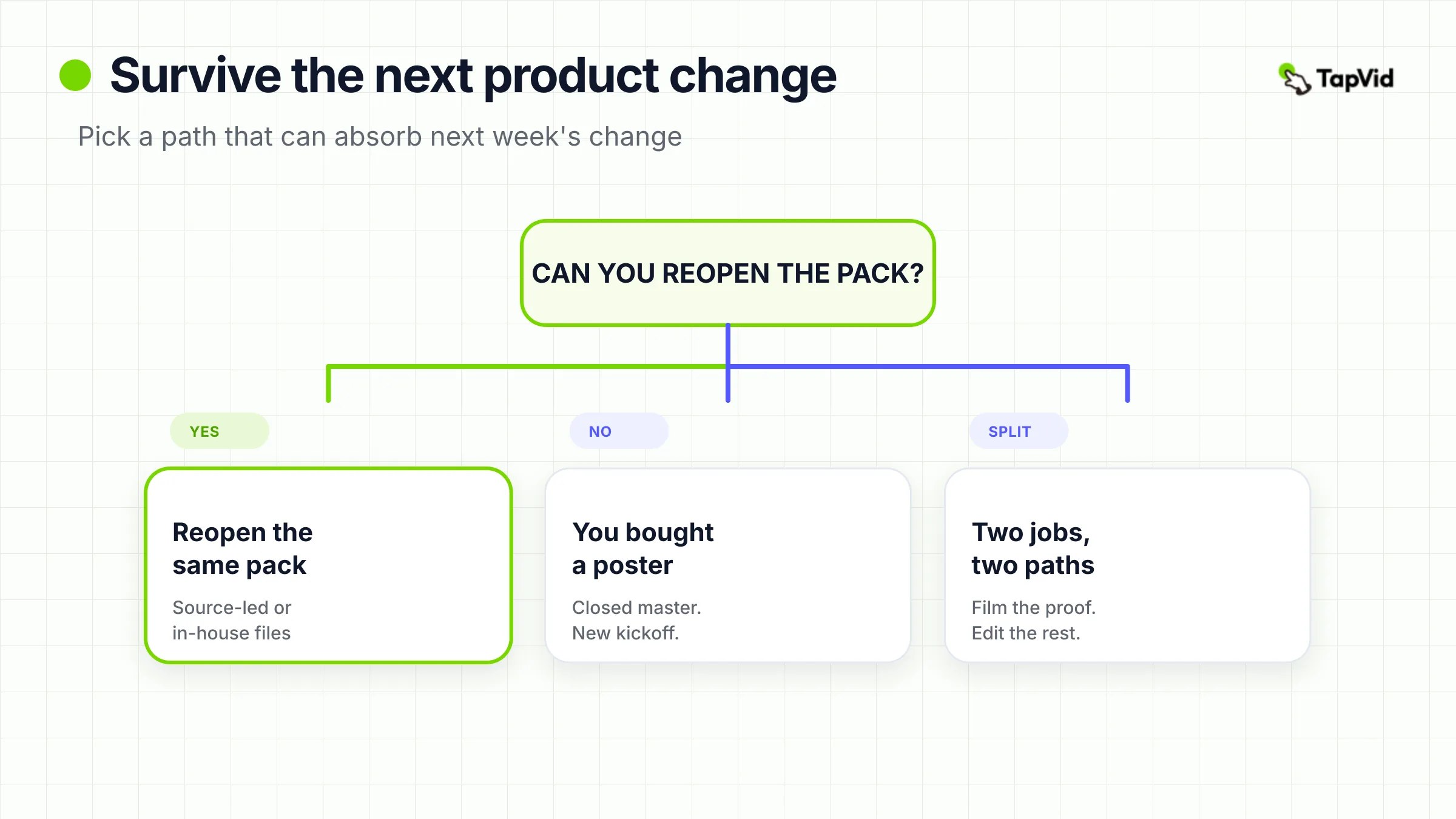
Change rate. If the UI, the offer, or the narrative will move inside one quarter, prefer a path that can open the same source pack again. Agency launch films and one-off freelance masters belong on stories that should last. Source-led and a well-instrumented in-house timeline belong on stories that will not.
Proof type. Live capture is mandatory when the viewer must see a place, a person, or a physical process that does not exist in files. Lemonlight is right that live action can build credibility faster for physical products. Screen recordings and annotated graphics often outperform cinematic production for early software, which Bunker Hill also notes. If the proof is already in the product and the docs, filming the office to "look real" does not make the claim truer.
Fact owners. Someone has to approve names, numbers, legal lines, and the screenshot that proves them. If that person is not named in the brief, you are buying a meeting that happens inside someone else's timeline. Put the owner and the review window in the quote. If the founder who can say yes is on the road during review week, do not book the shoot.
A useful finish line is an approved master, the named source of truth used to check it, and a written rule for the next change. A weak finish line is "make it look like a real company." The second one has no stop condition, so it burns revision rounds.
Levitate's "never cut script and strategy" advice is correct and incomplete. Script quality matters. So does whether the script is attached to files you can still edit. A perfect script locked inside a closed After Effects package is still a one-shot buy.
05
When a studio or agency is the right spend
Buy a studio or agency when the job is a flagship moment and the proof needs production you cannot staff. A Product Hunt launch film, an on-location founder story, a customer who will only sit for a directed interview, or a hardware reveal that needs lighting and hands on the object are all capture jobs. Knowlify's comparison keeps premium shops such as Sandwich for that once-a-year cinematic film and says everyday operational video should not wait 8 to 16 weeks. Use that split. Do not hire the flagship vendor for the weekly changelog.
A flagship film still needs a recut rule.
Ask for a process you can inspect, not a mood board you can admire:
- What source pack they need before day one, in writing.
- How many consolidated revision rounds are included, and the hourly rate after that.
- Whether vertical and square cuts are in the fee.
- Who owns raw footage, project files, fonts, and licensed music after delivery.
- The price of a 15-second claim change 60 days later.
- Whether that change is a recut or a reshoot.
Lemonlight's partner pitch is that internal coordination pulls founders away from the company. That is true for a multi-day shoot. It is not an argument for outsourcing a UI walkthrough that product already recorded. If the agency asks to "punch up" a metric, a plan name, or a legal line, that is a risk, not a creative upgrade.
Agency work also fails in a specific startup way: the film is approved against last month's deck, then the raise narrative changes, and the only editable output is a 1920-pixel master. If you still want the film, buy the recut rule before the shoot. If you cannot afford the recut rule, you cannot afford the film.
For a brand-system problem rather than a startup path problem, use brand video production. That page owns repeatable brand-film delivery. This page owns whether a young company should buy that system yet.
06
When a freelancer is enough, and what you still own
A freelancer is the right buy when the brief is already true and the missing piece is craft. You have the script, the screenshots, or the interview clips. You need someone who can cut, caption, grade, or animate. You do not need a strategy department.
Write the job as a task, not a vibe. "Make us look funded" is not a brief. "Cut a 60-second homepage explainer from this deck, keep these six lines verbatim, and return an editable project plus an MP4" is a brief. Knowlify's freelancer row is useful as a warning, not as a price target. The $200 listing is a floor for inconsistent marketplace work. A specialist motion pass can sit much higher and still be cheaper than an agency kickoff.
You still own four things the invoice will not mention:
A freelancer sells a task, not a bench.
- The source of truth. If two founders send conflicting notes, the freelancer will implement the louder one.
- The review clock. A two-day review window that you miss becomes a two-week slip.
- The file handover. Ask for the timeline, the font list, and the music license in the same delivery as the MP4.
- Brand continuity across videos. One freelancer can match one brief. Three freelancers across three months will drift unless you keep a written visual rule.
Marketplace risk is not moral. It is operational. The person who cut your seed demo may be booked the week you rename the product. If that risk is unacceptable, you need either a bench (agency) or a source pack you can reopen without that person (source-led or a documented in-house project).
Do not hire a freelancer to invent the company story. That is how you get a handsome video that no one on the team can defend on a sales call.
07
When in-house means a queue, not a camera
In-house production is a staffing decision. Phones, lights, and CapCut do not create a path. A named owner, a weekly slot, and a file convention do.
Bunker Hill's mix of professional hero plus self-shot social is the right shape only after that owner exists. Founder iPhone clips are fine for a ship announcement. They are a weak homepage explainer if the same founder also has to raise, sell, and debug. Levitate's DIY advice (founder updates, early messaging tests) belongs on low-stakes surfaces. Do not put an unreviewed phone demo on the pricing page.
Stand up in-house only when you can answer yes to all four:
A phone is not a path.
- Someone can spend a protected block every week, not leftover hours.
- That person can reject a claim that is not in the source pack.
- Raw files live in a shared drive with names a stranger can understand.
- The next video uses the same aspect, caption style, and end card unless a written exception says otherwise.
If any answer is no, in-house is a hobby. A hobby is allowed. It is not a production plan. Paying a freelancer for one locked task is usually cheaper than pretending the CEO is an editor.
In-house also fails when the team films new B-roll for every feature because nobody saved the last timeline. The cost is not the SD card. The cost is the lost Tuesday.
08
When source-led production is the cheaper second video
Use this path when the explanation already exists on paper or in the product. The job is to keep names, numbers, and supplied visuals intact, then make the story watchable. The job is not to invent a day in the life of the warehouse.
Reviewable explanation. Not a filmed brand spot.
Knowlify's how-to is the closest public benchmark on this point: pull the core lines from the deck, the landing page, or the product docs, then tighten them into a 30 to 90 second script. Keep that method. Do not accept the page's conclusion that one vendor is the default. The production question is whether those source files remain attached after export.
A source-led workflow is the better second-video buy when:
- The product is software, a workflow, or a documented offer.
- The claims already exist in a deck, a help center, a changelog, or approved ad copy.
- Someone can review a scene list before render.
- Next month's change is a line, a figure, or a screenshot, not a new physical proof.
It is the wrong buy when the viewer must see a factory, a customer face you did not record, or a motion the files do not contain. Those jobs stay on the capture paths above. Product video production owns claim-to-scene accuracy for a single product. This page only decides whether a startup should open that workflow instead of hiring a crew.
TapVid can carry the source-led path when the input is an approved deck, a PDF, a URL, or supplied product assets. The official PPT to video page states three constraints that matter here: approved copy stays verbatim, supplied assets are matched to the right scene rather than redrawn, and a later line or image change reruns only the affected scene while the rest stays in place. Storyboard, script, and narration stay visible before render. That is a reviewable explanation, not a filmed brand spot. Human review is still required. It is not a zero-error claim, and it does not replace a studio when the proof is missing.
First-hand RESULT from one Harborline sample run. The workspace still shows the chat, the scene strip, and the locked $49 price on Chapter 02. Not a studio shoot.
If you need the composer rather than this decision page, start from an approved deck on PPT to video or from a document or URL on the explainer generator. Do not brief TapVid as if it were the agency in the first column.
09
Lock a source pack before anyone starts
The source pack is the production contract. Write it once. Reuse it on every path. Agencies, freelancers, in-house editors, and source-led tools all fail in the same way when the pack is missing: they invent the missing fact, then you pay to remove it.
A usable startup pack is small and strict:
The pack is the contract.
- One viewer decision and one next step.
- The words that cannot be paraphrased: product names, prices, plan names, legal lines, the ask.
- The visuals that cannot be invented: current screenshots, product images, diagrams, logos, any supplied footage.
- The date those files were true.
- A named reviewer and a review window measured in hours, not "when you can."
- The change you already expect next, so the path is chosen against that change.
If a vendor or a tool asks for "just a vibe and a logo," they are offering to guess. Guessing is expensive on a homepage.
For capture jobs, add the shot list that Bunker Hill and Levitate both recommend: horizontal and vertical frames, extra B-roll, and soundbites that can live in more than one cut. That advice is sound for a day you should have booked. It does not justify booking a day to explain a settings page you can screenshot in ten minutes.
For source-led jobs, add the scene-to-claim map. Each claim in the script points at one file. If a claim has no file, delete the claim or go get the file. Do not ask the renderer to illustrate a metric you will not publish in text.
Keep rights with the pack. Faces, music, and customer quotes need a usage window that matches the channels. A seed demo that later runs as a paid ad with an expired music license is not a marketing win.
10
When a polished cut still cannot ship
The failures that look creative are usually factual.
Looks finished is not the same as still true.
A video that paraphrases the pricing page will be wrong the next time finance changes a number. A video that redraws the UI will be wrong the next time design ships. A video that uses last quarter's traction slide will be wrong the next time you update the deck. In each case the timeline looks professional and the company cannot defend the frame on a sales call.
Lemonlight's warning about AI volume is useful if you read it as a QA warning, not as a ban. High-frequency social tests can tolerate a generic look. The homepage, the investor forward, and the paid campaign cannot tolerate an invented spec. Use generation for pacing and structure. Do not use it to create the proof.
Levitate's common-mistake list (overproducing too early, no distribution plan, leading with features, skipping pre-production) is true and still incomplete. The startup-specific miss is shipping a closed master of a moving product. Distribution cannot save a file you cannot correct.
Stop before export if any of these are true:
- Two people still disagree on the one viewer decision.
- A number, a name, or a screenshot is newer in Notion than in the timeline.
- You cannot name who owns the project file.
- The next expected product change has no priced path.
- Legal has not seen the lines that sound like promises.
If the work is already in an editor and you need stage-by-stage craft, the editing workflow is the downstream page. Do not open a timeline to decide whether you should have hired a crew.
Startup video production pays off when the second video is cheaper than the first because the source pack survived. If the second video requires a new kickoff, you bought a poster.
11
Frequently asked questions
What is startup video production?
Startup video production is how an early company turns a current, approved fact into a shippable video under limited time, cash, and internal staff. It includes the path (agency, freelancer, in-house, or source-led), the source pack, and the rule for the next product change. It is not a content calendar and it is not a request to look like a later-stage brand.
What should a startup's first video be?
Make the video that removes the most expensive confusion this month. Lemonlight frames the usual fork as explainer versus founder story: clarity versus trust. That fork is useful only after you name the viewer. A homepage visitor needs the workflow. An investor forward may need the founder and the current traction slide. A sales loop needs the product as it exists today. Do not shoot a brand film to postpone that choice.
How much does startup video production cost?
Published bands vary by path. Levitate's August 2026 page cites about $5,000 for an early single video and $10,000 to $15,000 for a Series A multi-asset day. Bunker Hill publishes $3,000 to $7,000 for a lean founder or explainer and $7,000 to $12,000 for a multi-video package. Knowlify puts everyday animated work from free to about $2,000 and traditional agency films in high four to five figures. Ask for the recut price, not only the first-cut price. A low first invoice with no project file is often the more expensive path.
Should a startup hire an agency, a freelancer, or do it in-house?
Hire an agency when the proof needs a crew and the story should last. Hire a freelancer when the brief is locked and you can QA. Build in-house only when a person owns a weekly queue and a file convention. Use source-led work when the explanation already lives in a deck, a doc, or the UI. The wrong default is "we are a startup, so we must look expensive."
Can AI make a startup video?
AI can draft structure, narration, and motion from files you already trust. Knowlify and Lemonlight both treat AI as a speed tool, not as a substitute for judgment on high-stakes brand moments. The usable rule is narrower: if the claim must stay literal, the tool must keep supplied words and visuals inspectable and let you change one scene without rebuilding the rest. If the proof is missing, AI cannot ethically invent it.
How long should a startup video be?
Keep most explainers and launch clips between 30 and 90 seconds, which is the band Knowlify and Bunker Hill both use. A demo that walks a real workflow can run two to three minutes if every stretch of runtime still earns its place. Length is not a strategy. A two-minute film with three jobs is still three unwritten briefs.
When is TapVid the wrong tool for this?
TapVid is the wrong tool when you need a filmed location, a customer face you did not record, or a physical process that does not exist in the source pack. It is also the wrong briefing if you want an agency to invent the company story. Use it when an approved deck, document, URL, or asset set already contains the explanation and you need a reviewable cut you can correct by scene. See PPT to video.