
TL;DR
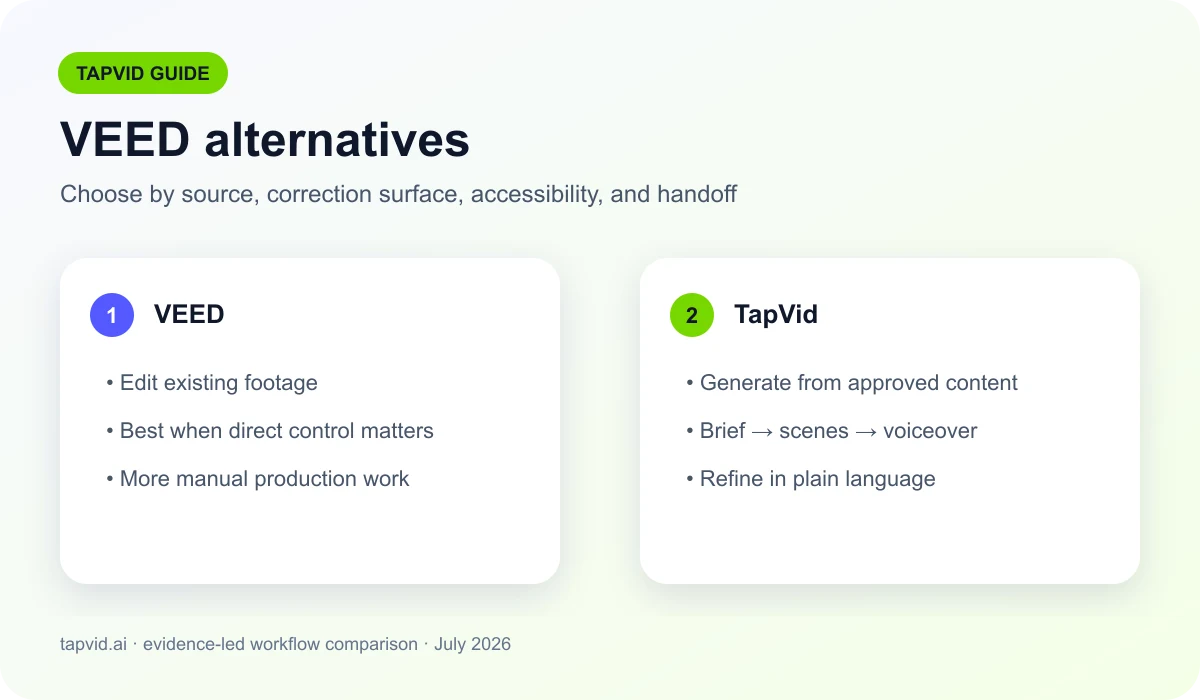
Choose a VEED alternative by matching the source material, correction workflow, accessibility requirements, and handoff cost. TapVid is designed for turning approved content into a structured explainer.
Best VEED Alternatives for Explainer Videos (2026). VEED is a browser video editor: you upload clips and cut, caption, and arrange them on a timeline. TapVid is an Explainer Video Engine: it turns your existing content, an article, PDF, script, or link, into a polished explainer video in minutes, with no timeline and no editing skills. When you want to create an explainer from your content instead of editing footage, TapVid is the closer fit. Start free.
01
Best VEED Alternatives for Explainer Videos (2026): The short answer
VEED is a capable browser video editor. You upload or record footage, then cut it, add subtitles, and arrange clips on a timeline. That is a good fit for editing existing footage, adding captions, and repurposing a long video into short clips. It is still an editor, though, which means the work and the skill are on you.
VEED's current official watermark policy says free exports include a VEED watermark and a paid plan is required to remove it. If your goal is to create an explainer video from an article, a PDF, or a script rather than to edit clips you already have, an editor asks you to build the video yourself.
TapVid takes a different path. It is an Explainer Video Engine: you paste your existing content, a prompt, an article, a PDF, or a link, and it structures and animates it into a polished explainer video, with voiceover and music, in minutes. No timeline, no editing, no motion-graphics work by hand.
This guide separates product facts from independent evidence. Product capabilities are checked against current official documentation, while workflow recommendations also use research and accessibility standards. That matters because a vendor feature list can describe what buttons exist, but it cannot prove that a video will be understood, accessible, or economical for your team.
Video is already a mainstream business format, so the decision is no longer whether to use it. In Wyzowl’s late-2025 survey of 266 respondents, 91% of businesses said they use video as a marketing tool. The useful question is which production model removes the actual bottleneck: generating a structured first draft, editing existing footage, or controlling every movement manually.
02
How to choose the right replacement
VEED is a browser video editor: you upload clips and cut, caption, and arrange them on a timeline. TapVid is an Explainer Video Engine: it turns your existing content, an article, PDF, script, or link, into a polished explainer video in minutes, with no timeline and no editing skills. When you want to create an explainer from your content instead of editing footage, TapVid is the closer fit. Start free.
Start with the input you already own. If the truth source is an article, PDF, product page, or approved script, choose a system that can preserve that structure before it generates scenes. If the raw material is recorded footage, choose an editor. If the deliverable requires frame-level compositing, expressions, or hand-tuned motion, choose a professional motion tool.
Then identify the person who must make the final correction. A marketer can usually revise a prompt, outline, or scene description. An editor can trim clips and repair captions. A motion designer can work with keyframes and layers. Buying the most capable tool is wasteful when the production owner cannot comfortably use its correction surface.
Finally, compare total correction time rather than demo speed. Measure time to a usable first draft, time to fix factual errors, time to match the brand, caption review, export restrictions, and the time another teammate needs to take over. The fastest generation is not the fastest workflow when cleanup dominates the project.
03
A practical content-to-video workflow
Paste your content. Drop a prompt, article, PDF, or link. No footage to upload and no timeline to edit.
TapVid builds the explainer. It structures your content into scenes and animates each one as motion graphics, with voiceover and music.
Refine and export. Adjust by describing changes in plain language, then export an MP4, watermark-free on paid plans.
04
The replacement workflow I tested
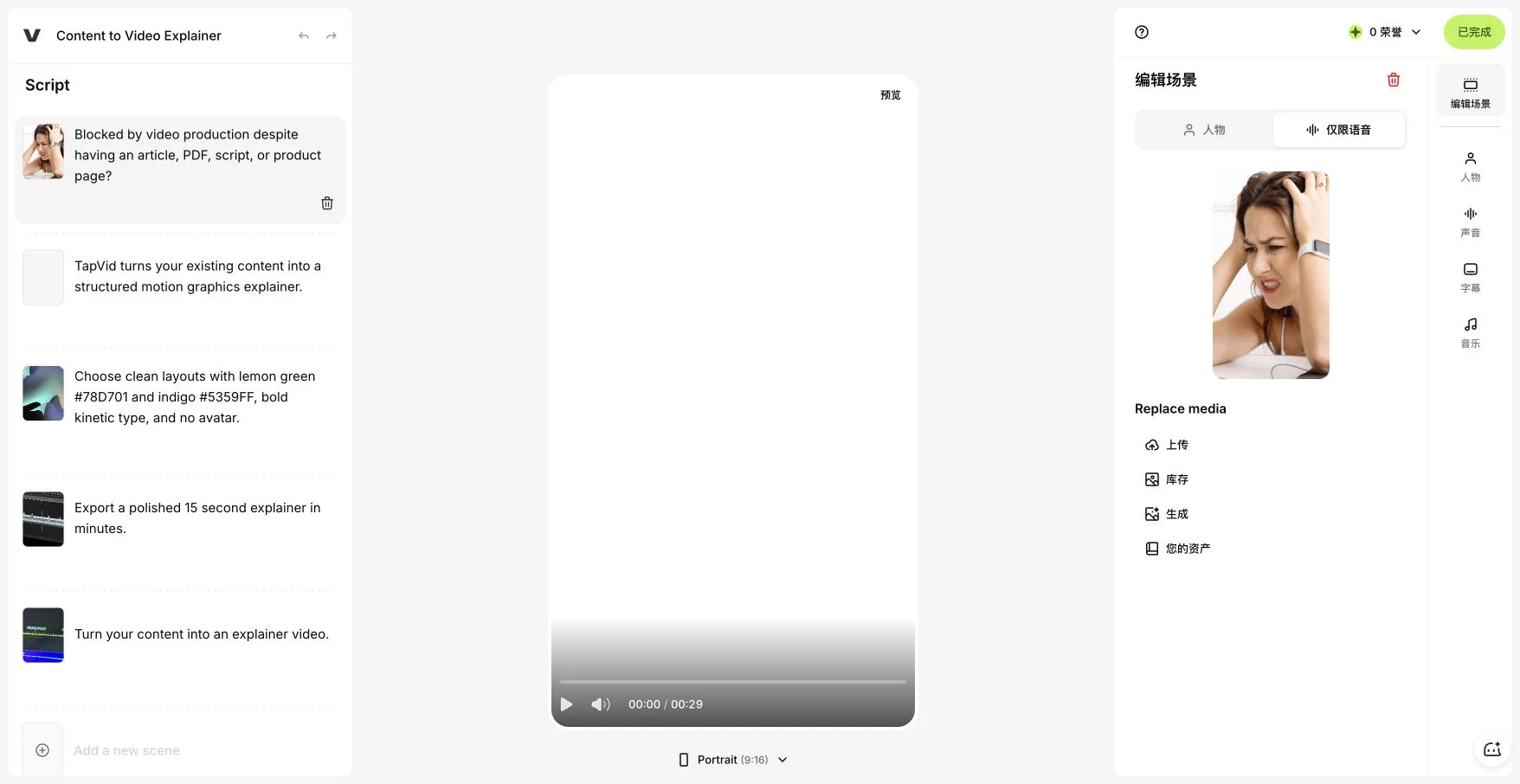
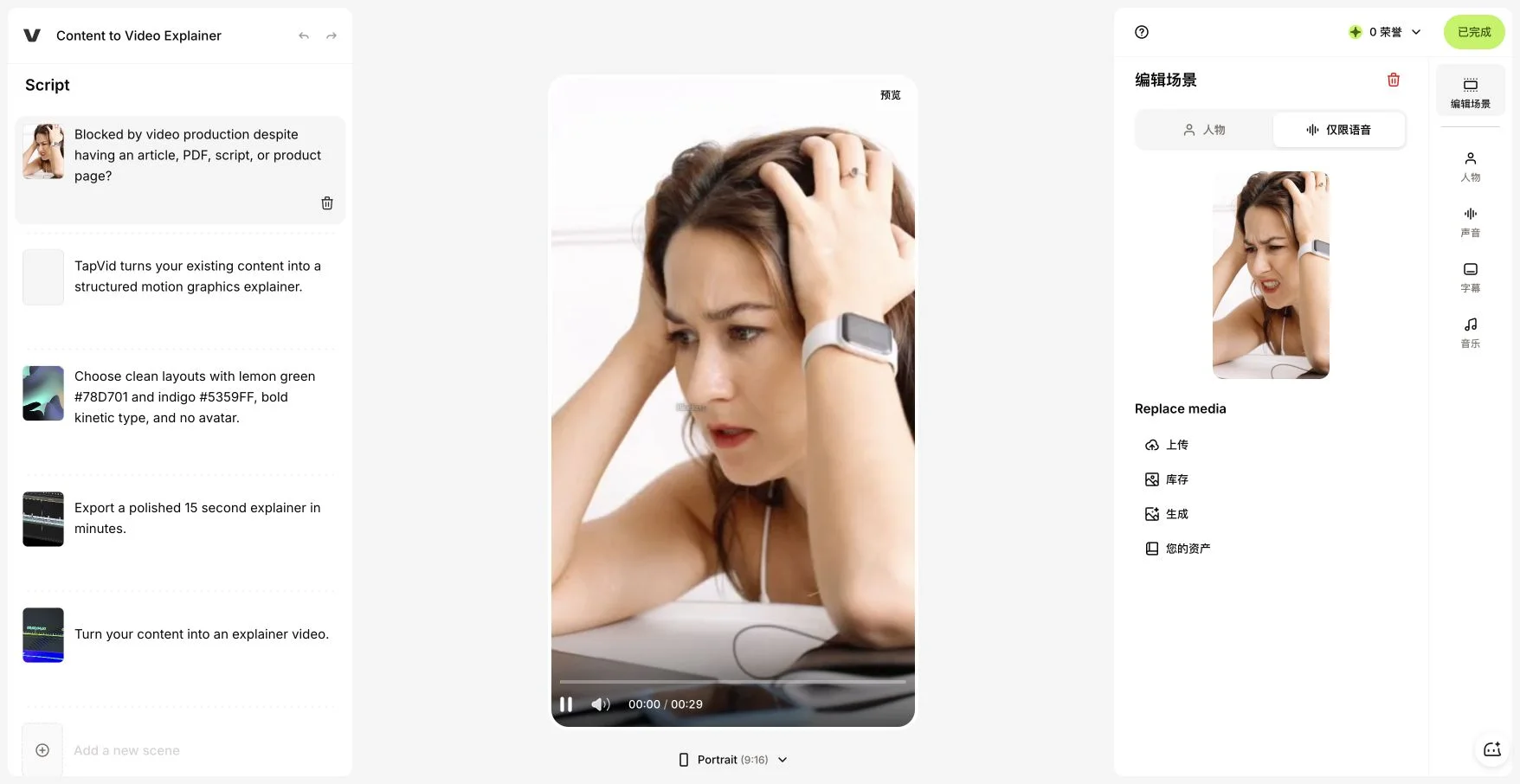
I reopened the VEED AI Studio project created on July 22, 2026 with the same constrained brief used for the motion-tool comparison. The prompt asked for a 15-second, 16:9 product explainer with a light background, lemon green #78D701, indigo #5359FF, bold kinetic type, no avatar, and a fixed closing line. VEED created five script scenes and kept the project in voice-only mode, but the visible result was 29 seconds in 9:16 portrait format and used generic stock footage of a person. This is a prompt-adherence finding from the saved project, not a claim about every VEED generation.
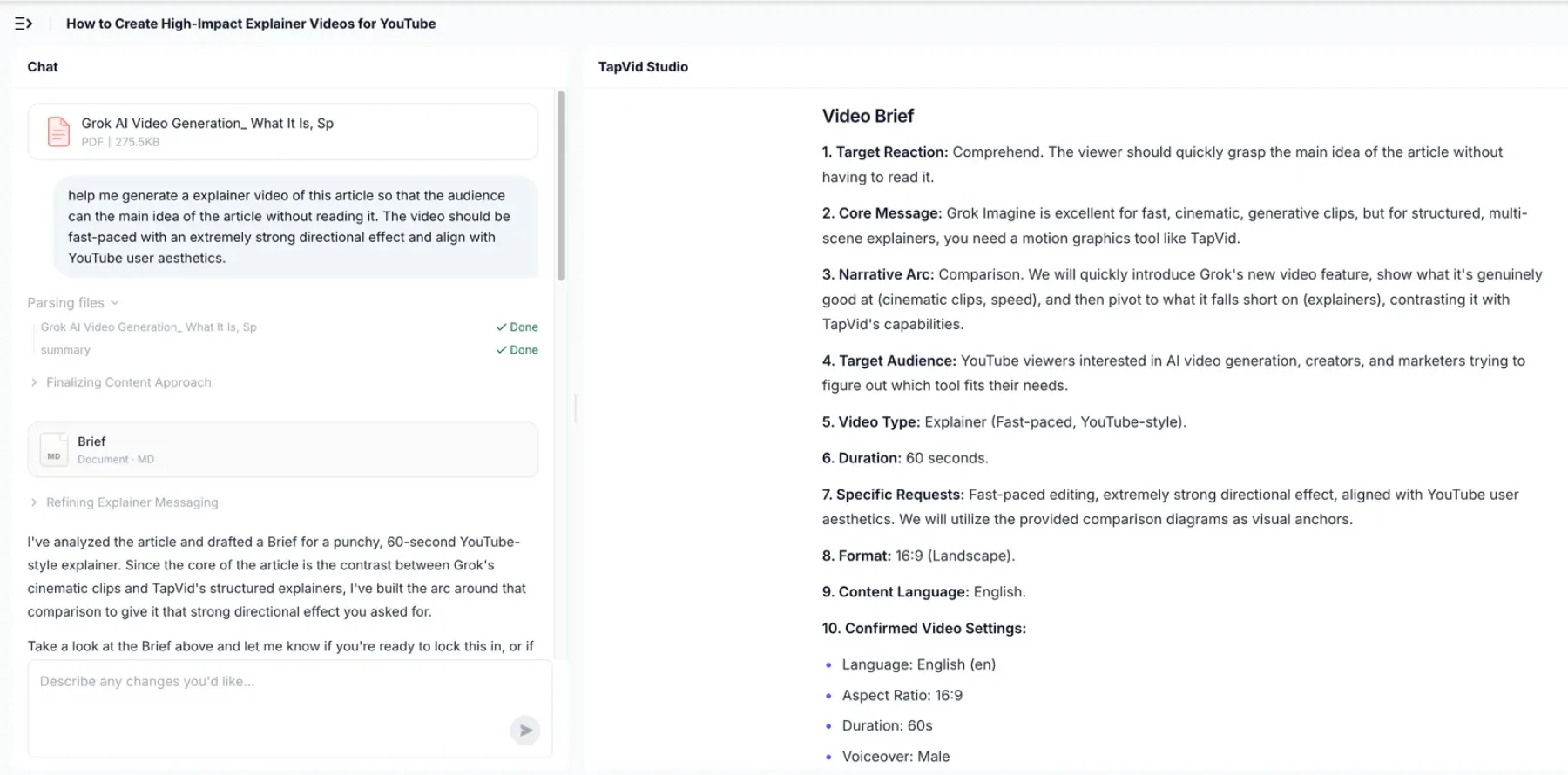
I then tested the content-first replacement with a real 275.5KB article PDF. TapVid exposed audience, target reaction, core message, narrative arc, duration, format, and voice in a brief before scene generation. The next checkpoint contained four 15-second beats and a timed script, so I could correct the story before rendering; upload to finished video took 6 minutes 21 seconds. VEED’s official AI video documentation says aspect ratio is an available setting and AI generation uses credits, while its watermark policy says free exports carry a watermark. I would choose VEED when footage already exists and needs editing. I would choose the tested content-first path when the truth source is a document and the missing asset is the explainer itself.
05
TapVid vs VEED
Both give you a finished MP4 in the browser. The difference is whether you edit the video yourself or generate it from your content, and what it costs. VEED figures are based on VEED's public pricing (2026).
| TapVid | VEED | |
|---|---|---|
| Core approach | Generate an explainer from your content | Edit clips on a timeline |
| How you start | Paste an article, PDF, link, or prompt | Upload or record footage |
| Skill needed | Describe changes in plain language | Video editing |
| Motion graphics | Generated for you | Add and animate by hand |
| Free plan | Free to start, 720p, watermark, clips ≤ 1 min | Watermark on every export |
| Best for | Explainer videos, product demos, tutorials | Editing and clipping existing footage |
Prices and plan limits change frequently. Treat the table as a workflow comparison, then verify the current commercial terms on each vendor’s official site before purchase.
06
Why teams pick TapVid over VEED
Generate, do not edit. TapVid builds the explainer from your content, so you start from a finished draft instead of a blank timeline.
Start from your content, not footage. Paste an article, PDF, or link. TapVid structures it for you, so you are not sourcing clips or cutting a timeline.
No editing skills required. You do not need to know video editing. Describe what you want and refine it in plain language.
Structured and information-dense. TapVid breaks a topic into clear steps and animates each one, so a viewer follows the idea instead of watching raw footage.
Motion graphics without the work. Animated text, diagrams, and callouts are generated for you, not built clip by clip on a timeline.
Ship-ready output. Export a clean MP4 with voiceover and captions. Watermark-free on paid plans, at 1080p, sized for any channel.
07
Built for Product, Marketing, and Creators
Product & SaaS. Turn release notes, a PRD, or a one-pager into an explainer or demo, no editing required.
Marketing. Make launch and landing-page explainers with a designed motion-graphics look, without a timeline.
Creators & educators. Turn an article or script into a structured knowledge explainer without learning to edit video.
When VEED is the better choice. If you already have footage and need to edit it, cut clips, add subtitles, record your screen, or repurpose a long video into short social clips, VEED is a capable browser editor built for exactly that. TapVid does not edit your existing footage. It is the right pick when you want to generate a structured explainer video from your content, not edit clips on a timeline.
08
What independent research and standards change about the decision
Accessibility is part of production quality, not a final checkbox. The W3C requirement for prerecorded captions says synchronized captions must cover prerecorded audio in synchronized media, except when the media is itself a clearly labeled alternative to text. Any replacement workflow should therefore make captions easy to generate, review, correct, and export.
Motion can also create access problems. W3C’s guidance on pause, stop, and hide covers moving or auto-updating content that begins automatically, lasts more than five seconds, and appears beside other material. Its guidance on animation from interactions also recommends a way to disable nonessential motion triggered by interaction. A polished animation is not finished if users cannot control distracting movement.
Public-sector publishing guidance makes the production implications concrete. The UK Home Office advises teams to provide captions, transcripts, audio description, and an accessible media player. GOV.UK’s video guidance similarly requires captions and a transcript in an accessible format. These requirements favor workflows in which narration, on-screen text, timing, and source material remain reviewable.
Performance matters on the page where the video is published. Chrome’s developer guidance explains that non-composited animations can appear janky and increase cumulative layout shift. Exported video and lightweight, deliberate web motion are often safer than layering expensive decorative animation into a landing page. Test the final page, not just the editing canvas.
These sources point to one operational rule: keep the message, narration, captions, motion, and delivery page independently reviewable. A workflow that hides all five inside one opaque generation step can look efficient during the demo but becomes expensive when legal, brand, product, or accessibility reviewers request changes. Prefer a system that makes the next correction obvious and lets the team preserve the approved parts.
09
Test before you migrate
- Use one real article, PDF, footage set, or design brief rather than a vendor demo.
- Record time to first draft and time to an approved export separately.
- Check factual accuracy, caption accuracy, brand colors, duration, and aspect ratio.
- Confirm watermark, resolution, credit use, licensing, and commercial-use terms.
- Ask a second teammate to make one revision so handoff cost becomes visible.
10
Frequently asked questions
What is the best VEED alternative?
It depends on what you are doing. VEED is a browser video editor for cutting and captioning footage you already have. If you want to create an explainer video from an article, a PDF, or a script rather than edit clips, TapVid is the closer fit: it is an Explainer Video Engine that structures and animates your content, with no timeline to edit.
How is TapVid different from VEED?
VEED gives you a timeline to edit footage yourself. TapVid generates a finished explainer video from your content, so there is no editing to do. You start from an article, PDF, or link rather than uploading clips, and you refine by describing changes in plain language.
Is TapVid free, and is there a watermark?
You can start for free with no credit card. Free exports are 720p with a watermark and clips up to 1 minute; paid plans are watermark-free with 1080p exports. See all plans on our pricing page.
Does TapVid replace a video editor like VEED?
For creating explainer videos from your content, yes: TapVid generates the video so you do not edit a timeline. If your job is editing footage you already have, cutting, captioning, or clipping, a browser editor like VEED is built for that.
Can I turn a PDF, article, or slides into a video?
Yes. Paste a prompt, drop a PDF, or paste an article or product URL, and TapVid reads it, structures the script, and animates each section as a scene. That is a different starting point from editing footage on a timeline.
Why do teams switch from VEED to TapVid?
The common reasons are effort and workflow. Teams that want a finished explainer generated from their content rather than a timeline to edit, that would rather paste an article or PDF than source and cut clips, and that do not have video-editing time tend to prefer generating the video end to end.