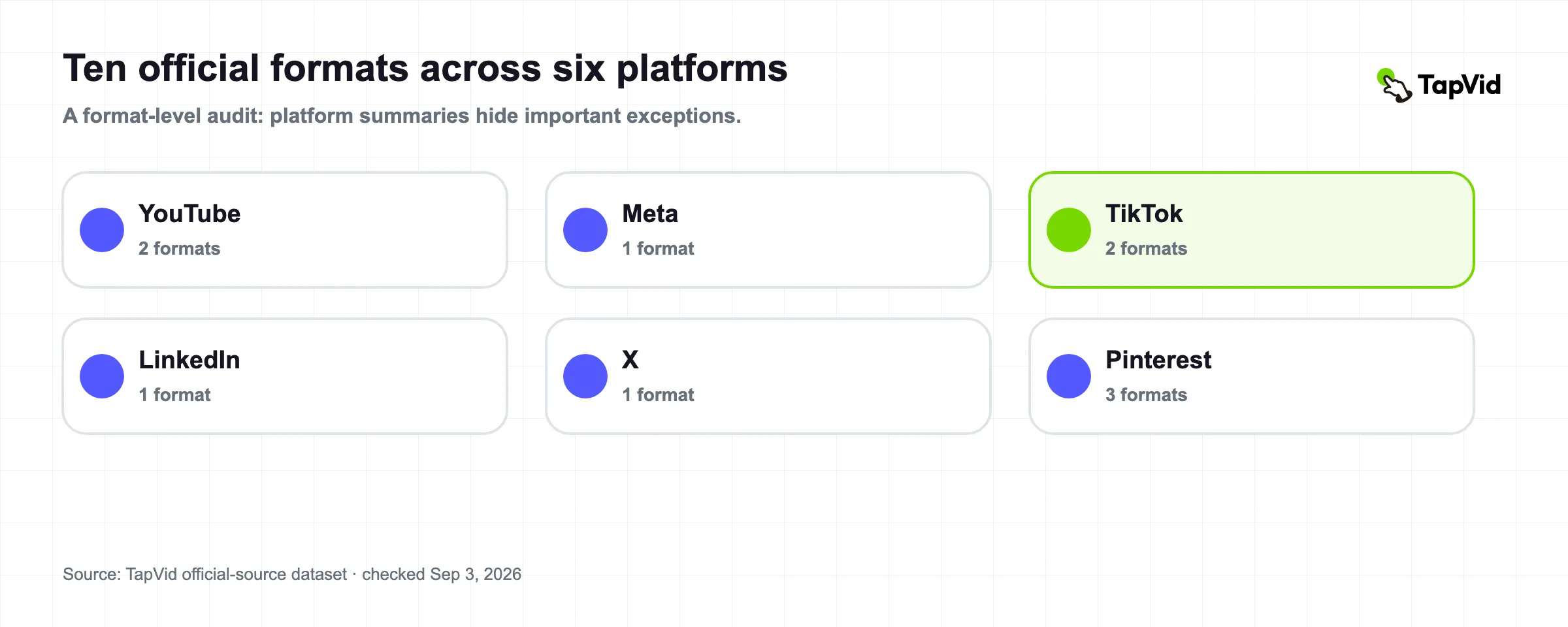

Social media video specs are often presented as one giant cheat sheet. The problem is that platform, placement, account type, upload path, and ad product can each change the rule. We audited ten formats across six platform families using only first-party documentation checked on September 3, 2026: YouTube, Meta, TikTok, LinkedIn, X, and Pinterest. The documented duration window spans from three seconds for a LinkedIn video ad to 12 hours for a verified YouTube upload. TikTok Spark and non-Spark ads have different restrictions, while Pinterest publishes three different ratio and duration systems for standard-width, max-width, and Idea ads. A 9:16 MP4 is a useful short-form master, but it is not a universal delivery file.
01
Key findings from ten official format records
Official-source audit at a glance
10
format records
Each record keeps its own placement and upload-path rules.
TapVid official-source datasetChecked 2026-09-03
6
platform families
YouTube, Meta, TikTok, LinkedIn, X, and Pinterest.
TapVid methodologyChecked 2026-09-03
3s–12h
documented span
An acceptance range across different products, not a creative recommendation.
LinkedIn and YouTube official helpChecked 2026-09-03
The dataset keeps hard limits, recommended settings, and undocumented fields separate. We do not turn a recommendation such as “15 seconds or less” into an acceptance limit.
| Value | Finding | Scope | Source |
|---|---|---|---|
| 10 | format records | Six platform families and ten distinct organic or paid upload products. | Download the TapVid dataset |
| 6 | platform families | YouTube, Meta, TikTok, LinkedIn, X, and Pinterest. | Methodology |
| 3 sec–12 hr | documented duration span | LinkedIn video-ad minimum to verified YouTube upload maximum; not a recommended creative range. | LinkedIn and YouTube |
Source: TapVid official social media video specs dataset, checked September 3, 2026.
02
There is no platform-level specification without a format
“TikTok specs” is incomplete because a non-Spark ad and a Spark ad do not share the same restrictions. “Pinterest video size” is incomplete because standard-width, max-width, and Idea ads have different ratios and limits. “YouTube duration” changes with account verification and whether the upload qualifies as a Short.
The correct unit is platform × format × upload path. Our ten-row dataset uses that unit so a reader can cite a rule without silently moving it to another product.
03
The ten-format social media video specs table
| Platform / format | Ratio or resolution | Duration | File ceiling | Official source |
|---|---|---|---|---|
| YouTube standard | Player adapts to vertical, square, or horizontal | Up to 12 hours for verified accounts | 256 GB | YouTube Help |
| YouTube Shorts | Square or vertical | Up to 3 minutes | Not stated on cited page | YouTube Help |
| Meta Reels ads | 9:16 recommended; safe-zone creative | Placement-dependent | Not stated on cited page | Meta for Business |
| TikTok non-Spark in-feed | 9:16 recommended; 16:9 and 1:1 accepted | Up to 10 minutes | 500 MB | TikTok Ads |
| TikTok Spark | No separate ratio restriction | Up to 10 minutes | No separate file-size restriction | TikTok Ads |
| LinkedIn video ad | 16:9, 1:1, 4:5, or 9:16 | 3 seconds–30 minutes | 500 MB | LinkedIn Help |
| X standalone video ad | Six listed ratios from 4:5 to 16:9 and 9:16 | Up to 2:20; ≤15 seconds recommended | 1 GB | X Ads |
| Pinterest standard-width | 1:1, 2:3, 4:5, or 9:16 recommended | 4 seconds–15 minutes | 2 GB | Pinterest Business |
| Pinterest max-width | No taller than 1:1 | 4 seconds–15 minutes | 2 GB | Pinterest Business |
| Pinterest Idea ad | 9:16 and 1080×1920 recommended for full bleed | Up to 5 minutes | 2 GB mobile; 100 MB web | Pinterest Business |
Source: TapVid public research dataset; verified 2026-09-03.
The table is a planning snapshot. Use the linked source immediately before publishing because platform documentation changes without preserving the old rule on the same page.
04
What a 9:16 MP4 master actually covers
A vertical MP4 is a sensible production master for Meta Reels, TikTok non-Spark ads, LinkedIn vertical ads, X vertical video ads, Pinterest standard-width video, Pinterest Idea ads, and YouTube Shorts. Every cited platform either explicitly recommends or accepts that combination.
But “accepted” is not “optimal” and not “complete.” A platform can accept the file while UI overlays cover text, the ad product requires a different safe zone, music rights shorten the usable segment, or the chosen placement favors a square or horizontal composition.
Source: TapVid public research dataset; verified 2026-09-03.
Source: TapVid official social media video specs dataset, checked September 3, 2026.
05
Where the universal master fails
A single master fails in four recurring ways. First, Pinterest max-width video cannot be taller than 1:1. Second, long-form YouTube is commonly composed for a horizontal watch page even though the player adapts to other ratios. Third, platform UI creates placement-specific safe zones. Fourth, paid products can impose rules that organic uploads do not—for example, TikTok non-Spark ads publish minimum dimensions and a 500 MB ceiling while Spark ads reuse an organic post.
The solution is not dozens of unrelated edits. Keep one approved information layer—product images, logos, literal prices, model names, screenshots, and legal wording—then recompose it into a small number of aspect-ratio masters. This preserves factual consistency while letting layout change.
06
A two-master export system for most teams
Final preflight before upload
- Name the exact platform and format, not only the platform.
- Separate hard limits from recommendations.
- Check ratio, duration, file size, codec, safe zone, captions, and audio.
- Verify the current official page on the day of publication.
- Keep product assets and literal claims unchanged across variants.
For a small team, the lowest-complexity system is two visual masters plus a placement preflight.
| Master | Primary use | What still needs checking |
|---|---|---|
| 9:16 at 1080×1920 | Reels, Shorts, TikTok, vertical LinkedIn/X, Pinterest Idea | Safe zone, duration, music rights, file-size ceiling |
| 16:9 at 1920×1080 | YouTube long-form, horizontal LinkedIn/X, display surfaces | Placement-specific duration and autoplay behavior |
| Placement preflight | The final selected product | Current official page, account eligibility, captions, destination copy, and thumbnail |
Use square or 4:5 only when the destination or creative job justifies the third composition. Building every possible ratio before deciding the channel creates maintenance cost without guaranteeing distribution.
07
Methodology
We selected ten high-use organic or paid video formats from six platform families and inspected their first-party help or business documentation on September 3, 2026. One row represents one platform-format-upload-path combination.
The dataset records ratio, resolution, file type, file-size limit, duration, and caption or audio notes. We preserved the difference between required, accepted, and recommended settings. When the cited page omitted a field, we recorded “Not stated” or described the scope of the missing value instead of borrowing a number from a third-party roundup.
Source: TapVid public research dataset; verified 2026-09-03.
This unit prevents a permissive organic upload, paid placement, or adjacent format from silently donating its limits to another row. Each record remains traceable to one official page and one stated scope.
The row-level data is available as CSV. This research used no new video generations and no account-level upload experiments.
08
Limitations
This is a purposive snapshot, not a census of every social format, region, API, connected-TV product, live-video system, or account tier. Meta's cited Reels page emphasizes creative recommendations rather than exposing every upload field, so undocumented cells remain blank.
A file that meets technical requirements can still be rejected for policy, rights, landing-page, or account reasons. Platform pages can also change after our check date. Use this report to choose masters and spot conflicts, then verify the exact official page immediately before delivery.
09
References and citation
Cite this research
Recommended citation (APA)
Chen, K. (2026, September 3). Social media video specs 2026: 10 official formats audited (Version 1.0). TapVid Research. https://tapvid.ai/blog/social-media-video-specs
BibTeX
@techreport{chen2026socialMediaVideoSpecs,
  author = {Kenneth Chen},
  title = {Social Media Video Specs 2026: 10 Official Formats Audited},
  institution = {TapVid Research},
  year = {2026},
  month = {September},
  url = {https://tapvid.ai/blog/social-media-video-specs},
  note = {Version 1.0}
}
Data and source register
- TapVid official social media video specifications dataset (CSV)Checked 2026-09-03
Version 1.0
This report keeps source links beside the claims they support. The methodology and limitations sections define the sample, measurement window, calculation rules, and boundaries. Use the canonical URL and version below when quoting the findings; use the linked public data files to reproduce or audit the calculations.
10
Frequently asked questions
What video format works on most social media platforms?
MP4 is the safest common container across the formats audited here. A 9:16 MP4 works for many short-form placements, but duration, file size, safe zones, captions, and audio still need a placement-specific check.
Is 1080×1920 the best social media video size?
It is a practical 9:16 master for Reels, Shorts, TikTok, vertical LinkedIn and X ads, and Pinterest full-bleed formats. It is not a universal answer for horizontal YouTube or Pinterest max-width ads.
How long should a social media video be?
The official acceptance limits in this dataset range from three seconds to 12 hours because they describe different products. Creative length should be chosen for the viewer task and placement, not by averaging those limits.
How often should social media video specs be checked?
Check the exact official page at final export and again before a major campaign or batch publish. Store the source URL and check date with the delivery file.