
Product storytelling is the practice of explaining a product through a customer's situation, a specific problem, the mechanism that changes it, and evidence of the result. It is not a feature list with a dramatic opening. A useful product story helps a buyer understand where the product fits in their work, why the change matters, and what they can verify before acting.
The customer is the protagonist. The product is the tool that changes what the customer can do. That distinction keeps the story relevant and prevents a common mistake: turning the product into a heroic character while the buyer's real problem disappears.
This guide gives you a five-beat framework, a method for translating features into credible outcomes, and examples for a fictional small SaaS product. It also shows how to preserve the story when it moves from a webpage into a sales deck or product video.
01
What is product storytelling?
Product storytelling combines fact and narrative to communicate how a product changes a customer's situation. The facts are the product's real capabilities, constraints, screens, assets, and evidence. The narrative connects those facts in a causal sequence that a buyer can follow.
A simple product story sounds like this:
> When a support request arrives while several teammates are online, two people can reply at once while another request receives no owner. Routing rules assign each request to one channel and one person, so the team can see who owns the next step. Create one rule to test the workflow with your own inbox.
The story has a customer context, friction, a product mechanism, an observable changed state, and a next action. It does not need a fictional founder, a villain, or cinematic language.
ProductPlan's guidance on a well-crafted product story makes the same central choice: the user is the hero. Product Marketing Alliance similarly defines storytelling as a combination of fact and narrative, then adapts familiar story structures to product marketing. The useful principle is not that every product needs a hero's journey. It is that the audience's change should organize the message.
02
Product storytelling vs. brand storytelling
Product storytelling and brand storytelling can support each other, but they answer different questions.
| Format | Main question | Typical evidence | Best use |
|---|---|---|---|
| Product storytelling | How does this product change a specific situation? | Product screens, workflow, demonstration, specification, or approved result | Product page, launch, sales deck, demo, explainer video |
| Brand storytelling | Why does this company exist and what does it choose to stand for? | Origin facts, company decisions, people, process, or company milestones | About page, brand film, recruiting, company campaign |
| Product description | What is included? | Attributes, dimensions, compatibility, price, or package contents | Catalog, ecommerce listing, procurement |
| Product demo | Can I see the product perform the mechanism? | Live or recorded product behavior | Evaluation, onboarding, sales proof |
| User story | What should a product team build for a user? | Requirement, acceptance criteria, and product context | Product development |
A brand story might explain why a company chose to reduce packaging waste. A product story should show what changed in a particular package, how that affects the buyer's use or disposal, and what evidence supports the claim. The first builds meaning around the company. The second helps someone evaluate a product.
You do not have to choose one forever. You do need to know which job the current page, presentation, or video must complete. If a product page spends most of its space on the founder's childhood, the buyer may still leave without understanding the product.
03
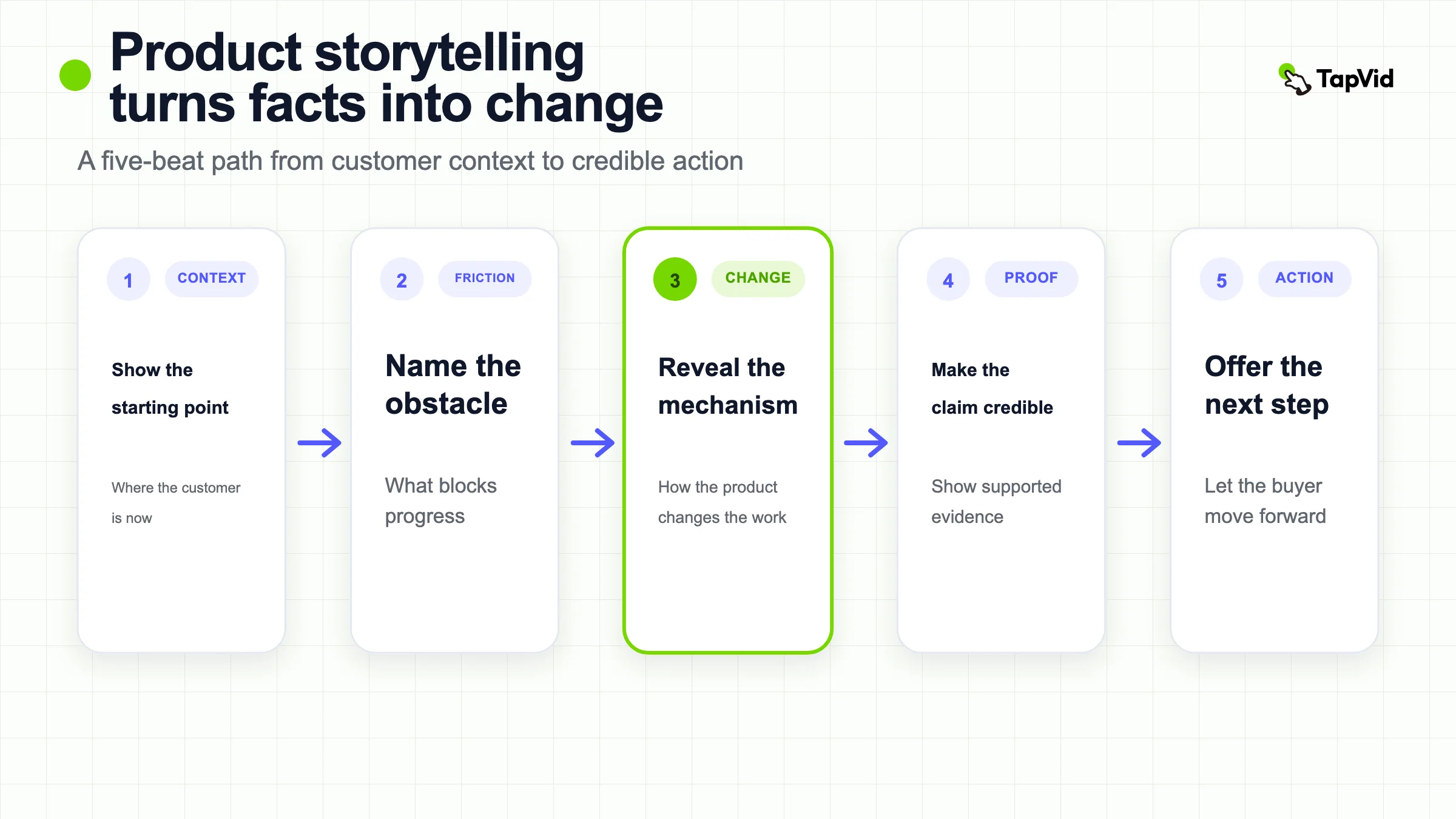
Use a five-beat product storytelling framework
The framework below works for a homepage section, launch message, sales narrative, or short product explanation. Give each beat one job.
1. Context: name the customer and trigger
Start with the moment when the product becomes relevant. A role alone is too broad. "For support teams" says who, but not when or why.
Stronger context:
> A new support request arrives while several teammates are active in the same inbox.
The trigger makes the story concrete. It also gives you a scene to show later. For a different product, the trigger might be a new SKU going live, a finance team closing the month, or a customer trying a feature for the first time.
2. Friction: show the current workaround and consequence
Describe what the customer does now and where it breaks. Avoid broad pain language such as "work is inefficient." Name the visible consequence.
> Teammates check the inbox, message each other, and still produce duplicate replies while another request remains unassigned.
This is more useful than escalating the emotion. The reader can recognize the workflow and decide whether it matches their own experience.
3. Change: explain the product mechanism
Introduce the product when the mechanism enters the story. Use a verb that describes real behavior: routes, compares, assigns, highlights, converts, locks, or exports.
> Routing rules send each request to the correct channel and assign one owner before anyone replies.
"Makes support effortless" is not a mechanism. It asks the buyer to accept the conclusion without understanding how the product creates it.
4. Proof: return to the opening situation
Show the same trigger under the new process. Proof should resolve the opening, not introduce a different benefit.
> The next request appears once, reaches the correct owner, and receives one coordinated response.
The strongest proof is observable: an approved screen, a live action, a documented comparison, or a supported customer result. If you do not have outcome data, demonstrate the mechanism and changed state instead of inventing a percentage.
5. Action: continue the story by one step
Choose a next action that fits what the reader now understands.
> Create your first routing rule.
"Transform your support today" is vague. "Create your first routing rule" lets the buyer test the exact mechanism the story just explained.
The complete framework is:
| Beat | Question | Output |
|---|---|---|
| Context | When does the need appear? | One customer, role, and trigger |
| Friction | What happens under the current process? | One workaround and visible consequence |
| Change | What does the product actually do? | One observable mechanism |
| Proof | What is different under the same conditions? | One supported or demonstrable changed state |
| Action | What should the buyer do next? | One concrete step |
Case: turn visible noise into a meaningful change
The internal TapVid case Follow Builders: Where It All Began makes the friction beat visible before the change arrives. The selected 10-second excerpt begins with exaggerated information noise, then moves toward the story's useful signal. That contrast works because the video does not begin with a feature inventory. It gives the audience a state they can recognize, then earns the transition.
04
Turn product features into a credible story
A feature belongs in a story when you can connect it to a situation and show what it changes. Use this chain:
Feature → mechanism → visible effect → evidence → boundary
The boundary matters because a clear limit often makes the claim more credible. It tells the buyer what the feature does without implying that it solves everything around it.
Here is the fictional shared-inbox example:
| Raw feature | Mechanism | Visible effect | Evidence to show | Boundary |
|---|---|---|---|---|
| Routing rules | Match a request condition to a channel and owner | One request follows one defined path | Rule setup and resulting assignment | Does not guarantee response quality |
| Shared status | Display the same owner and state to teammates | Fewer ownership questions inside the inbox | Two user views showing the same state | Depends on teammates using the shared workflow |
| Templates | Insert approved response text | Repeated answers begin from the same wording | Template and inserted draft side by side | A human may still need to review the reply |
| Activity log | Record changes to owner and status | A teammate can trace what changed | Timestamped activity panel | Records actions, not the reason behind every decision |
Notice how the story becomes more specific without becoming more promotional. The product can be capable and still have boundaries.
You can use the same chain to repair weak copy:
- Weak: "Work faster with intelligent automation."
- Better: "Routing rules assign each new request to a channel and owner before a teammate replies."
- Stronger with proof: "Watch a billing request move to the Billing channel and appear with one named owner."
The final version gives the page or video a visual task. It can be shown, checked, and discussed.
05
A complete product storytelling example
Assume a small SaaS team is launching routing rules for a shared support inbox. The following examples use the same facts in three formats. The company and product are fictional, so the copy demonstrates structure rather than a real performance claim.
Homepage version
Headline: One request, one owner, one clear next step
Body: When several teammates work from the same support inbox, duplicate replies and unassigned requests are easy to miss. RelayBox routing rules send each request to the right channel and assign one owner before anyone replies. See the next request follow a clear path from arrival to response.
CTA: Create your first rule
The homepage version compresses the five beats. It earns relevance with a familiar trigger, names the mechanism, and gives the buyer a testable next action.
Sales deck version
- Context: Three support teammates are active when a billing request arrives.
- Friction: Two people begin replies, while a second request has no owner.
- Change: A billing rule sends the first request to the Billing channel and assigns Maya.
- Proof: Every teammate sees the same owner, status, and conversation.
- Action: Configure one rule with the prospect's request categories.
The sales version can pause at each beat and invite questions. A product expert can show the rule and assignment rather than relying on a polished claim.
Short video version
| Time | Narration | Visual job |
|---|---|---|
| 0 to 5 seconds | Two teammates answer the same request. Another request has no owner. | Show one request splitting into two replies, then isolate an unassigned request |
| 5 to 12 seconds | Routing rules send each request to the right channel and assign one owner. | Show a visible rule connecting request type, channel, and owner |
| 12 to 20 seconds | Now every teammate sees the same owner, status, and next step. | Show the shared state across two teammate views |
| 20 to 25 seconds | Create your first routing rule. | Hold the rule action and CTA long enough to read |
The video version does not add a new claim. It gives movement to the same causal chain. For a production-ready structure with timing and source columns, use the explainer video script guide.
06
Separate story language from product truth
Storytelling gives facts sequence and meaning. It does not give permission to invent facts.
The U.S. Federal Trade Commission says advertisers need a reasonable basis for objective claims before they are disseminated. Its advertising substantiation policy applies to express and implied claims. For a working content review, place every important line on one of four levels:
| Level | Meaning | Example | Decision |
|---|---|---|---|
| Exact | Wording or data must remain literal | Product name, price, model, legal line, interface label | Lock it |
| Supported | The source proves the meaning, but wording may change | A rule assigns requests based on configured conditions | Paraphrase carefully |
| Aspirational | A desired future, clearly presented as a goal | Build a calmer support process | Label as aspiration |
| Unsupported | No source supports the express or implied claim | Never miss a customer request again | Remove or acquire evidence |
This review catches invented specificity. "Teams lose time" cannot quietly become "teams lose three hours a day." "Assigns one owner" cannot become "eliminates mistakes." A precise claim may sound better in a story, but precision raises the need for evidence.
Review visuals the same way. An image can imply a customer, location, product capability, or result that the script never states. The net story comes from words, images, sequence, and context together.
07
Adapt one product story across channels
The core causal chain should stay stable, while the amount of context and proof changes by channel.
| Channel | Keep | Expand | Remove |
|---|---|---|---|
| Product page | Trigger, mechanism, visible proof, CTA | Screens, specifications, objections, boundaries | Long company history |
| Launch post | New trigger, changed mechanism, immediate proof | What changed from the previous workflow | Unrelated roadmap items |
| Sales deck | Customer-specific friction and proof | Questions, comparison, implementation context | Generic brand adjectives |
| Product demo | Mechanism and changed state | Live behavior, edge cases, setup | Claims the screen cannot support |
| Product video | One causal chain and one CTA | Visual correspondence, pacing, approved assets | Dense feature inventory |
Do not rewrite the product into a different character for every channel. If the website says the feature "assigns an owner" while the video says it "runs support automatically," the story has expanded beyond the mechanism.
Create a short story source before producing channel assets:
- Customer and trigger
- Current workaround and consequence
- Product mechanism
- Approved proof
- Exact strings and assets
- Boundaries and exclusions
- One next action
This source can be one page. Its purpose is to keep every version recognizable and reviewable.
08
Use product storytelling in video without changing the product
Video is useful when the mechanism is easier to understand as a sequence than as a paragraph. The risk is that production adds visual drama by changing the product, wording, or relationship between them.
Review a product story video in three passes:
- Asset fidelity: Does the product image, logo, UI, packaging, or footage match the approved source?
- Information fidelity: Do names, labels, numbers, specifications, prices, and legal wording remain exact?
- Correspondence: When the narration discusses Product A or Feature A, does the frame show the correct product, feature, and proof?
TapVid is an Explainer Video Engine built for this product explanation job. It turns supplied product assets and an approved script into a video while keeping the source material available for review. The practical promise is not that storytelling becomes automatic. The value is that your real assets and chosen wording can remain the factual spine of the video instead of being redrawn or rewritten.
Case: show the mechanism instead of skipping to the result
The internal TapVid Launch Film case turns a source artifact into the spine of the story. Its selected excerpt shows part of the README-to-launch-video transition, so the audience can see an input, a product action, and an output instead of being asked to accept an unexplained transformation.
Open the TapVid case or open the generated video.
If you already have the source packet and script, the product demo video workflow shows how those materials can become a reviewable video. Check the final artifact before delivery. A correct script does not prove that every frame is correct.
09
Common product storytelling mistakes
Making the product the hero
Buyers care about their work, risk, goals, and identity. Present the product as the mechanism that helps the customer move, not the character receiving applause.
Opening with a feature inventory
A feature list makes the reader perform the translation from capability to value. Start with one trigger and connect the features that change it.
Skipping the mechanism
Moving directly from problem to outcome creates a promise without an explanation. The mechanism is where understanding and credibility are built.
Using emotion instead of evidence
Emotion can come from a recognizable consequence, such as a customer receiving conflicting replies. It does not require unsupported urgency, fear, or a dramatic statistic.
Telling several stories at once
One message cannot explain the launch, company mission, full feature set, every audience, and every CTA. Choose one customer, one trigger, and one changed state.
Letting each channel invent a new claim
Adapt length and format, but keep the causal chain and factual boundaries stable. Review the page, deck, demo, and video against the same source.
10
Product storytelling template
Copy this brief before writing the final copy:
> Customer: [one role or user]>> Trigger: [the moment the product becomes relevant]>> Current process: [what the customer does now]>> Visible friction: [what goes wrong or becomes difficult]>> Product mechanism: [what the product actually does]>> Proof: [screen, action, specification, comparison, or supported result]>> Boundary: [what the product does not claim to solve]>> Next action: [one concrete step]>> Exact strings and assets: [names, numbers, labels, legal copy, logo, product images]
Then test the draft with five questions:
- Can the reader recognize the opening situation?
- Does the product perform an observable action?
- Does the proof resolve the same problem introduced at the start?
- Can every objective claim be traced to a source?
- Does the CTA let the buyer test or continue the mechanism?
If all five answers are clear, the story is ready to adapt. If the mechanism or proof is vague, more adjectives will not repair it.
11
Frequently asked questions
What is product storytelling in one sentence?
Product storytelling explains how a real product changes a specific customer situation through a clear sequence of context, friction, mechanism, proof, and action.
Who should be the hero of a product story?
The customer should be the protagonist. The product is the tool or mechanism that helps the customer move from the current situation to a better, observable state.
How is product storytelling different from brand storytelling?
Product storytelling explains how a particular product changes a customer's situation. Brand storytelling explains why a company exists, what it believes, or what choices define it. A product story needs product-level mechanism and proof.
Does every product story need an emotional arc?
No. It needs relevance and consequence. Emotion can come from recognizing a frustrating or valuable moment. A technical buyer may respond more strongly to clear risk, control, and proof than to a dramatic narrative.
Can AI write a product story?
AI can help organize approved facts, generate variants, and adapt a story to different formats. A product owner still needs to verify capabilities, claims, assets, exact wording, and the final artifact. Do not let a model invent customer results or product behavior to make the copy sound more complete.
How long should a product story be?
Use the shortest version that preserves the five beats needed for the channel. A homepage block may need a headline, two sentences, and a CTA. A sales narrative or video may need more time for mechanism, proof, boundaries, and questions. Length should follow the decision the buyer needs to make.