
Searches for "storyboarder ai" usually come from teams trying to reduce pre-production time. Speed helps only when review quality keeps up. This article gives a review-centric framework for using storyboarder AI outputs in real production.
01
Why review design matters more than generation speed
Storyboarder AI can generate many options quickly, but without a strong review rubric teams still select weak narrative paths.
A useful rubric checks scene objective, transition logic, viewer comprehension, and CTA continuity before animation starts.
02
A practical review rubric
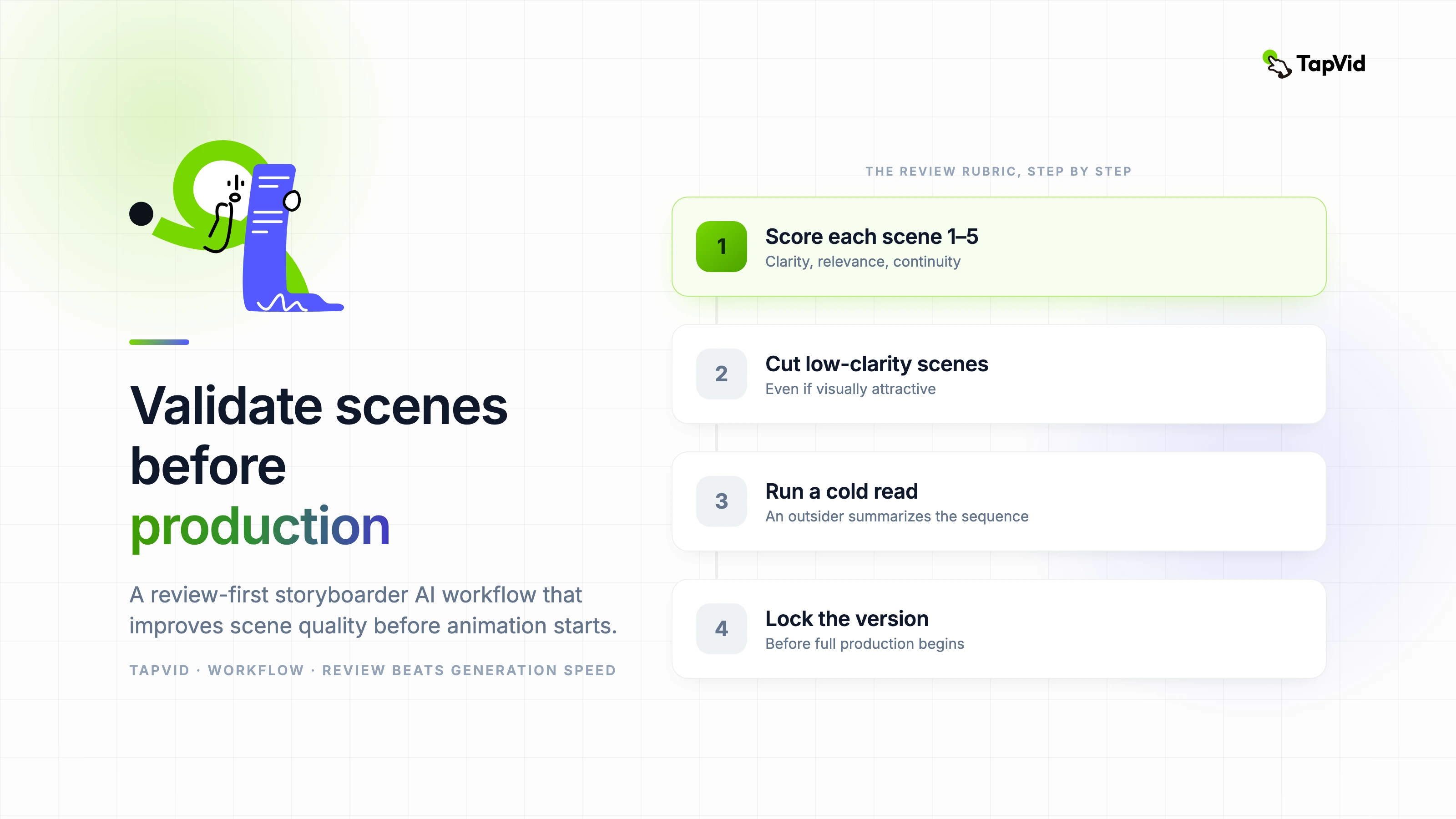
Score each scene from 1 to 5 on clarity, relevance, and continuity. Remove scenes that score low on clarity even if they look visually attractive.
Then run a "cold read" with someone outside the project. If they cannot summarize the sequence accurately, storyboard logic needs revision.
- Validate each scene against one explicit objective.
- Check that transitions preserve narrative momentum.
- Confirm CTA appears as a natural outcome, not a sudden insert.
- Lock storyboard version before full production begins.
03
How this improves SEO-oriented video content
Better storyboard logic improves watch behavior, and stronger watch behavior supports discoverability and engagement signals on search-linked pages.
When scenes answer user intent directly, content is more likely to satisfy informational queries and reduce bounce behavior.
04
Feature path for review-driven execution
For segmented audience communication, use https://tapvid.ai/feature/competitive-comparison-video after storyboard lock to create clearer differentiation.
For high-level explanation pages, pair review-ready storyboards with https://tapvid.ai/feature/explainer-video-generator to preserve intent alignment.
05
Frequently asked questions
How many storyboard variants should teams compare? Two to four variants are usually enough to choose a direction without analysis overload.
What is the biggest review mistake? Selecting based on style preference before checking message clarity.
Can storyboard review reduce production cost? Yes, because early structural fixes are cheaper than late animation revisions.