
I came to text-to-video AI tools skeptically. As someone who's spent twelve years learning how to control every aspect of a moving image, I wasn't excited about handing compositional decisions to a model. That skepticism has been partially revised. Here's my honest assessment of where these tools fit in a professional workflow — and where they categorically don't.
01
What text-to-video AI is actually doing
When you write a text prompt and a video comes back, what's happening isn't a system that understands your description and constructs a scene from first principles. It's a diffusion model that's learned statistical associations between text descriptions and video sequences. It's generating the most probable video that matches the distribution of videos in its training data that correspond to your text.
This matters practically because it explains why text-to-video tools produce such different results from the same prompt. They're sampling from a probability distribution, not executing a precise specification. The implications: you'll get variation across runs, the model has strong biases toward common visual interpretations, and highly specific compositional requirements are difficult to enforce through text alone.
02
The output quality in 2026: honest assessment
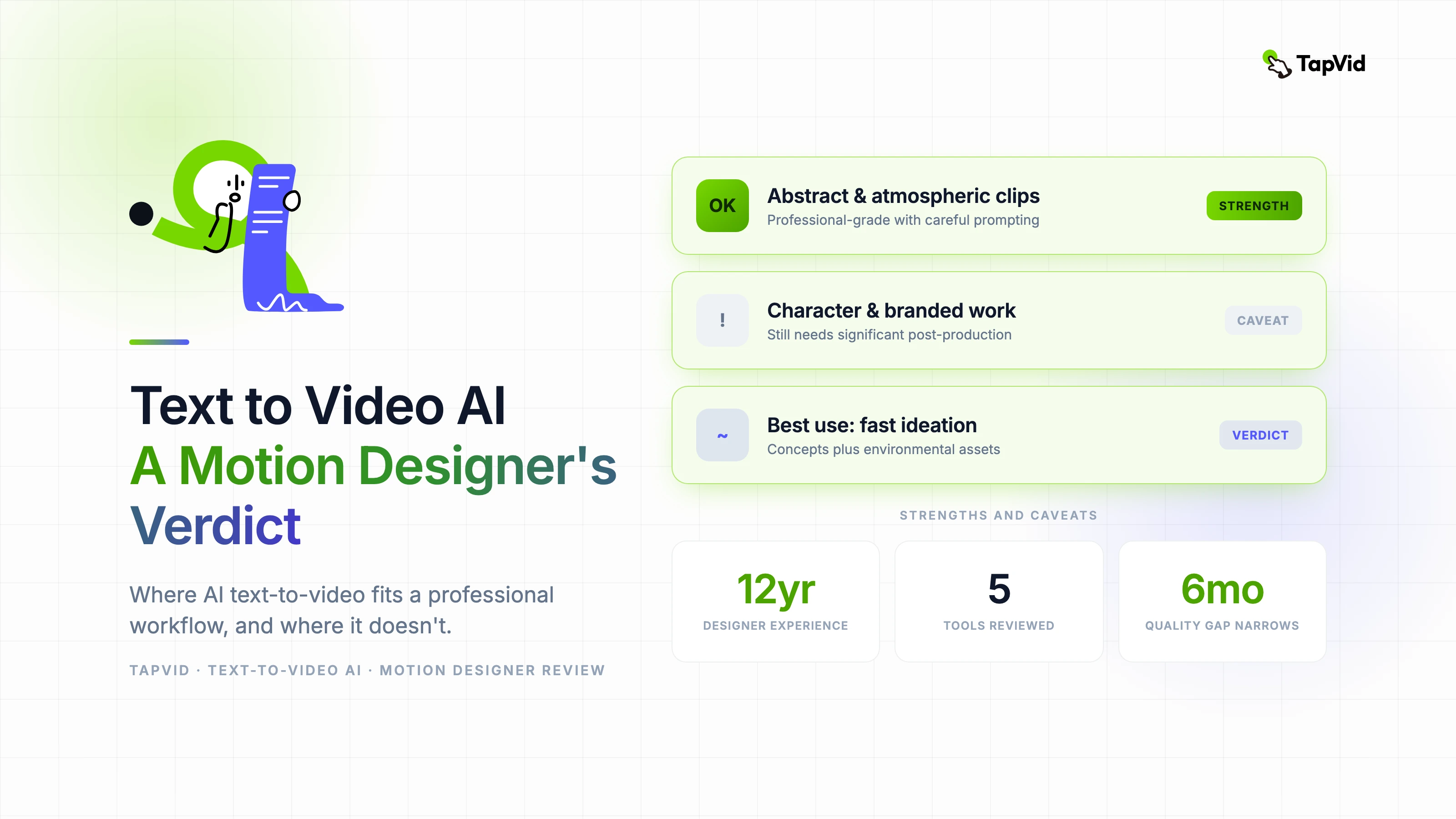
The best text-to-video outputs in 2026 — from Sora, Veo 3, and Runway Gen-3 at their respective quality ceilings — are genuinely impressive. For abstract and atmospheric content, environmental scenes without human subjects, and stylized motion graphics sequences, the output can be professional-grade with careful prompting and curation.
For anything requiring precise compositional control, consistent characters, readable text in frame, or precise timing tied to external audio, text-to-video AI is still a support tool rather than a primary production tool. The gap between what a professional can specify and what a model can reliably deliver narrows every six months, but it hasn't closed.
The honest benchmark I use: would I submit this clip to a client without explaining it came from AI? For abstract environments and atmospheric clips, yes, regularly. For character work, branded content with specific visual requirements, and anything requiring product accuracy, not without significant post-production work.
03
The AI animation software worth knowing about
- Runway Gen-3 Alpha: Highest quality ceiling for text-to-video. Best temporal consistency. The editor tools are good enough for post-generation refinement.
- Veo 3 (Google): Strong on cinematic prompts. Better than Runway on photorealistic environments. Access is currently limited through Vertex AI.
- Sora (OpenAI): Exceptional prompt comprehension, particularly on complex scene descriptions. Access limitations make it less practical for regular production use.
- Kling AI: Best performance on human motion and character-focused prompts. Korean-developed, well-supported in Asian markets.
- Hailuo AI: Strong value proposition. Consistent quality on atmospheric and environmental content. Less capable on complex narratives.
04
How to prompt effectively for motion design outputs
After extensive testing, the prompting structure that consistently produces the most useful motion design outputs follows this pattern: camera movement first, then subject description, then environment, then visual style, then duration and pacing cues. 'Slow dolly forward, neon grid lines forming geometric patterns, dark studio environment, flat motion graphics style, smooth and unhurried' produces substantially better results than a paragraph of descriptive text.
Reference to specific cinematographic or design styles helps significantly. Terms like 'Bauhaus geometric', 'Swiss design', 'neon noir', 'cel animation style', and 'kinetic typography aesthetic' all produce more consistent and specific outputs than general aesthetic descriptions. Build a library of style modifiers that work for your typical output requirements.
05
My verdict as a working professional
Text-to-video AI belongs in a professional motion design workflow as a fast ideation and asset generation tool, not as a replacement for production expertise. The value I get from it is concentrated in two areas: rapidly generating visual concepts to explore before committing to manual production, and producing atmospheric and environmental assets that would otherwise require significant production time.
The professional risk to watch out for is quality drift — when you get comfortable accepting AI output that's good enough rather than right. The output ceiling of these tools is high, but reaching it requires consistent critical judgment. The tool doesn't do the quality control; you do.