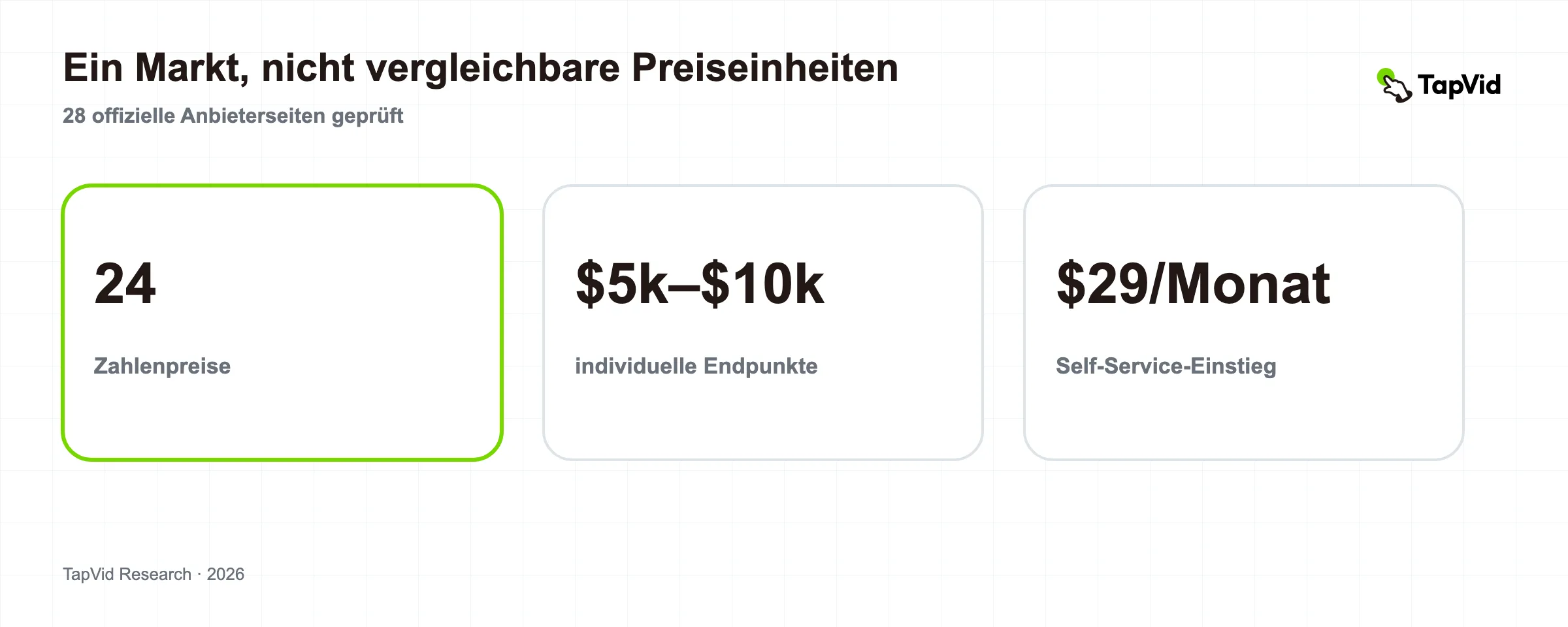

Die Kosten für Erklärvideos werden oft auf eine einzige dramatische Spanne reduziert. Diese Abkürzung verschleiert vier verschiedene Käufe: ein individuelles Produktionsprojekt, freiberufliche Arbeit, einen laufenden Kreativservice und Self-Service-Software. Diese Preise verwenden unterschiedliche Einheiten und sollten nicht miteinander gemittelt werden. Wir haben am September 2, 2026 die offiziellen Seiten von 28 Anbietern geprüft: 12 Studios oder Agenturen, ein Freelancer-Marktplatz und 15 KI- oder Self-Service-Tools. Vierundzwanzig davon wiesen einen numerischen Preis aus, den wir verifizieren konnten. Unter sieben Anbietern mit einer begrenzten Custom-Animation-Spanne lag der mediane veröffentlichte untere Endpunkt bei $5,000 und der mediane obere Endpunkt bei $10,000. Unter acht Self-Service-Tools mit einem verifizierten monatlichen Einstiegspreis lag der Median bei $29 pro Monat. Diese Zahlen beschreiben beworbene Seitenwerte, nicht Endrechnungen oder Kosten pro fertigem Video. Die nützliche Schlussfolgerung ist nicht, dass ein Weg immer günstiger ist. Sie lautet, dass Käufer Leistungsumfang, Überarbeitungsregeln und Abrechnungseinheiten vergleichen sollten, bevor sie Preisetiketten vergleichen.
01
Wichtige Erkenntnisse aus 28 offiziellen Anbieterseiten
Wichtige Erkenntnisse aus 28 offiziellen Anbieterseiten
28
Anbieter wurden geprüft
Die Stichprobe umfasste 12 professionelle Studios oder Agenturen, einen Freelancer-Marktplatz und 15 KI- oder Self-Service-Tools.
TapVid-Datensatz der Preis-Seiten aus erster HandGeprüft 2026-09-02
24
Anbieter wiesen einen verifizierbaren numerischen Preis aus
Ein Anbieter zeigte Leistungen ohne öffentlichen Betrag, während drei Preis-Seiten in zugänglichem Seitentext keinen aktuellen numerischen Betrag offenlegten.
TapVid-Datensatz der Preis-Seiten aus erster HandGeprüft 2026-09-02
$5,000
medianer unterer Endpunkt
unter sieben begrenzten Custom-Produktionsspannen
TapVid-Datensatz der Preis-Seiten aus erster HandGeprüft 2026-09-02
$10,000
medianer oberer Endpunkt
unter denselben sieben Spannen
TapVid-Datensatz der Preis-Seiten aus erster HandGeprüft 2026-09-02
| Wert | Metrik | Kontext | Quelle | Verifiziert |
|---|---|---|---|---|
| 28 | Anbieter wurden geprüft | Die Stichprobe umfasste 12 professionelle Studios oder Agenturen, einen Freelancer-Marktplatz und 15 KI- oder Self-Service-Tools. | TapVid-Datensatz der Preis-Seiten aus erster Hand | 2026-09-02 |
| 24 | Anbieter wiesen einen verifizierbaren numerischen Preis aus | Ein Anbieter zeigte Leistungen ohne öffentlichen Betrag, während drei Preis-Seiten in zugänglichem Seitentext keinen aktuellen numerischen Betrag offenlegten. | TapVid-Datensatz der Preis-Seiten aus erster Hand | 2026-09-02 |
| $5,000 | medianer unterer Endpunkt | unter sieben begrenzten Custom-Produktionsspannen | TapVid-Datensatz der Preis-Seiten aus erster Hand | 2026-09-02 |
| $10,000 | medianer oberer Endpunkt | unter denselben sieben Spannen | TapVid-Datensatz der Preis-Seiten aus erster Hand | 2026-09-02 |
| $29/month | medianer bezahlter Einstiegspreis | unter acht Self-Service-Tools mit verifizierter monatlicher Preisstellung | TapVid-Datensatz der Preis-Seiten aus erster Hand | 2026-09-02 |
| 5–6 weeks | medianer veröffentlichter Zeitrahmen für professionelle Produktion | Sieben Anbieter legten einen numerischen Produktionsplan offen; die Zeitplanung wird separat in unserer Studie zum Video-Produktionszeitplan analysiert. | TapVid-Datensatz der Preis-Seiten aus erster Hand | 2026-09-02 |
Quelle: Öffentlicher TapVid-Forschungsdatensatz; geprüft 2026-09-02.
Der Quellentyp ist first-party-test. Dies war eine gezielte Marktstichprobe, keine zufällige Anbieterumfrage. Preise sind beworbene Werte, keine ausgehandelten oder bezahlten Rechnungen.
02
Der Preis-Benchmark für Custom-Produktion
Sieben Studios oder Agenturen veröffentlichten entweder eine untere und obere Grenze für ein kundenspezifisches animiertes Videoprojekt oder beschrieben den Umfang eindeutig. Wir schlossen Einstiegspreise, monatliche Kreativabos, nicht öffentliche Preise und eine hochpreisige Live-Action-Route aus der Perzentilberechnung aus.
| Beworbener Endpunkt | N | Minimum | Q1 | Median | Q3 | Maximum |
|---|---|---|---|---|---|---|
| Untere Grenze der vom Anbieter veröffentlichten Spanne | 7 | $2,000 | $3,750 | $5,000 | $5,500 | $20,000 |
| Obere Grenze der vom Anbieter veröffentlichten Spanne | 7 | $3,000 | $6,500 | $10,000 | $20,000 | $25,000 |
Das bedeutet nicht, dass die mediane Erklärvideo-Transaktion $5,000 oder $10,000 betrug. Es bedeutet, dass der mediane untere Endpunkt unter sieben beworbenen Spannen $5,000 betrug, während der mediane obere Endpunkt $10,000 betrug. Wir bewahren beide Verteilungen, weil das Umwandeln jeder Spanne in einen Mittelpunkt einen synthetischen Preis erzeugen würde, den niemand genannt hat.
Die sieben begrenzten Spannen decken außerdem unterschiedliche Umfänge ab. Einige sind 60-Sekunden-Beispiele, eine umfasst 30–60 Sekunden, eine 90 Sekunden, und andere beschreiben die Standardproduktion allgemeiner. Sie sind nützlich, um beworbene Budgetspannen zu verstehen, nicht um Anbieter so zu bewerten, als sei jedes Paket identisch.
03
Veröffentlichte Preisbeispiele für kundenspezifische Erklärvideos
Der engste vergleichbare Teilbestand umfasst immer noch mehrere Vielfache.
| Anbieter | Verwendeter veröffentlichter Preis | Umfang | Hinweis zu Revisionen/Zeitrahmen | Offizielle Quelle |
|---|---|---|---|---|
| Breadnbeyond | $2,000–$3,000 | Einfaches 60-Sekunden-2D-Erklärvideo | Unbegrenzte Revisionen; 5–7 Wochen | Breadnbeyond |
| Blue Carrot | $2,500–$3,000 | Ungefähre Full-Cycle-60-Sekunden-Animation | Allgemeiner Zeitrahmen von 4–8 Wochen | Blue Carrot |
| Creamy Animation | $5,000–$10,000 | Standardmäßiges professionelles 60-Sekunden-Custom-Erklärvideo | Etwa 6 Wochen | Creamy Animation |
| Epipheo | $5,000–$25,000 | Essentials-Tarif; 30–60 Sekunden; 2D oder Motion Graphics | Zwei Überarbeitungsrunden; 4–6 Wochen | Epipheo |
| Kasra Design | $5,000–$10,000 | 90-Sekunden-2D-, 2.5D- oder isometrische Animation | 4–6 Wochen für 2D/2.5D | Kasra Design |
| Explainify | $6,000–$15,000 | Veröffentlichte Spanne für ein 60-Sekunden-Custom-2D-B2B-Erklärvideo | Überarbeitungsrunden enthalten; Anzahl nicht angegeben | Explainify |
| Demo Duck | $20,000–$25,000 | Höherwertiges animiertes Erklärvideo | 8–10 Wochen Produktion | Demo Duck |
Einige dieser Seiten beschreiben das eigene Paket eines Anbieters; andere präsentieren eine vom Anbieter formulierte Spanne für den Leistungsumfang. Der Datensatz kennzeichnet diesen Unterschied, statt zu suggerieren, dass jede Zeile ein verbindliches Angebot sei.
04
Einstiegspreise sind Einstiegspunkte, keine Durchschnitte
Drei professionelle Anbieter veröffentlichten nur einen Einstiegspreis oder eine andere Kaufeinheit:
- Wyzowl veröffentlichte einen Einstiegspreis von $2,700 für ein animiertes Erklärvideo.
- Yum Yum Videos sagte, dass die kundenspezifische Produktion eines 60-Sekunden-Erklärvideos bei $8,000 beginnt.
- Vidico veröffentlichte ein laufendes Kreativabonnement ab etwa $5,000 pro Monat, nicht einen Preis für ein einzelnes Projekt.
Sandwich veröffentlichte einen typischen Einstiegspunkt von $200,000 für hochwertige Live-Action-/Produktproduktion und stellte ausdrücklich klar, dass das Unternehmen keine animierten Erklärvideos produziert. Wir behielten es als Beleg für einen anderen Produktionsweg bei, schlossen es jedoch aus den Statistiken zur Custom-Animation aus.
Die richtige Art, einen Einstiegspreis zu verwenden, besteht darin zu fragen, welcher Umfang dort beginnt. Er kann weder einen Durchschnitt noch ein Maximum oder die wahrscheinliche Endrechnung für ein Projekt mit anderen Anforderungen belegen.
05
Was Freelancer-Preise Ihnen sagen - und was nicht
Upworks offizielle Freelancer-Seite für Erklärvideos zeigte eine Marktplatzspanne von $17–$32 pro Stunde. Außerdem veröffentlichte sie Beispiel-Projektspannen: $300–$800 für ein 30–60 Sekunden langes Whiteboard-Video, $800–$2,500 für ein 60–90 Sekunden langes Standard-2D-Erklärvideo und $2,500–$5,000 für 60–120 Sekunden Premium-Motion-Graphics.
Quelle: Öffentlicher TapVid-Forschungsdatensatz; geprüft 2026-09-02.
Wir haben die Stunden-Spanne nicht mit einer angenommenen Stundenzahl multipliziert. Wir haben die Beispielpakete auch nicht mit der Studio-Verteilung zusammengeführt. Marktplatzsätze variieren je nach Freelancer, Region, Prozess, Portfolio und danach, was der Kunde bereitstellt. Ein $17-Stundensatz und ein Projektpaket von $2,500 sind unterschiedliche Beobachtungen, keine austauschbaren Einheiten.
Für Käufer ist die fehlende Frage oft die Koordination. Ein Freelancer kann dann eine starke Wahl sein, wenn der Stil einer Person zum Briefing passt und der Kunde Skript, Feedback und Asset-Vorbereitung selbst übernehmen kann. Der Satz allein sagt Ihnen nicht, wer diese Aufgaben managt.
06
Preise für KI-Erklärvideo-Tools
Acht KI- oder Self-Service-Tools legten einen verifizierten bezahlten Einstiegspreis für monatliche Abrechnung offen.
| Tool | Bezahlter monatlicher Einstieg | Verwendete veröffentlichte Preisspanne | Wichtiger Unterschied der Einheit | Offizielle Quelle |
|---|---|---|---|---|
| Renderforest | $12/mo | $12–$59/mo | Credits plus Template-Exporte | Renderforest |
| Fliki | $28/mo | $28–$88/mo | Credit-basierte Text-zu-Video-Pläne | Fliki |
| Synthesia | $29/mo | $29–$89/mo | Generierte Videominuten | Synthesia |
| HeyGen | $29/mo | $29–$149/mo | Credits, Sitze und planspezifische Laufzeitlimits | HeyGen |
| Pictory | $29/mo | $29–$199/mo | Videominuten-Kontingente und Teamumfang | Pictory |
| Biteable | $29/mo | $29–$99/mo | Export- und Maximallängen-Limits | Biteable |
| Elai.io | $29/mo | $29–$125/mo | Render-Minuten und Sitze | Elai.io |
| Vyond | $99/mo | $99–$199/mo | Credits und maximale Videolänge | Vyond |
Der Median-Einstiegspreis in diesem Acht-Tool-Teilbestand lag bei $29 pro Monat; Q1 lag bei $28.75 und Q3 bei $29. Vier weitere Produkte - Animaker, Colossyan, Steve AI und AI Studios - zeigten im erfassten Seitenzustand ein monatliches Äquivalent mit jährlicher Abrechnung. Ihre Einstiegspreise lagen effektiv zwischen $10 und $59 pro Monat, mit einem Median von $19.50. Wir haben sie getrennt gehalten, weil eine jährliche Verpflichtung nicht denselben Kauf darstellt wie monatlicher Zugang.
Die Häufung um $29 ist eine Beobachtung aus Preis-Seiten, kein Kosten-pro-Video-Ergebnis. Enthaltene Credits, generierte Minuten, Modellzugang, Avatare, Exportregeln, Sitze und maximale Laufzeiten unterscheiden sich. Würde man den Abonnementpreis durch eine Marketing-Schätzung von „Videos pro Monat“ teilen, entstünde ein falscher Vergleich.
Drei offizielle Preisseiten - die von invideo AI, VEED und Lumen5 - waren während der Erhebung zugänglich, legten aber in verifizierbarem Seitentext keinen aktuellen numerischen Planbetrag offen. Wir ließen ihre Preisfelder leer, statt einen erinnerungsbasierten oder drittanbieterlichen Wert fortzuschreiben.
07
Überarbeitungsregeln können die praktischen Kosten verändern
Der erste Preis ist nicht die einzige wirtschaftliche Variable. Die Anbieterseiten zeigten deutlich unterschiedliche Ansätze für Änderungen:
- Wyzowl und Breadnbeyond warben für unbegrenzte Revisionen innerhalb des angegebenen Produktionsangebots oder Pakets.
- Epipheos Essential-Tarif umfasste zwei Runden.
- Elai.io erklärte, dass das erneute Rendern eines bearbeiteten Videos erneut Minuten verbraucht.
- Synthesia erklärte, dass beim Bearbeiten eines bestehenden Videos nur die neu geänderten generierten Sekunden berechnet werden.
Diese Richtlinien sind nicht direkt vergleichbar. Eine Studio-Revision umfasst professionelle Arbeit und Terminplanung; eine Software-Revision kann Credits oder generierte Sekunden verbrauchen und verlangt vom Nutzer, die Bearbeitung selbst vorzunehmen. Der Punkt ist enger: Wenn sich Produkt, Preis, Oberfläche oder juristische Formulierung wahrscheinlich ändern, gehört die Revisionseinheit ins Budget.
Für wiederholbare Produkt-Erklärvideos sollten Sie das Video so gestalten, dass eine lokale Änderung lokal bleiben kann. Wenn sich ein Bildschirm oder eine Spezifikation ändert, erhöht das Wiederaufbauen nicht zusammenhängender, bereits freigegebener Szenen sowohl Zeit als auch Risiko. Unser Leitfaden zum Video-Editing-Workflow behandelt die Review- und Versionierungsseite dieser Entscheidung.
08
Wie Sie die richtige Produktionsroute budgetieren
So budgetieren Sie den passenden Produktionsweg
Ein Studio oder eine Agentur ist passend, wenn das Projekt individuelle Art Direction, Originalillustrationen, Figurenarbeit, Live-Action, ein großes Kampagnensystem oder spezialisiertes Produktionsmanagement erfordert.
Vergleichen Sie Angebote erst, nachdem alle Anbieter auf dasselbe Briefing geantwortet haben.
Freelance-Produktion kann zu einem klaren, begrenzten Briefing passen, wenn bereits freigegebene Texte, Ausgangsmaterialien, eine entscheidende Person und eine passende kreative Referenz vorliegen.
Planen Sie Projektmanagement und Prüfung ein, auch wenn diese Aufgaben nicht auf der Rechnung stehen.
Ein KI- oder Vorlagen-Workflow passt zu Teams, die regelmäßig Produkterklärungen, Updates, Lokalisierungen oder Varianten aus vorhandenen Materialien benötigen.
Entscheidend ist dann die Abrechnungseinheit: Credits, Sekunden, Minuten, Exporte, Plätze, Modelle oder eine Kombination.
Beginnen Sie damit, was das Video beweisen muss, und wählen Sie dann den Kauf. Klären Sie die Aufgabe des Erklärvideos und ob Motion Graphics zum Material passen, bevor Sie Produktionsangebote vergleichen.
Wählen Sie Custom-Produktion, wenn der Wert in originärer Gestaltung liegt
Ein Studio oder eine Agentur ist dann sinnvoll, wenn die Aufgabe maßgeschneiderte Art Direction, originelle Illustration, Figurenarbeit, Live-Action, ein großes Kampagnensystem oder spezialisiertes Produktionsmanagement erfordert. Vergleichen Sie Angebote erst, nachdem die Anbieter auf dasselbe Briefing geantwortet haben.
Bitten Sie jeden Anbieter anzugeben:
1. die exakte Dauer und das Format; 2. ob Recherche, Skript, Storyboard, Illustration, Sprecherstimme, Musik, Untertitel und Quelldateien enthalten sind; 3. Anzahl und Umfang der Überarbeitungsrunden; 4. den Produktionszeitplan und was ihn pausiert; 5. die Kosten für eine weitere Sprache, einen Cutdown, ein Seitenverhältnis oder eine Eil-Lieferung; 6. die Rechte und Bedingungen, die für die finalen Assets gelten.
Wählen Sie einen Freelancer, wenn Sie den Prozess selbst steuern können
Freiberufliche Produktion kann zu einem klar abgegrenzten Briefing passen, wenn der Kunde bereits freigegebene Texte, Quell-Assets, eine Entscheidungsperson und eine passende kreative Referenz hat. Planen Sie Projektmanagement und Review mit ein, auch wenn diese Aufgaben nicht auf der Rechnung erscheinen.
Wählen Sie Self-Service-Software, wenn Wiederholbarkeit zählt
Ein KI- oder Template-Workflow eignet sich für Teams, die wiederkehrende Produkterklärungen, Updates, Lokalisierungen oder Variationen auf Basis vorhandener Materialien benötigen. Die zentrale Kostenfrage wird dann die Einheit: Credits, Sekunden, Minuten, Exporte, Sitze, Modelle oder eine Kombination.
TapVid ist ein Explainer Video Engine, das auf bereitgestellten Assets und freigegebenen Formulierungen basiert. Der Workflow ist für Teams gedacht, die Produktbilder, Interface-Screenshots, Namen, Zahlen und das Verhältnis von Aussage zu Bild vor dem Export überprüfbar halten wollen. Sie können diesen Weg mit dem AI explainer video generator testen.
Wählen Sie Software nicht nur deshalb, weil ihr monatlicher Einstiegspreis niedriger ist. Wählen Sie sie dann, wenn Ihr Team die Produktwahrheit liefern kann und den wiederholbaren Teil produzieren möchte, ohne jedes Mal auf einen neuen Custom-Auftrag warten zu müssen.
09
Methodik
Wir erfassten am September 2, 2026 eine Zeile pro Anbieter. Die Stichprobe umfasste 28 unabhängige Anbieter: 12 professionelle Studios oder Agenturen, einen Freelancer-Marktplatz und 15 KI- oder Self-Service-Tools, die Erklärvideo-ähnliche Inhalte erzeugen können.
Akzeptiert wurden nur offizielle Preis-, Service-, FAQ-, Help-Center- oder First-Party-Guide-Seiten der Anbieter. Such-Snippets, Affiliate-Zusammenstellungen, Bewertungsseiten und die Behauptung eines Konkurrenten über einen anderen Anbieter wurden ausgeschlossen. Wenn eine offizielle Seite keinen verifizierbaren aktuellen numerischen Betrag offenlegte, blieb der Preis leer.
Wir hielten die Kaufeinheiten getrennt:
- `per_project` für ein fixes oder bandbreitenbasiertes Produktionsengagement;
- `per_hour` für Marktplatzarbeit;
- `per_month` für monatlichen Software- oder Servicezugang;
- `per_month_effective_billed_annually` für ein monatliches Äquivalent mit jährlicher Abrechnung.
Einstiegspreise behielten ein leeres Maximum. Wir schlossen weder einen 60-Sekunden-Preis aus monatlichen Credits ab, noch wandelten wir Stundensätze in Projekt-Schätzungen um, noch teilten wir ein Abo durch eine angenommene Ausgabemenge. Gratispläne wurden nicht als niedrigster bezahlter Preis verwendet.
Quartile verwenden die Type-7-Linearinterpolationsmethode. Begrenzte Custom-Produktionsstatistiken umfassen sieben Zeilen mit jeweils einer unteren und oberen Projektspanne. Monatliche KI-Statistiken umfassen acht Zeilen mit verifizierter monatlicher Abrechnung. Jede Zahl in Überschrift und statistischen Tabellen stammt aus diesen vorab definierten Teilmengen.
Laden Sie die vollständige 28-Anbieter-CSV herunter. Sie enthält jede Einheit, jeden fehlenden Wert, jeden Hinweis zum Umfang, jede offizielle Quellen-URL und jedes Verifizierungsdatum, die in dieser Analyse verwendet wurden.
10
Einschränkungen
- Die Stichprobe war gezielt und bevorzugt Anbieter mit auffindbaren offiziellen Seiten. Sie ist nicht statistisch repräsentativ für jeden Anbieter.
- Beworbene Preise sind keine Endrechnungen. Steuern, Eilaufträge, zusätzliche Sprachen, Premium-Sprecher, weitere Formate, Quelldateien und Revisionen können den Betrag verändern.
- Vom Anbieter verfasste Leitfäden können einen typischen Umfang statt eines verbindlichen Tarifs beschreiben. Der Datensatz kennzeichnet diese Zeilen entsprechend.
- Dynamische, geolokalisierte und Promotionspreise können je nach Besucher, Währung oder Abrechnungsumschalter abweichen.
- Die Studie misst weder Ausgabequalität noch faktische Genauigkeit, Zufriedenheit oder Geschäftsergebnisse.
- Der Preissnapshot unterstützt einen Querschnitt aus dem Jahr 2026, keine Aussage zu Veränderungen gegenüber dem Vorjahr.
- Der Datensatz sollte vor jeder größeren Artikelaktualisierung erneuert werden, da sich öffentliche Preise ändern.
11
Quellen und Zitierweise
Diese Studie zitieren
Empfohlene Zitierweise (APA)
Chen, K. (2026, September 2). Explainer video cost in 2026: 28 providers analyzed (Version 1.0). TapVid Research. https://tapvid.ai/blog/how-much-does-an-explainer-video-cost
BibTeX
@techreport{chen2026explainerVideoCost,
  author = {Kenneth Chen},
  title = {Explainer Video Cost in 2026: 28 Providers Analyzed},
  institution = {TapVid Research},
  year = {2026},
  month = {September},
  url = {https://tapvid.ai/blog/how-much-does-an-explainer-video-cost},
  note = {Version 1.0}
}
Daten und Quellenverzeichnis
- Explainer-video provider pricing dataset (CSV)Geprüft 2026-09-02
Version 1.0
Dieser Bericht platziert Quellenlinks direkt bei den Aussagen, die sie stützen. Die Abschnitte zu Methodik und Einschränkungen definieren Stichprobe, Messzeitraum, Berechnungsregeln und Grenzen. Verwenden Sie beim Zitieren der Ergebnisse die kanonische URL und die unten angegebene Version; mit den verlinkten öffentlichen Datendateien lassen sich die Berechnungen reproduzieren oder prüfen.
12
Frequently asked questions
Wie viel kostet ein 60-Sekunden-Erklärvideo?
In unserem offiziellen Seiten-Snapshot vom September 2026 lagen vergleichbare veröffentlichte 60-Sekunden-Beispiele zwischen $2,000–$3,000 für ein einfaches 2D-Paket und $5,000–$10,000 für ein standardmäßiges professionelles Custom-Erklärvideo, während eine höherwertige 30–60-Sekunden-Stufe bis $25,000 reichte. Das sind beworbene Leistungsumfänge, kein marktweiter Durchschnitt.
Was sind die durchschnittlichen Kosten für ein Erklärvideo?
Unser Datensatz stützt keinen Marktdurchschnitt, weil die Stichprobe gezielt ist und die Angebote unterschiedliche Einheiten verwenden. Unter sieben begrenzten Custom-Produktionsspannen lag der mediane untere Endpunkt bei $5,000 und der mediane obere Endpunkt bei $10,000. Das sind Mediane beworbener Endpunkte, keine medianen Rechnungen.
Wie viel kosten KI-Tools für Erklärvideos?
Unter acht Self-Service-Tools mit verifiziertem monatlichen bezahlten Einstiegspreis lag der Median bei $29 pro Monat. Die enthaltenen Leistungen unterscheiden sich so stark, dass daraus keine durchschnittlichen Kosten pro fertigem Video abgeleitet werden sollten.
Warum schwanken Angebote für Erklärvideos so stark?
Ein Angebot kann unterschiedliche Niveaus von Strategie, Skript, Illustration, Sprecherstimme, Sound, Animation, Projektmanagement, Revisionen, Lokalisierung, Quelldateien und Rechten enthalten. Die Dauer allein macht diese Unterschiede nicht vergleichbar.
Ist ein günstigeres Erklärvideo für wiederkehrende Inhalte immer besser?
Nein. Ein niedriger Listenpreis kann trotzdem Mehrarbeit erzeugen, wenn der Workflow nicht die richtigen Assets, die exakte Wortwahl und lokale Änderungen bewahrt. Vergleichen Sie die Revisionseinheit und die eigene Arbeitszeit des Teams, nicht nur Rechnung oder Abo.
13
Die Kaufperspektive
Es gibt keinen ehrlichen Einheitspreis für „ein Erklärvideo“, solange der Käufer nicht definiert, was genau gekauft wird. Im 28-Anbieter-Snapshot lagen begrenzte Custom-Animationsspannen bei medianen unteren und oberen Endpunkten von $5,000 und $10,000, während monatliche Self-Service-Einstiegspreise sich um $29 gruppierten. Diese Zahlen gehören zu unterschiedlichen Märkten.
Für einen fairen Vergleich senden Sie jedem Custom-Anbieter dasselbe evidenzgestützte Briefing, halten Sie Einstiegspreise getrennt von begrenzten Spannen und bepreisen Sie erwartete Revisionen. Bei Software vergleichen Sie Credits, Minuten, Exporte, Sitze, Modelle und Änderungskosten. Die günstigste sichtbare Zahl ist selten die vollständige Produktionsentscheidung.