
I deleted my entire motion graphics portfolio three years ago and rebuilt it from scratch around a single aesthetic. It felt terrifying at the time. Within six months, I was getting enquiries from exactly the kind of clients I'd always wanted to work with — people who found me specifically because my work looked different from everything else. The niche was the strategy. Here's how I built it, and how you can too.
01
Why generic motion graphics work against you
Most motion graphics look the same. Smooth eases, minimal color palettes, sans-serif type, geometric shapes. Clean, competent, and completely forgettable. If you are building an independent creative practice or a distinctive channel presence, generic is the worst possible outcome.
The creators and studios that build real followings in motion design are almost always known for something specific — a particular color sensibility, an unusual approach to timing, a recurring visual motif. The specificity is not a limitation. It is the thing that makes the work recognizable and therefore valuable.
Developing a niche aesthetic is not about being different for its own sake. It is about finding the intersection between what you find genuinely interesting and what communicates clearly to an audience. When those two things align, the work has an authenticity that generic production never achieves.
02
How to identify your natural visual instincts
The most reliable method I know for finding your motion design aesthetic is to collect obsessively before you create. Save every piece of motion work that makes you stop and look. At the end of a month, look at your collection and identify the patterns.
You will find themes: certain color relationships appear repeatedly, specific timing behaviors catch your eye, particular visual metaphors show up across everything you saved. Those patterns are your instincts. Design deliberately from them rather than fighting against your own taste.
Do not try to develop a style by studying what is commercially popular. Study your own reactions to work you encounter naturally. Commercial popularity and personal instinct often converge, but if they do not, your instinct is usually the better guide for building something durable.
03
Techniques for developing a distinctive motion aesthetic
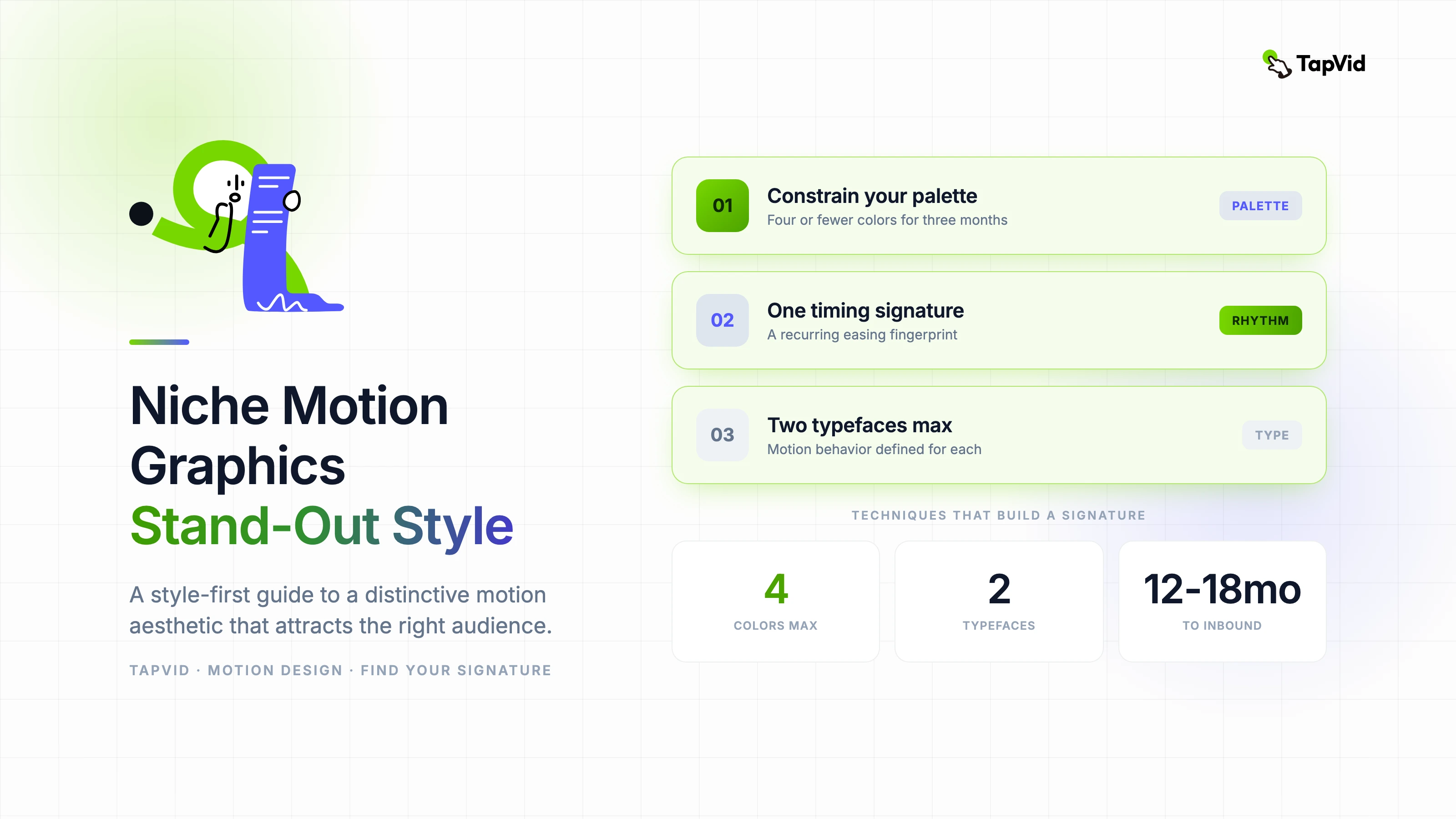
- Constrain your color palette to four or fewer colors and use them consistently across everything you make for at least three months.
- Choose one timing signature — a specific easing behavior or a consistent hold duration — and apply it to every project as a recognizable fingerprint.
- Experiment with texture: grain, noise, film burn, and hand-drawn elements on top of clean digital animation create instant aesthetic differentiation.
- Develop a recurring visual motif — a shape, a pattern, a transition type — that appears in every piece of work you produce.
- Limit yourself to two typefaces maximum and define their motion behavior precisely so they feel like part of your visual signature.
04
Using AI tools to explore style without losing identity
AI motion design tools present a specific creative risk for style-conscious creators: the default output aesthetic of popular AI tools can homogenize your work toward whatever visual style the model was trained on.
The solution is to use AI as a structural tool and apply your style decisions in post-processing. Use AI to generate the motion skeleton — scene timing, element positioning, basic transitions — then apply your color palette, texture overlays, and timing adjustments in your preferred editing environment.
Treat AI output as raw material, not finished product. The creators who maintain a distinctive voice while using AI tools are the ones who are clear about which creative decisions they own and which ones they are comfortable delegating to the model.
05
Building a portfolio that communicates your style clearly
A motion graphics portfolio should communicate your aesthetic within the first thirty seconds of someone watching it. If a viewer has to watch five pieces before understanding what you do, the portfolio is not working.
Lead with your most stylistically distinctive work, not your most technically impressive work. Clients and collaborators who respond to your aesthetic will self-select. Those who do not respond to your aesthetic are unlikely to be good long-term clients even if they hire you initially.
Update your portfolio every three months. Remove anything that no longer represents where your aesthetic is heading. A portfolio is an argument for a specific point of view, not a comprehensive archive of everything you have ever made.
06
Monetizing a niche motion graphics practice
The commercial argument for a distinctive aesthetic is stronger than most independent creators realize. Clients who are looking for exactly your style will pay a premium because finding a replacement is difficult. Generic work is replaceable at market rate. Distinctive work commands above-market rates.
The path to monetization is consistent publication — social media, a newsletter, or a portfolio site with regular updates — over a long enough time frame for the right clients to find you. Most independent motion designers underestimate how much time this takes: typically twelve to eighteen months of consistent output before the right inbound inquiries start arriving.
Commission work in your niche is the starting point, but the most durable business models for independent motion creators combine commissions with passive income from templates, courses, or motion asset packs built around your signature style.