
A year ago I had to answer this question with real money on the line — whether to hire two junior designers or invest equivalent budget in AI graphic tools. I chose to run both in parallel for six months before committing. What I found doesn't fit the clean narrative that either the 'AI will replace everyone' or 'AI is just a tool' camps want to hear.
01
The honest answer to whether AI replaces graphic designers
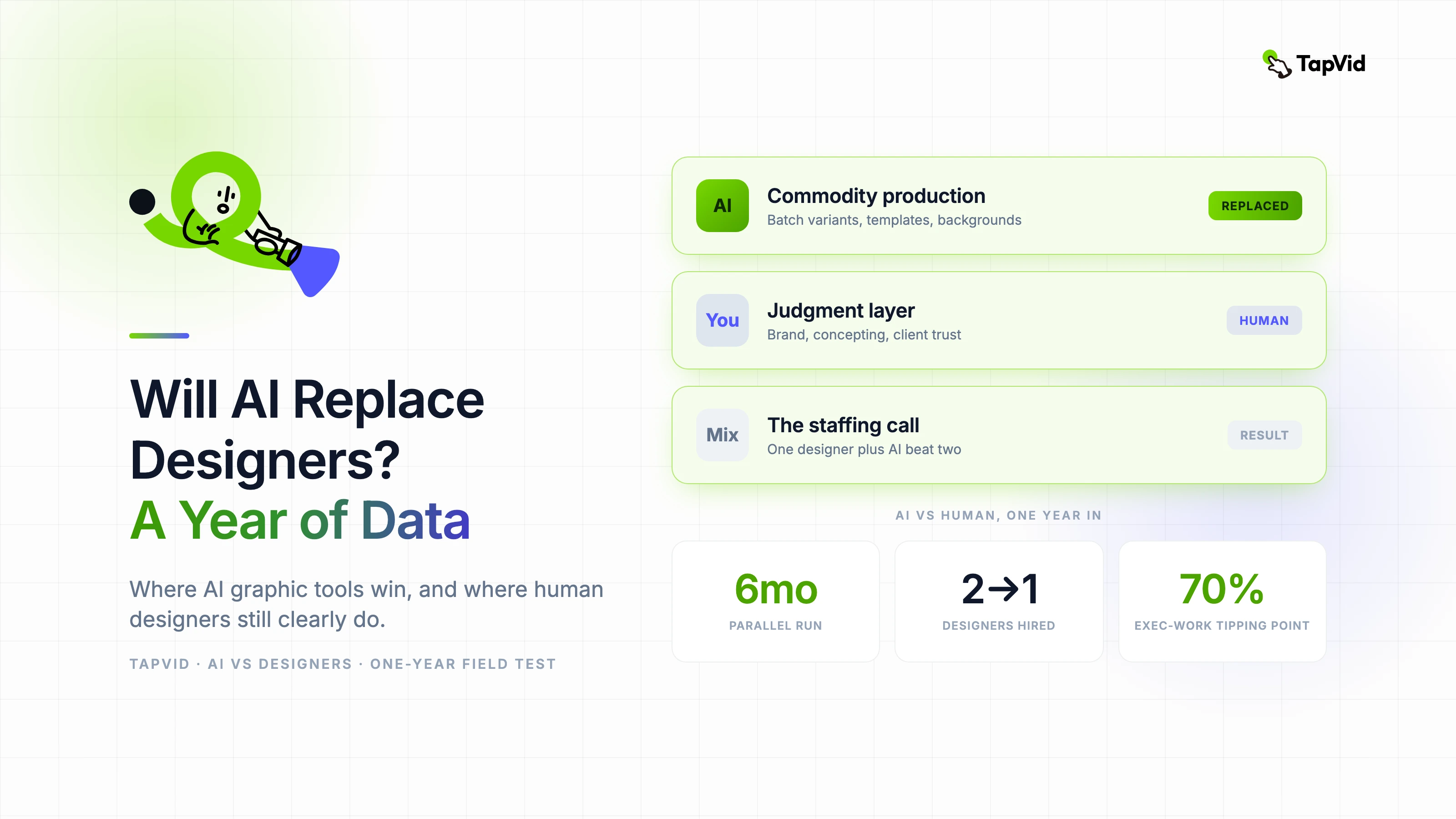
AI has already replaced some of the work graphic designers do. The category of work it's replaced is: high-volume, pattern-consistent asset production — the 50th variation on a social media template, the 12th localized version of a banner, the batch of product background images for an e-commerce catalog. This work was consuming significant designer time and producing limited creative value.
The category AI hasn't replaced: work requiring aesthetic judgment, brand interpretation, client communication, and the ability to translate an ambiguous brief into something the client didn't know they wanted until they saw it. That work is still exclusively human, and it's the work most senior designers are actually paid for.
So: will AI replace graphic designers? It already has, for the commodity production layer. It hasn't, and won't soon, for the judgment layer. The designers who are vulnerable are those whose role was primarily execution of well-defined tasks. The designers who are not vulnerable are those whose role was primarily judgment.
02
What AI graphic design tools are actually good at
- Batch asset variation: generating 20 size/format variants of a design at once — work that used to take a junior designer half a day takes minutes.
- Style exploration in early-stage concepting: ai illustration generator tools produce more visual options faster than any human in the ideation phase.
- Background and environment generation: product photography backgrounds, abstract environments, texture surfaces — AI handles these better than stock photography for most use cases.
- Template-driven social content: for teams that have established brand templates, AI fills those templates faster than humans without quality degradation.
- Reference image generation: AI-generated style references communicate art direction more effectively than verbal description in client briefs.
03
Where human designers still clearly win
The best ai for graphic design tasks still struggles with brand nuance that requires understanding the strategic positioning of a company, not just its visual guidelines; novel concepts requiring genuine creative invention rather than statistical interpolation of existing styles; and communication design — work where the primary goal is to change how someone thinks or feels.
Human designers also win on relationship work. Clients spending serious money on brand design want a human counterpart who understands their business, asks follow-up questions, and takes creative responsibility for outcomes. AI tools don't do that.
04
What I actually decided and what happened
After the six-month parallel run, I hired one designer instead of two and invested the remaining budget in AI tools. The one designer focuses exclusively on judgment-layer work: concepting, client-facing creative, and setting the visual direction that AI tools then execute at scale. The combination produces more output than two designers would have, at higher quality on the judgment-layer work.
The designers who've thrived in this model are the ones who understood that their value was never in production speed — it was in judgment. The AI tools have made their judgment more visible by removing the production work that used to obscure it.
05
Practical guidance if you're making this decision now
Before deciding whether AI can replace a design role on your team, audit what that role actually does. Track for two weeks: how much time is spent on execution of well-defined tasks versus interpretation of ambiguous briefs? If the ratio is 70% execution, AI tools can absorb a meaningful portion of that. If it's 70% judgment work, AI won't change the staffing equation much.
The best ai for graphic design tools in 2026 — Midjourney for illustration and concept generation, Adobe Firefly for production assets with commercial licensing, and Canva AI for template-based content — are genuinely capable at the execution layer. Run a pilot before making staffing decisions based on assumptions.